
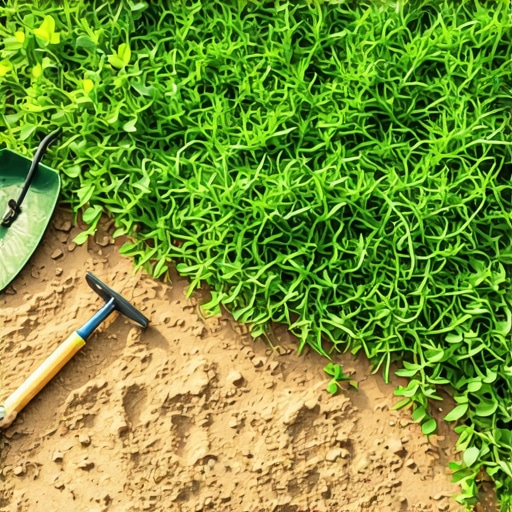
The Forensic Autopsy of a Failing Sandy Lawn
To grow a thick lawn in sandy soil, you must address the low Cation Exchange Capacity (CEC) and high hydraulic conductivity of coarse-textured substrates through the strategic integration of organic amendments, biochar, and precision irrigation scheduling that forces deep root architecture.
The ground was crunchy. Not the crisp crunch of a morning frost, but the brittle, hollow sound of dead organic matter turned into glass. I recently stood on a property where the homeowner had spent five figures on a custom landscape design, only to watch it wither into a patchy, yellowing mess within six months. The symptom was visible: localized dry spots and nutrient chlorosis. But the autopsy revealed the true culprit. When I took a soil probe, the sample crumbled like dry sugar. There was zero aggregate stability. This wasn’t a gardening problem; it was a physics problem. Sandy soil is essentially a collection of microscopic rocks between 0.05mm and 2.0mm in diameter. Because these particles are so large compared to clay, the pore spaces are massive. Water doesn’t sit in the soil; it falls through it. This particular homeowner had exacerbated the issue by falling for the ‘chemical nightmare’ trap. They had applied a high-salt, synthetic 32-0-4 fertilizer during a 90-degree heatwave. In sandy soil, there is no buffer. Those fertilizer salts sat on the root flares and performed a reverse-osmosis maneuver, sucking the moisture out of the grass blades until the entire front yard was effectively mummified. We had to strip it all, remediate the sub-base, and start from the biological foundation.
The Physics of Sand: Why Your Nutrients Are Leaching
Sandy soils suffer from high macroporosity, meaning the large gaps between grains allow gravitational water to move downward faster than the turf roots can intercept it, leading to a total loss of mobile nutrients like nitrogen and potassium.
When you look at soil under a microscope, sand grains are the boulders of the pedosphere. They lack the surface area and the negative electrical charge required to hold onto cations. This is why you can dump a gallon of liquid gold fertilizer on a sand-based lawn on Monday, and by Thursday, the plant is starving again. The nitrogen has already leached past the root zone and is headed for the water table. To fix this, we have to engineer a ‘bridge’ between these boulders. This is where soil organic matter (SOM) becomes the contractor’s best friend. By introducing humic acids and composted leaf mold, we increase the surface area and create ‘glue’ that binds particles together into peds. These peds create micropores—tiny pockets that hold water against the pull of gravity through capillary action.
“Sandy soils, having low water-holding capacity and high infiltration rates, require more frequent but smaller applications of water and nutrients to prevent leaching beyond the root zone.” – Texas A&M AgriLife Extension
How much organic matter should I add to sandy soil?
For a standard residential lawn, you need to incorporate at least 2 to 4 inches of high-quality organic compost into the top 6 inches of the existing sand. This isn’t a suggestion; it’s a structural requirement. If you just lay sod on top of raw sand, you are creating a ‘perched water table’ effect that will lead to root rot in the sod layer and drought in the sub-soil. You must till the amendments in to create a transition zone. My crew uses a heavy-duty hydraulic tiller to ensure the blend is homogenous. If I see layers or ‘streaks’ of sand, I make them go over it again. Consistency is the difference between a lawn that survives a drought and one that turns into a desert.
The Engineering of a Successful Sod Install on Sand
A successful sod installation on sandy soil requires a granular transition zone where the sod’s nursery soil is mechanically integrated with the native sand to prevent root girdling and ensure hydraulic continuity between the layers.
Most ‘mow-and-blow’ hacks will just throw sod down on top of a leveled sand bed. Within a year, that sod will peel up like a cheap carpet because the roots refuse to leave the nutrient-rich nursery soil to enter the harsh, dry sand below. This is called root girdling or ‘the pot-bound effect.’ We prevent this through a rigorous yard cleanup and preparation protocol. First, we remove every weed and rock larger than a nickel. Then, we apply a ‘tackifier’ layer of biochar and kelp meal. Biochar is essentially prehistoric charcoal that stays in the soil for centuries, acting like a permanent sponge for nutrients.
| Soil Property | Raw Sandy Soil | Remediated Sandy Soil | Impact on Turf |
|---|---|---|---|
| Water Retention | Very Low | Moderate-High | Prevents mid-day wilt |
| CEC (Cation Exchange) | 1-5 meq/100g | 15-25 meq/100g | Reduces fertilizer waste |
| Microbial Activity | Dormant | Highly Active | Natural thatch control |
| Compaction Risk | Low | Moderate | Supports heavy foot traffic |
Can you put sod directly on sand?
You can, but it is a recipe for high-maintenance failure unless you use a specific ‘sand-grown’ sod variety. Most sod is grown on muck or clay-based farms. When you place that heavy soil over porous sand, the water will actually stop at the interface due to surface tension. You must ‘verticut’ or core aerate the new sod immediately after installation to break that interface and allow the roots a path downward. Don’t skip this. It will rot.
Irrigation Engineering: The Deep-and-Infrequent Mandate
Irrigation on sandy soil must be calibrated to deliver water at a rate that matches the soil’s infiltration capacity while reaching a depth of 6-8 inches to encourage the development of a deep, drought-resistant root system.
The internet will tell you to water your lawn for 20 minutes every morning. The internet is wrong. In sandy soil, frequent shallow watering is a death sentence. It keeps the roots in the top two inches of soil, where they are cooked by the sun’s infrared radiation. I tell my clients: water deep, water rarely. You want to deliver roughly 0.5 to 0.75 inches of water per session, but only twice a week. You need to force those roots to ‘chase’ the moisture down into the cooler sub-soil. This is how you build a lawn that can handle 100-degree days without flinching. We use ‘smart’ irrigation controllers with soil moisture sensors buried at 4 inches and 8 inches. If the 8-inch sensor is dry, the system runs. If it’s wet, it stays off. No exceptions.
“Soil texture determines the rate of water movement; sand-dominated profiles can have infiltration rates exceeding 1 inch per hour, necessitating precision delivery to avoid runoff and deep percolation loss.” – Penn State Center for Turfgrass Science
How often should you water grass in sandy soil?
During the establishment phase (first 21 days), you water 3 to 4 times daily for short bursts. Once established, you transition to a ‘pulse’ schedule. This involves watering for 15 minutes, letting it soak for 30, and watering for another 15. This overcomes the hydrophobic nature of dry sand and ensures the entire root zone is saturated without wasting water through deep percolation.
The Professional Maintenance Checklist for Sandy Lawns
- Monthly Soil pH Testing: Sandy soils drift toward acidity quickly. Maintain a pH of 6.5 to 7.0 to ensure nutrient availability.
- Biannual Top-Dressing: Every spring and fall, spread 1/4 inch of finely screened leaf compost over the turf.
- Slow-Release Only: Use polymer-coated urea or organic meals. Never use quick-release ‘fast green’ products.
- High Mowing Heights: Keep your deck at 3.5 to 4 inches. Taller grass shades the soil, reducing evaporation from the sand.
- Wetting Agents: Apply a professional-grade surfactant every 60 days to prevent ‘dry spots’ where the sand becomes water-repellent.
Final Inspection: The Long Game
Building a thick lawn on sand isn’t about the turf; it’s about the medium. You are a soil manager first and a grass grower second. If you treat your soil like a sterile substrate, your lawn will always be one skipped watering away from disaster. But if you treat it as a biological engine—feeding the microbes, increasing the CEC with biochar, and engineering your irrigation for depth—you will have the thickest, most resilient yard in the neighborhood. Don’t let the ‘mow-and-blow’ crews tell you a bag of 10-10-10 will fix it. It won’t. Soil science is the only way forward.