
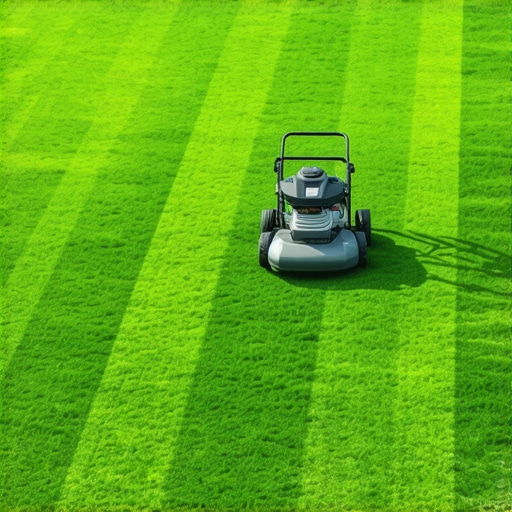
The Physics of the Stripe: Why Light Reflection Matters
Achieving stadium-grade stripes requires manipulating the leaf blade orientation to reflect light at specific angles using mechanical weight. This is achieved by bending the blades toward or away from the viewer, where darker stripes are blades leaning forward and lighter stripes are blades leaning away. It is not about the paint or the chemical; it is pure physics and plant physiology. I always drill into my new crew members: if you don’t fix the soil grading first, every plant you put in the ground is just expensive compost. The same goes for turf. If the ground is lumpy, your stripes will look like a heart monitor readout. We don’t do ‘pretty’ without ‘precise.’ You need a perfectly level base before you even think about the visual finish. Most DIYers think a stripe is a cosmetic trick. It is not. It is the signature of a healthy, turgid leaf blade that has been mechanically trained. If the grass is dehydrated, it won’t hold the bend. If the soil is compacted, the roots won’t support the blade density. You need density for contrast. Period.
“Turfgrass stripes are simply a matter of light reflection; the darker stripes are the result of grass blades bent toward the viewer, while the lighter stripes result from blades bent away.” – University of Tennessee Agricultural Extension
The Foundation: Why Yard Cleanup and Soil Health Dictate the Visual
Professional results start with aggressive yard cleanup and soil remediation to ensure a uniform surface. Removing debris, thatch, and rocks is non-negotiable because any surface irregularity will cause the mower deck to oscillate, resulting in uneven striping patterns and scalping of the crown. I have seen guys try to stripe over a half-inch layer of thatch. It looks like garbage. Thatch is a spongy layer of organic debris that sits between the green blades and the soil surface. If it is too thick, your mower sinks. Your rollers won’t provide the PSI needed to bend the blade. They will just mush it. You need a clean, firm surface.
How do I get deep stripes in my lawn?
To get deep stripes, you must increase the turgor pressure within the grass blades through deep irrigation and apply a heavy mechanical roller or striping kit to force the blades to lay flat in one direction. It takes weight. A standard residential mower is too light. You need to add a tow-behind roller or a weighted striping kit. The blade needs to be long enough to bend—usually 3 to 4 inches for cool-season grasses. If you scalp it, you have nothing to bend. No bend means no stripe. Short grass is for golf greens, and those guys use 5,000-pound reel mowers to get their patterns. You are using a push mower. Leave it long.
| Grass Type | Optimal Mowing Height | Striping Capability | Water Requirements |
|---|---|---|---|
| Kentucky Bluegrass | 3.0″ – 3.5″ | High | High |
| Perennial Ryegrass | 2.5″ – 3.5″ | Excellent | Medium |
| Tall Fescue | 3.5″ – 4.0″ | Moderate | Low |
| Bermuda (Hybrid) | 1.0″ – 1.5″ | Low (Requires Reel) | Medium |
Selecting the Right Turf: Sod Install vs. Seed for High-Contrast Patterns
If you want instant results, a professional sod install is the only way to guarantee the density required for high-contrast patterns without waiting three years for a thin lawn to fill in. When we lay sod, we are looking for 100% ground cover with zero gaps. If I can see a seam, the job isn’t done. For striping, Perennial Ryegrass is the king because of the waxy cuticle on the underside of the leaf. It reflects light like a mirror. Kentucky Bluegrass is a close second. If you are down south dealing with St. Augustine or Bermuda, your job is harder. Those grasses grow horizontally via stolons and rhizomes. They don’t like to bend. They like to creep. You can still stripe them, but you need a reel mower and a lot of nitrogen to keep the color dark enough to show the contrast. Don’t skip the 811 call before you dig for any site prep. I have seen too many ‘pro’ hacks nick a gas line because they were too lazy to wait for a mark-out. It is dangerous. It is stupid. Don’t do it.
“Soil compaction is the primary enemy of turf health, limiting the gas exchange necessary for the vigorous growth required for aesthetic patterning.” – Agronomy Manual for Professional Turf Managers
The Irrigation Factor: Deep Rooting for Resilient Leaf Blades
Consistent irrigation is the biological engine that powers the aesthetic of a striped lawn by maintaining cell wall rigidity. You cannot stripe a dormant lawn. While the internet tells you to water every day, turf grass actually needs deep, infrequent watering—exactly 1 inch per week—to force roots to chase the water down. This builds a massive root system that can support a heavy, wide leaf blade. If you frequent-water for 5 minutes a day, you get shallow roots. Shallow roots lead to weak blades. Weak blades don’t stripe; they just wilt. Check your heads. If your irrigation system has clogged nozzles or poor head-to-head coverage, you will have ‘donuts’ in your lawn. Brown spots don’t stripe. They just look like dead dirt. We use a catch-can test on every site to ensure we are hitting that 1-inch mark across the entire zone. No exceptions.
Does grass type affect lawn striping?
Yes, grass type is the most significant factor in stripe intensity, as cool-season grasses like Ryegrass and Bluegrass have longer, more flexible blades that reflect light better than stiff, warm-season grasses. If you are trying to stripe a thin, weedy lawn, you are wasting your time. You need a monoculture. Mixed-weed lawns have different growth rates and different leaf textures. Broadleaf weeds like dandelions don’t bend; they just snap or bounce back. You need 90% or higher turf purity. This is why we use pre-emergents in the spring and targeted herbicides in the fall. A clean lawn is a stripeable lawn.
- Scalp Prevention: Always mow at the highest setting your grass type allows.
- Sharp Blades: A dull blade tears the grass, leading to white, frayed tips that ruin the reflection.
- Pattern Rotation: Change your striping direction every two weeks to prevent ‘grain’ and soil ruts.
- Nitrogen Push: Use a slow-release nitrogen fertilizer to keep the green deep and dark.
- Weight Check: Use a roller that is at least 15-20 lbs per foot of width.
Mechanical Execution: Rollers, Striping Kits, and Mower Deck Physics
The actual act of striping is a mechanical process where a rear-mounted weight follows the cutting blade to press the grass in the direction of travel. You need to understand the ‘turn.’ When you reach the end of a pass, you must lift the deck or make a wide Y-turn to avoid tearing the turf with the mower tires. If you zero-turn on a dime, you will rip the grass right out of the soil. It is called ‘turf shear.’ It looks unprofessional. It kills the grass. I tell my guys to imagine they are driving a semi-truck, not a go-kart. Slow down. The beauty is in the straight line. Pick a landmark on the horizon and drive toward it. Don’t look at the front of the mower. Look 20 feet ahead. If your first line is crooked, the whole yard is ruined. Start at the longest straight edge of the property, usually the driveway or a straight fence line. Use that as your guide. If you mess up the first pass, you are done. The roller will have already set the grain, and it is hard to undo in one day. Take your time. Precision pays. Speed kills quality. Period. [{“@context”:”https://schema.org”,”@type”:”HowTo”,”name”:”How to Stripe Your Lawn Like a Professional”,”step”:[{“@type”:”HowToStep”,”text”:”Perform a thorough yard cleanup to remove rocks, twigs, and thatch.”},{“@type”:”HowToStep”,”text”:”Check irrigation levels to ensure the turf has 1 inch of water for maximum turgidity.”},{“@type”:”HowToStep”,”text”:”Set your mower deck to 3.5 or 4 inches to allow for blade bending.”},{“@type”:”HowToStep”,”text”:”Attach a weighted striping roller to the rear of your mower.”},{“@type”:”HowToStep”,”text”:”Mow in straight lines, using a distant landmark to maintain accuracy.”},{“@type”:”HowToStep”,”text”:”Turn slowly at the end of each pass to avoid turf shear.”}]}]