
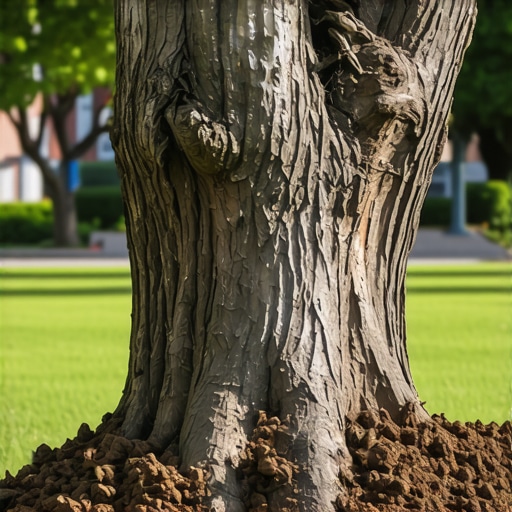
The Fatal Mistake of the Mulch Volcano: Why Your Landscaping Habits May Be Killing Your Trees
I always drill into my new crew members: if you don’t fix the soil grading first, every plant you put in the ground is just expensive compost. I have spent two decades watching homeowners and inexperienced contractors dump hundreds of dollars of premium hardwood mulch directly against the base of beautiful, mature trees. They think they are protecting the plant, but in reality, they are initiating a slow-motion execution. This practice, colloquially known as the mulch volcano, is a fundamental misunderstanding of tree biology and civil engineering. When we talk about high-end landscaping, we are talking about managing the delicate balance between moisture, oxygen, and structural integrity. Piling mulch against the bark violates every one of those principles. It is a shortcut used by those who value aesthetics over the life of the organism. If you want your trees to last a century, you have to treat the root flare as holy ground.
The Biological Cost of Mulch Volcanoes
Mulch against tree bark, often called a mulch volcano, traps moisture against the trunk, causing the bark to rot and suffocating the root flare, which requires oxygen exchange. This structural error invites fungal pathogens and encourages girdling roots that eventually strangle the tree’s vascular system over a period of five to ten years.
To understand why this is a death sentence, you have to look at the anatomy of a tree. The trunk is covered in bark, which is composed of suberin and other compounds designed to protect the tree from the elements while remaining dry. Below the bark lies the phloem and xylem, the tree’s vascular highway. When you pile wet mulch against this area, you create a perpetually damp environment that the bark cannot withstand. It begins to soften and decay. Once the bark is compromised, opportunistic fungi like Armillaria or Phytophthora move in. These are not just surface mold; they are aggressive pathogens that eat the living tissue of the tree. I have seen 50-year-old maples collapse because their base had turned to mush under a pile of decorative cedar chips. It is a tragedy that is 100 percent preventable.
“A tree’s root flare is the critical junction where the trunk transitions into the root system; burying this area in mulch restricts gas exchange and promotes decay.” – Horticultural Standards Manual
Furthermore, the root flare is the part of the tree where oxygen is exchanged. Unlike the deep roots, the flare needs to breathe. When you bury it, the tree enters a state of anaerobic stress. In a desperate attempt to find oxygen and moisture, the tree may send out adventitious roots into the mulch pile itself. These roots do not grow down into the soil; they grow in circles around the trunk. As they thicken, they become girdling roots, literally choking the tree as it grows. This is why many trees in suburban developments lean or fall over during moderate storms. They have no structural root flare to anchor them because it has been rotted away by years of improper mulching.
How Proper Mulching Integrates with Irrigation and Yard Maintenance
Coordinating mulching with irrigation schedules and yard cleanup ensures that the root zone receives 1 inch of water per week without saturating the trunk. Over-mulching interferes with water infiltration, often shedding water away from the roots while trapping lethal moisture against the delicate bark tissue and creating hydrophobic layers.
When we perform a sod install, we always leave a significant ring around existing trees for this exact reason. You cannot run turf right up to the trunk. Turf requires frequent, shallow watering that is detrimental to tree bark. Similarly, irrigation systems should be calibrated so that sprinkler heads are not spraying directly onto the tree’s trunk. If you have a mulch volcano and an irrigation head hitting it, you are basically creating a petri dish for rot. During a standard yard cleanup, the first thing my crew does is pull back excess mulch. We look for the flare. If we cannot see where the trunk widens out to meet the roots, the tree is too deep. We use hand tools to carefully excavate the area, often finding that the bark underneath is already discolored and soft. This is the forensic reality of poor maintenance.
| Mulch Type | Recommended Depth | Water Retention | Decomposition Rate |
|---|---|---|---|
| Triple-Shredded Hardwood | 2 to 3 inches | High | Moderate |
| Pine Bark Nuggets | 2 to 3 inches | Moderate | Slow |
| Cedar Mulch | 2 to 3 inches | High | Very Slow |
| Wood Chips (Fresh) | Not Recommended | Variable | Fast (Nitrogen Depletion) |
The table above illustrates that even the best materials become a liability if applied at the wrong depth. I prefer triple-shredded hardwood because it stays in place and builds soil microbiology, but only when applied in a flat donut shape. Never use fresh wood chips from a tree service directly against your plants without aging them, as the decomposition process can actually pull nitrogen out of the top layer of soil, starving your smaller landscape plants.
How far should mulch be from a tree trunk?
For most residential trees, you should keep mulch at least 6 to 12 inches away from the base of the trunk. This creates a dry zone where the root flare can remain exposed to the air. The mulch ring itself should extend out to the drip line of the tree if possible, as this is where the majority of the feeder roots are located. In tight urban landscaping scenarios, even a 3-foot radius ring is better than nothing. The key is the gap. No touch, no rot. It is that simple. I tell my clients to think of it as a donut, not a volcano. The hole in the middle is the life-saver.
Can you save a tree with a mulch volcano?
Yes, but you must act before the vascular damage is terminal. The remediation process involves carefully removing the excess mulch by hand or with an air spade to avoid damaging the bark. Once the root flare is exposed, you need to inspect for girdling roots. If they are small, they can be pruned. If they are thick and already wrapping around the trunk, you may need a certified arborist to perform a root collar excavation. After exposure, leave the area bare for a few weeks to let the bark dry out and harden before applying a very thin, 1-inch layer of compost nearby to kickstart the soil biology. Do not cover the flare again.
“A retaining wall doesn’t fail because of the stone; it fails because of the water trapped behind it.” – Hardscape Engineering Axiom
The same logic applies to your trees. It is not the mulch itself that kills the tree; it is the moisture trapped against the trunk. Whether you are dealing with a sod install or a massive yard cleanup, the engineering of your soil and drainage is what dictates the health of your plants. In heavy clay soils, like those found in many inland regions, this issue is even more pronounced because the clay holds moisture for much longer than sandy loam. You have to account for your local geology. If you have poor drainage, a mulch volcano is even more lethal. Always check with your local 811 service before digging deep to fix drainage issues near trees, as irrigation lines and utilities often congregate near these focal points.
The Professional Mulching Protocol
- Identify the root flare: The point where the trunk widens at the soil line.
- Remove existing mulch: Excavate until the flare is fully visible.
- Apply mulch in a 3-3-3 rule: 3 inches deep, in a 3-foot radius, 3 inches away from the trunk (though 6 inches is safer).
- Use organic materials: These improve soil structure over time.
- Check moisture levels: Mulch should feel damp but not saturated.
Landscape maintenance is not about making things look pretty for a week; it is about stewardship. When you see a crew out there with a blower and a rake, look at what they are doing to the trees. If they are mounding up dyed red mulch like a pyramid, fire them. They are charging you to kill your assets. A healthy tree adds thousands of dollars in property value and provides cooling for your home. Don’t let a $20 bag of mulch take that away. Keep the flare clear. It is the most important rule in the book. It will save your trees. It will save you money. Don’t skip this.
[PLACEHOLDER_IMAGE]