
The Lost Infrastructure: Why Every Inch of Soil Matters
I always drill into my new crew members: if you don’t fix the soil grading first, every plant you put in the ground is just expensive compost. The same logic applies to irrigation. Locating buried sprinkler valves with a simple probe requires an understanding of soil compaction, irrigation layout, and the physical resistance of valve boxes hidden beneath the sod install or years of yard cleanup debris. It is a game of sensory feedback where your hands must interpret what the soil is hiding.
The Apprentice Lesson: The Cost of a Blind Dig
Ten years ago, I had a kid on my crew who thought he could find a lost manifold by swinging a pickaxe like a madman. He didn’t just find the valve; he sheared the 1-inch lateral line and the 24V wiring harness. That five-minute search turned into a six-hour repair in a mud hole. Since then, we use the probe first. We listen to the ground. We respect the landscaping infrastructure that exists out of sight. If you cannot find your valves, you cannot manage your irrigation system’s hydraulic health. It is that simple.
The Physics of the Soil Probe Method
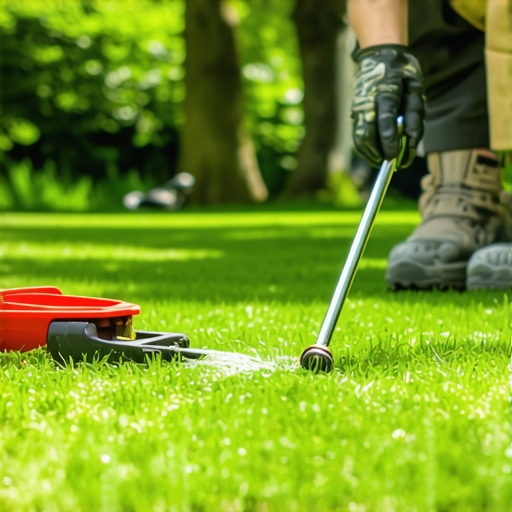
Locating buried sprinkler valves involves using a 1/2-inch steel soil probe to penetrate the ground in a grid pattern to detect the hard plastic of a valve box or manifold. This method relies on hydrostatic resistance and tactile feedback to differentiate between rocks, roots, and irrigation components. It is the most cost-effective way to find lost components without expensive electronic locators.
“Irrigation system maintenance begins with the accessibility of the control valves; buried or inaccessible valves lead to uneven pressure distribution and localized dry spots.” – Irrigation Association Technical Manual
When you are pushing a probe into the earth, you aren’t just looking for a hit. You are measuring density. A rock has a sharp, jarring stop. A tree root has a springy, fibrous bounce. A valve box lid has a distinct, hollow ‘thud’ that vibrates through the steel handle of the probe. If you are working in heavy clay, the suction will be higher, requiring a slow, rhythmic vertical movement. In sandy loam, the probe will slide easily until it hits the target. Don’t force it. If you bend the probe, you’re pushing too hard.
Preparation: The Forensic Search Pattern
Before you ever touch the dirt, you have to think like the guy who installed the system twenty years ago. Most contractors are lazy; they will run the irrigation lines in the shortest path from the controller to the zones.
How do I find a lost irrigation valve without a locator?
You can find a lost irrigation valve by tracing the wires from the controller, identifying the sod install seams, or using a soil probe in a 12-inch grid pattern near the house foundation or backflow preventer. Look for depressions in the landscaping or areas of greener grass caused by small leaks.
| Method | Required Tools | Accuracy | Risk Level |
|---|---|---|---|
| Soil Probing | 1/2″ Steel Probe, Marking Paint | High | Low (with care) |
| Wire Tracing | Electronic Locator, Headphones | Extreme | Very Low |
| Visual Scouting | None (Observation) | Low | Zero |
| Blind Trenching | Shovel, Pickaxe | Moderate | Extreme (Pipe Damage) |
Start your search near the backflow preventer. Usually, the first set of valves is within ten feet of where the main line enters the yard. If you’ve recently done a yard cleanup and added sod install, the valves might be buried under two to four inches of new organic matter and turf. This is common in landscaping where the grade was raised without extending the valve box risers.
Step-by-Step: The Surgical Probe Execution
- Map the Zone: Identify which zone isn’t working and trace the straightest line back to the water source.
- Moisten the Soil: Dry soil is like concrete. Run a hose over the search area for 20 minutes to lubricate the earth.
- The Grid Search: Insert the probe every 12 inches. When you feel a flat, hard surface, move the probe 2 inches to the left. If you hit it again, you’ve likely found a lid.
- Verify with Sound: Tap the probe on the object. A plastic valve box sounds different than a limestone rock.
- The Reveal: Use a hand trowel to carefully remove the top layer of sod. Do not use a full-sized shovel yet.
How deep are sprinkler valves usually buried?
Most irrigation valves are buried between 6 and 18 inches deep, housed within a valve box. However, over years of landscaping and yard cleanup, additional soil and sod install layers can bury these boxes much deeper than their original installation depth.
The Engineering of a Professional Valve Box
Once you find the valve, the job isn’t done. If it was buried, the installation failed. A professional landscaping setup requires that the valve box sits 1/2 inch above the final grade. This prevents soil from washing over the lid during heavy rains. We use 4 inches of 3/4-inch crushed gravel at the base of the valve manifold to allow for drainage and to prevent the box from sinking into the mud. This is civil engineering on a micro scale. Without the gravel base, the box becomes a tomb for spiders and mud, making future irrigation repairs impossible.
“Proper drainage around irrigation components is essential to prevent anaerobic conditions that can lead to solenoid failure and wire corrosion.” – Penn State Agricultural Extension
If you find that your valves are sitting in a pit of muck, you have a drainage problem. This is where yard cleanup goes beyond just raking leaves. You need to excavate around the box and install a small French drain or at least a vertical sump filled with stone to bleed off excess hydrostatic pressure. If you don’t, the solenoid—the electrical heart of the valve—will eventually short out from constant water immersion.
Maintenance and Long-Term Reliability
After you have located and raised your valves to the correct grade, mark them. I don’t care if you think you’ll remember where they are. You won’t. Use a small, discreet landscaping stone or a map tucked inside the irrigation controller cabinet. Every spring, as part of your yard cleanup, pop the lids and check for leaks. A small drip at the manifold can waste 5,000 gallons of water a month and soften the soil so much that your sod install will start to heave. Be pragmatic. Be precise. Your yard is a machine; treat it like one. Don’t skip the details. It will rot if you do.