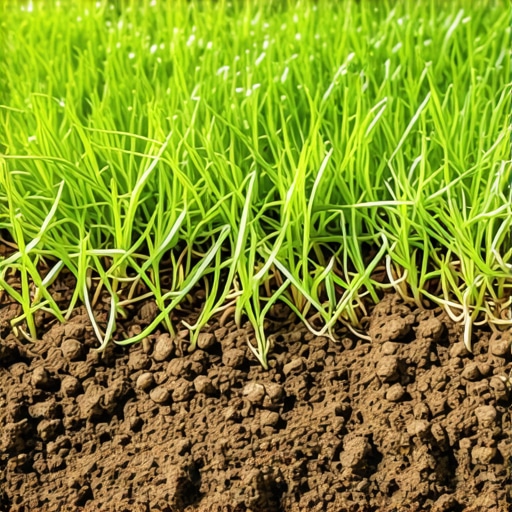
The scent of linseed oil usually calms me, but looking at a patchy lawn in Culpeper is like seeing a Queen Anne chair painted with neon latex. It is an insult to the craft. As I run my thumb over the rough grain of a half-finished restoration, I see the same neglect in the dirt outside my window. To fix bare dirt in Culpeper by 2026, you must prioritize mechanical thatching to clear the crust before introducing heat-tolerant Tall Fescue blends specifically rated for the Virginia Piedmont. This prevents the seed from washing away on our heavy clay slopes during spring rains. Editor’s Take: True restoration requires mechanical intervention; simply throwing seed on top of Virginia clay is a recipe for a failed investment. Success in 2026 depends on soil contact and moisture retention protocols that ignore the quick-fix marketing of big-box stores.
The friction between stone and stem
Grass seeding is not some spray-and-pray effort. It requires the same patience as waiting for a third coat of varnish to dry on a walnut table. When we talk about landscaping culpeper, we often forget that the soil here has a memory. It remembers every heavy footfall and every season of drought. The dirt becomes a sealed surface, almost like a piece of wood that has been over-polished until it no longer takes the stain. To fix this, we must look at thatching. This is the act of removing the dead organic matter that suffocates the soil. Without this step, your expensive seed is just bird food sitting on a plastic-like barrier. I have spent decades working with my hands, and I know that you cannot build a finish on a dirty surface. The same logic applies to your yard. If you want a lawn that survives the 2026 heatwaves, you need to strip away the old to make room for the new. This is where grass seeding becomes an art form rather than a chore. It is about the bond between the embryo of the plant and the mineral wealth of the earth. We are looking for a deep, resonant green, not the fleeting vibrancy of a cheap chemical fix.
Why Culpeper clay eats your grass seed
Our local geology in the Piedmont region is a stubborn apprentice. It is dense, iron-rich, and prone to compaction that would crack a lesser spade. When you engage in landscaping culpeper va, you are fighting against the natural tendency of the ground to turn into a brick. Mowing height is the first thing people get wrong. They scalp the grass, exposing the fragile soil to the sun, which then bakes the clay into a ceramic shield. A hardscapes project nearby might even change the way water flows across your yard, creating mini-canyons in your bare spots. I have watched neighbors pour money into seed only to see it wash down towards Mountain Run because they didn’t understand the topography. You need to create micro-grooves. Think of it as hand-sanding a surface before the primer. These grooves hold the seed in place. We must also discuss the necessity of grass pickup. Leaving heavy clumps of wet clippings on a recovering lawn is like leaving a wet rag on a finished sideboard. It creates rot. It breeds fungus. It kills the very thing you are trying to save. In the world of 2026, where weather patterns are becoming more erratic, the local authority comes from knowing exactly how our specific silt loam behaves under pressure.
The industry lie of the instant lawn
Most experts are lying to you about how fast grass grows. They want to sell you the dream of a green carpet in fourteen days. Real growth, the kind that lasts for generations of summers, is slow. It is rhythmic. If you are planning for 2026, you start the work now. You look at the edges where your landscaping meets your driveway. Those edges are high-stress zones where the heat from the asphalt cooks the roots. Most people ignore these margins, but a true restorer knows the edges define the piece. When you consider grass seeding, you must choose a blend that includes rhizomatous tall fescue. These varieties have a creeping habit that fills in bare spots without you having to lift a finger later. It is a self-repairing mechanism, much like a well-oiled joint in a piece of furniture that gets better with age. We see too many people opting for Kentucky 31 because it is cheap. That is the particle board of the grass world. It is coarse, it is ugly, and it clumping in a way that leaves the soil exposed. We want a fine-grained finish. We want a lawn that feels like velvet underfoot but has the structural integrity of oak.
Old ways for a new climate
The reality of 2026 is that the old rules of thumb are failing. We can no longer rely on a predictable April rain. We must engineer our success. This involves a deep understanding of soil chemistry. Have you tested your pH lately? Most Culpeper yards are too acidic, which locks away the nutrients. It is like trying to eat with your mouth sewn shut. Adding lime is the first step in the restoration. Then comes the thatching to ensure that lime actually reaches the root zone. I often tell my clients that a lawn is a living organism, not a static decoration. It breathes. It eats. It needs a grass pickup routine that removes the debris while leaving the nutrients. And do not get me started on mowing with dull blades. A dull blade tears the grass, leaving a jagged edge that turns brown and invites disease. It is no different than using a blunt chisel on a piece of cherry wood; you end up with a mess that no amount of sanding can fix. Keep your tools sharp. Respect the material. If you are struggling with a yard that looks more like a construction site than a home, it might be time to contact us to discuss a professional-grade restoration plan.
Questions from the dirt
Why does my fescue die every July? It is likely a lack of root depth. If you water shallowly every day, the roots stay near the surface where the sun can bake them. You need deep, infrequent soaking to pull those roots down into the cooler clay. Is thatching better than aerating? They serve different purposes. Thatching removes the surface debris, while aerating solves the deep compaction. In Culpeper, you usually need both to fix bare dirt properly. Can hardscapes kill my grass? Yes, through heat radiation and runoff. A stone patio acts like a radiator, pushing the soil temperature up by ten degrees. You need a buffer zone of heat-tolerant species there. Does grass pickup help new sprouts? Absolutely. New sprouts are fragile and need every bit of sunlight. If they are buried under old clippings, they will damp off and die before they ever take root. Is 2026 too late to start? No, but the window is closing if you want a mature stand of grass before the next major drought cycle hits. The best time to plant was yesterday; the second best time is now.
A lawn is a reflection of the care put into the soil. We are not just growing grass; we are restoring a piece of the Culpeper environment. Every seed is a promise to the future. Let us make sure we are making promises we can keep with proper technique and the right materials. Your yard deserves a craftsman’s touch, not a salesman’s pitch. Build something that lasts.