
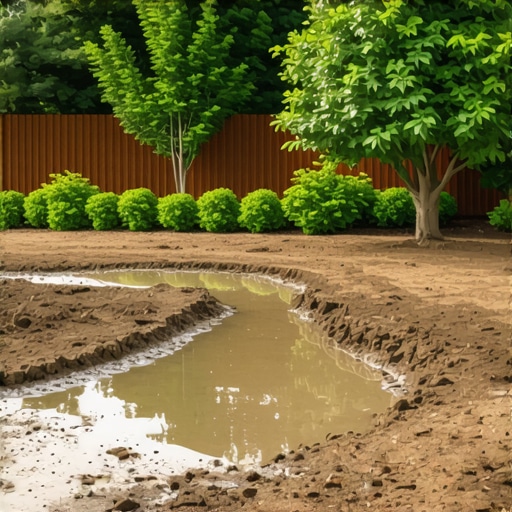
The Hardscape Autopsy: Why Your Yard is a Swamp
I recently got called out to tear up a $30,000 patio that was sinking because the previous contractor failed to understand the most basic principle of civil engineering: water always wins. The homeowners were dealing with a subterranean lake beneath their premium pavers. The sub-base had turned into a slurry of silt and crushed stone because there was no escape route for the hydrostatic pressure building up behind the retaining wall. It was a total loss. I had to tell them that the beautiful stone they paid for was essentially floating on a wet sponge. This is the reality for thousands of homeowners who ignore the grade of their land. You cannot fix a drainage problem with more mulch or a prettier flower bed. You fix it with physics.
Understanding Why Your Backyard is Always Soggy
Backyard sogginess is the result of poor surface grading, high soil bulk density, and inadequate infiltration rates. To remediate a wet yard, you must identify whether the issue is surface runoff or subsurface saturation, then apply a positive slope (minimum 1/4 inch per foot) to direct water toward a viable discharge point. It will rot. If you don’t address the core hydrology, your expensive landscaping is just a temporary decoration for a future mud pit.
The Physics of Soil Compaction and Hydrostatic Pressure
When you walk across your lawn and it feels like a wet sponge, you are dealing with pore space collapse. In healthy soil, roughly 50 percent of the volume is open space for air and water. In a heavy clay yard or a high-traffic area, those pores are crushed. This is soil compaction. Water can’t move downward (infiltration), so it sits. This creates hydrostatic pressure against your home’s foundation.
“A retaining wall doesn’t fail because of the stone; it fails because of the water trapped behind it.” – Hardscape Engineering Axiom
This pressure can exert thousands of pounds of force, eventually cracking concrete blocks or pushing walls out of alignment. Do not skip the gravel backfill.
The Grading Blueprint: How to Fix the Slope
Most people think grading is about making the yard look flat. That is a lie. Flat is your enemy. You want a consistent, predictable slope. Every yard needs a ‘positive grade,’ meaning the ground drops at least two to three inches for every ten feet of distance away from your foundation. If you have a ‘negative grade,’ you are funneling every rainstorm directly into your basement or crawlspace.
How much modified gravel do I need for a patio base?
To calculate the modified gravel (usually 2A or 2B crushed stone) needed for a stable, well-draining base, you must account for a minimum 6-inch depth for patios and 12-inch depth for walls. Multiply the square footage by the depth in feet, then divide by 27 to get cubic yards. Add 15 percent for compaction loss. Don’t eyeball it. If you under-calculate, you will compromise the structural integrity of the entire install.
| Drainage Solution | Primary Function | Material Cost | Installation Complexity |
|---|---|---|---|
| French Drain | Subsurface water removal | Medium | High |
| Dry Creek Bed | Surface runoff diversion | High | Medium |
| Catch Basin | Point-source collection | Low | Medium |
| Soil Amendment | Improving infiltration | Low | Low |
The Soil Remediation Checklist
- Test soil pH and cation exchange capacity (CEC).
- Excavate the top 6 inches of compacted ‘dead’ soil.
- Install perforated 4-inch SDR-35 pipe for subsurface drainage.
- Backfill with 1-inch clean washed stone.
- Incorporate 30 percent organic compost to break up clay bonds.
- Apply a high-quality sod install to stabilize the new grade.
Irrigation and Sod Install: The Final Layer
Once the grade is set, people often make the mistake of over-compensating with irrigation. If you have corrected the grade, you don’t need to drown the grass. A proper sod install requires the soil to be moist but not saturated. I see ‘mow-and-blow’ hacks all the time who put down sod on top of dry, hard clay. That is just expensive compost. You need to till the sub-soil, add your amendments, and then lay the sod with tight seams.
“Excessive soil moisture is the primary cause of anaerobic conditions that lead to root rot and turf failure in residential landscapes.” – Penn State Agricultural Extension
If you see water pooling on your new sod, your grade is wrong. Period. You must use a lawn roller to ensure root-to-soil contact, but don’t over-compact it. It is a delicate balance.
How do I know if my yard needs a French drain?
If water stands in your yard for more than 24 hours after a rain event, you have an infiltration failure. A French drain is a trench filled with gravel or rock containing a perforated pipe that redirects surface and groundwater away from an area. It works by providing a path of least resistance. We use NDS EZflow or traditional gravel-wrapped pipes depending on the soil’s hydraulic conductivity. Yard cleanup isn’t just about raking leaves; it is about ensuring your drainage inlets are clear of debris so the system can actually breathe.
Long-Term Maintenance and Yard Cleanup
Fixing the grade is a one-time structural fix, but maintenance is forever. You need to perform a deep yard cleanup every spring and fall. This includes core aeration to fight the inevitable return of compaction. Use a 3/4-inch hollow tine that pulls a 4-inch plug. This allows oxygen to reach the microbes that break down thatch. Without this, your soil will seal up again, and you will be back to square one with a soggy backyard. Skip the big-box liquid aerators; they are snake oil. You need mechanical disruption. Protect your investment by understanding the biology of your dirt.
Comments are closed.