
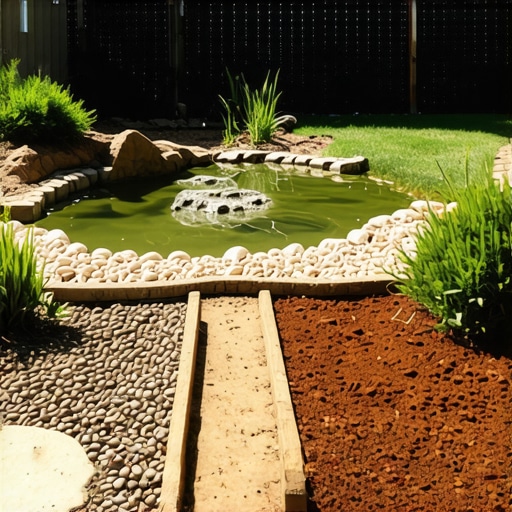
The Hardscape Autopsy: Why Your Yard is a Swamp
I recently got called out to tear up a $30,000 patio that was sinking because the previous contractor ignored the basic laws of physics. Water is the most destructive force in the landscape. It doesn’t care about your stone choice or your vision; it only cares about the path of least resistance. When that path leads to your foundation or the middle of your turf, you have a structural failure waiting to happen. Most ‘mow-and-blow’ outfits will tell you to just throw more dirt on it. That is a lie. You are just making a bigger mud pie. I see it every week: saturated root zones, rotted sill plates, and pavers that look like a roller coaster. You cannot out-build a drainage problem; you have to out-engineer it.
Identifying the Root Cause of Surface Water Accumulation
Backyard ponding occurs when soil saturation exceeds the infiltration rate, or when improper grading traps runoff against impervious surfaces. Fixing it requires managing hydrostatic pressure and ensuring a positive slope of at least 2% away from structural foundations and turf zones. If you have heavy clay soil, your infiltration rate might be as low as 0.05 inches per hour. A typical thunderstorm can dump ten times that. Without a mechanical way to move that water, your yard becomes a retention pond. It will rot. Don’t skip the site survey.
“A retaining wall doesn’t fail because of the stone; it fails because of the water trapped behind it.” – Hardscape Engineering Axiom
Tactic 1: The French Drain and the Physics of Subsurface Flow
A French drain redirects groundwater by providing a path of least resistance through a perforated pipe encased in washed gravel and wrapped in non-woven geotextile fabric. This system relieves hydrostatic pressure and prevents the soil from reaching its liquid limit. We don’t use that flimsy corrugated black pipe you find at big-box stores. It crushes. It clogs. We use SDR-35 thin-wall PVC. It is rigid, it has a smooth interior for high flow rates, and it lasts 50 years. You need to dig a trench 12 to 18 inches deep, line it with a 4-ounce non-woven fabric to prevent siltation, and use clean #57 stone. If you don’t wrap the pipe, the silt will choke it in three seasons. Your drain becomes a buried rock. Check your levels. You need a 1% minimum fall—that is 1/8 inch of drop per foot of pipe.
How much modified gravel do I need for a drainage trench?
Calculating aggregate volume requires multiplying the trench length by width and depth in feet, then dividing by 27 to get cubic yards. For a standard 12-inch wide trench, expect to use approximately 1.5 tons of #57 washed stone per 100 linear feet to ensure proper void space for water movement.
Tactic 2: Surface Swales and Catch Basins for Mass Flow Control
Surface swales are engineered depressions that channel large volumes of runoff toward catch basins or dry wells. Unlike French drains, they manage sheet flow from heavy rain, preventing sod erosion and localized flooding in low-lying areas of the landscape. Think of a swale as a dry creek bed. It should look natural, but its purpose is strictly hydraulic. We often integrate 12×12 catch basins at the lowest points. These basins act as a sump, catching the heavy debris before it enters your main lateral lines. This makes maintenance easy. You pop the grate, scoop the muck, and the system stays clear. If you are doing a yard cleanup, this is the time to identify these natural low spots. If you ignore them, your new sod install will simply float away in the first spring deluge.
| Drainage Method | Primary Water Source | Best Material | Maintenance Level |
|---|---|---|---|
| French Drain | Groundwater/Saturation | SDR-35 PVC & #57 Stone | Low (if fabric wrapped) |
| Surface Swale | Sheet Flow/Runoff | Dense Turf or River Rock | Moderate (mowing/debris) |
| Catch Basin | Point Source (Gutter/Low Spot) | High-Density Polyethylene | High (cleaning grates) |
Tactic 3: Soil Remediation and the Mechanics of Infiltration
Soil remediation improves drainage by breaking up compaction layers through core aeration and incorporating organic matter. Increasing the pore space within the soil profile allows for faster vertical percolation, reducing the need for mechanical drainage systems in moderately wet yards. Most suburban yards have ‘construction compaction.’ The heavy machinery used to build the house crushed the soil structure until it has the permeability of concrete. I tell my crew: if you can’t push a screwdriver six inches into the ground with one hand, your plants are going to drown. You need to core aerate—pulling actual 3-inch plugs—and top-dress with a compost-sand mix. This introduces biology and opens the ‘lungs’ of the earth. This is a critical step before any landscaping or irrigation work. If the soil is tight, your irrigation just runs off into the street. It’s a waste of money.
“Effective drainage is the foundation of soil health; without gas exchange in the root zone, anaerobic conditions will terminate aerobic microbial activity within 48 hours of saturation.” – Agronomy Extension Standards
How do I stop water from pooling on my new sod?
To prevent puddling on new turf, ensure the subgrade is laser-leveled with a 2% pitch and use a heavy lawn roller to eliminate air pockets during the sod install. Proper irrigation timing is also vital; over-watering fresh sod on compacted clay will create a perched water table that kills the roots.
The Professional Drainage Checklist
- Call 811 to mark all underground utilities before you strike dirt.
- Shoot your grades with a transit or a laser level; don’t eyeball it.
- Use non-woven geotextile fabric—avoid the cheap ‘weed barrier’ stuff.
- Direct all downspouts at least 10 feet away from the foundation into solid pipe.
- Perform a ‘perc test’ by digging a hole, filling it with water, and timing the drop.
Fixing drainage isn’t about making the yard look pretty today. It’s about ensuring your landscaping investment doesn’t wash into the neighbor’s yard next year. Do it once. Do it right. Or pay me double to fix it later. Your choice.
Comments are closed.