
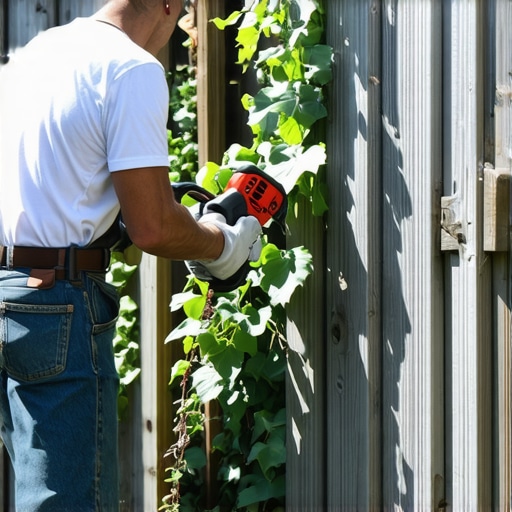
I always drill into my new crew members: if you don’t fix the soil grading first, every plant you put in the ground is just expensive compost. It is a lesson that applies to clearing invasive ivy as much as it does to a high-end sod install. I have spent two decades watching homeowners make the same mistake: they try to rip live English Ivy or Hedera helix off a wood fence while it is still green and supple. This is a death sentence for your pressure-treated pine or cedar fencing. You are not just pulling a vine; you are tearing the very cellulose fibers out of the wood. My hands have spent thousands of hours excavating the wreckage of fences that collapsed under the sheer hydrostatic weight of wet ivy. If you want it gone fast, you have to work slow at first. Biology does the heavy lifting for you.
Why Invasive Ivy Destroys Wood Fencing Systems
Invasive ivy destroys wood fencing by trapping moisture against the grain, accelerating fungal decay and providing a highway for subterranean termites and wood-boring insects. This micro-environment prevents the wood from drying out after rain, leading to structural rot and eventual fence failure under the weight of the biomass. It is a structural parasite. The plant uses adventitious rootlets to anchor itself. These rootlets secrete a bio-adhesive that penetrates the microscopic cracks in your fence boards. When you pull it green, you are pulling the fence apart. I have seen 4×4 posts snapped like toothpicks because the ivy acted as a massive sail during a windstorm, catching air and transferring that kinetic energy straight into the rot-weakened timber. Don’t be the homeowner who has to call me for a $5,000 fence replacement because they wanted a ‘natural look’.
“English ivy is a woody evergreen perennial that can grow as a groundcover or a climbing vine. Once it reaches a vertical surface, it produces adventitious roots that can damage masonry and wood structures by trapping moisture and physically invading cracks.” – Penn State Extension
How do I kill ivy roots permanently?
To kill ivy roots permanently, you must sever the main vascular system at the base and apply a concentrated triclopyr-based herbicide to the freshly cut stump. This systemic approach ensures the chemical travels down into the root architecture, preventing the plant from re-sprouting or suckering through your new sod install. Mere surface spraying is useless. The waxy cuticle on the leaves of Hedera helix is designed to shed liquids. You could dump a gallon of vinegar on it and the plant would just laugh at you. You need to hit it where the nutrients flow. In my firm, we use a 25% triclopyr concentration. We paint it on with a brush. Precision is everything. You don’t want that stuff leaching into your irrigation zones or killing the native shrubs nearby.
The Step-by-Step Remediation of Ivy Infestation
The remediation of ivy involves a strategic three-phase process: girdling the vines at the soil line, waiting for foliar desiccation, and then performing a dry-removal to preserve the structural integrity of the wood. This method avoids the physical trauma to the fence boards and ensures the roots are neutralized before they can re-infest the area. Look at the data below to understand the timeline you are dealing with.
| Phase | Action Taken | Timeframe | Expected Result |
|---|---|---|---|
| Girdling | Cut 12-inch gap in vines | Day 1 | Vascular disconnection |
| Chemical Strike | Apply Triclopyr to stumps | Day 1 | Root system necrosis |
| Desiccation | None (Natural Drying) | 3-6 Weeks | Brittle, dead foliage |
| Extraction | Manual peel/brush | Week 6+ | Clean wood surface |
The yard cleanup doesn’t end with the fence. Once that ivy is dead, it will drop seeds. You need to be prepared. If you are planning a sod install afterward, you must ensure the soil pH hasn’t been skewed by the years of decaying ivy leaves. Ivy is acidic. It drops the pH, which St. Augustine or Bermuda grass will hate. We usually have to lime the soil heavily before we even think about laying pallets of sod. And check your irrigation heads. Ivy loves to grow into sprinkler nozzles, clogging them and causing hydrostatic pressure blowouts in your PVC lines. Every landscaping project is interconnected. You can’t fix one thing without looking at the whole system.
Will ivy grow back after being cut?
Ivy will grow back aggressively if the root crown remains viable in the soil, as it stores significant carbohydrate reserves that fuel new growth even after the primary vines are severed. Only a systemic herbicide application or complete mechanical excavation of the root ball will stop the regrowth cycle and protect your landscaping investment. Do not trust a guy who says he can just ‘weed-whack’ it away. He is a hack. He is selling you a temporary fix. You want a permanent solution. You have to be more stubborn than the plant.
“Water trapped behind a dense mat of ivy can lead to the rapid deterioration of organic building materials, creating an ideal environment for wood-destroying organisms.” – International Code Council (ICC) Property Maintenance Standards
- Pruning Shears: For small 1/4 inch vines.
- Loppers: For the 1-2 inch ‘trunk’ vines.
- Reciprocating Saw: For the massive, old-growth 3-inch monsters.
- Triclopyr 4: The only chemical that really works on woody stems.
- Wire Brush: For scrubbing the dead, brittle rootlets off the wood after they have dried out.
Maintaining a Clean Fence Line Post-Cleanup
Maintaining a clean fence line requires monthly inspections for volunteer seedlings and ensuring your irrigation system is not overspraying directly onto the wood fence panels. Constant moisture is the primary catalyst for invasive species to take hold and for fungal pathogens to rot your hardscape. If you see a green shoot, pull it immediately. Don’t wait. A single ivy node can grow 10 feet in a season if it has enough water from a leaky sprinkler head. Check your drainage. If water pools at the base of the fence, you are creating a nursery for the very things that just destroyed your last one. Landscaping is a battle against entropy. You either manage the biology, or the biology manages you. It’s that simple.
Comments are closed.