
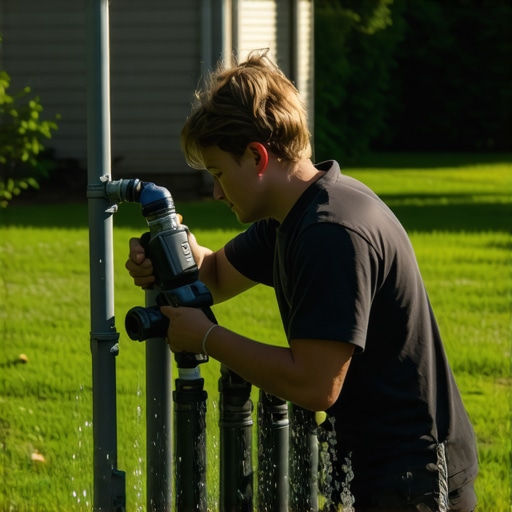
What is Water Hammer in Irrigation?
Water hammer, or hydraulic shock, is a high-pressure surge that occurs when water in motion is forced to stop or change direction suddenly, often caused by fast-closing solenoid valves. This energy creates a shockwave that rattles pipes, damages irrigation fittings, and can eventually lead to catastrophic main line failure if left unaddressed.
The Hardscape Autopsy: A $30,000 Lesson in Hydrostatic Pressure
I recently got called out to tear up a $30,000 patio that was sinking because the previous contractor ignored a violent water hammer in the adjacent irrigation zone. Every time the zone for the creeping thyme shut off, the shockwave rattled a loose 1-inch lateral line under the pavers. Over six months, that vibration created a micro-fissure. The resulting leak didn’t just waste water; it saturated the modified gravel base, turned the bedding sand into slurry, and caused the Techo-Bloc pavers to heave and dip. When I excavated, I didn’t just find a broken pipe; I found a complete structural failure of the hardscape caused by a simple $50 valve timing issue. Irrigation isn’t just about keeping grass green; it is about managing the kinetic energy of fluid dynamics. If you don’t respect the PSI, the water will find a way to destroy your investment. It is physics, plain and simple.
“The surge pressure in a piping system is directly proportional to the change in fluid velocity and the speed of the pressure wave.” – Irrigation Association Technical Manual
Why Your Irrigation System Sounds Like a Sledgehammer
The violent thud you hear when your sprinkler system shuts off is the result of kinetic energy having nowhere to go. In a standard landscaping setup, water travels through PVC or Poly pipes at speeds often exceeding 5 feet per second (fps). When a solenoid valve snaps shut in milliseconds, that moving column of water hits a dead end. The energy reverses, creating a pressure spike that can be five to ten times the static pressure of the system. If your static pressure is 60 PSI, a hammer event can spike to 400 PSI instantly. Most Schedule 40 PVC is rated for high pressure, but the glue joints and threaded fittings are the weak points. They will crack. It is only a matter of time. During a yard cleanup, I often see the tell-tale signs: damp soil near the valve box or oscillating heads that have lost their internal seals. These are the casualties of hydraulic shock.
How much pressure should my irrigation system have?
For most residential landscaping and sod install projects, the ideal static pressure is between 40 and 60 PSI. If your street pressure exceeds 80 PSI, you are in the danger zone for water hammer and premature component failure. High pressure doesn’t mean better coverage; it usually results in ‘misting’ where water evaporates before hitting the ground.
The Engineering Logic of Flow Velocity
To stop the noise, we have to look at velocity. Professional installers follow the ‘5 FPS Rule.’ If water moves faster than 5 feet per second, the risk of hammer increases exponentially. This is why we use larger diameter pipes for the main line and downsize for the laterals. It is a calculated reduction in speed. When homeowners do a DIY sod install, they often tap into a 1/2-inch copper line to run 10 gallons per minute (GPM). That is a recipe for disaster. The velocity in that scenario is over 13 fps. It will vibrate the solder right out of your home’s plumbing joints.
| Pipe Diameter (PVC Sch 40) | Max GPM (at 5 fps) | Velocity at 10 GPM | Risk Level |
|---|---|---|---|
| 3/4 Inch | 8 GPM | 6.3 fps | Moderate |
| 1 Inch | 13 GPM | 3.7 fps | Low |
| 1.25 Inch | 23 GPM | 2.2 fps | Minimal |
Actionable Fixes for a Noisy System
Don’t just ignore the bang. It won’t go away. Start by checking your irrigation controller. Some modern smart controllers have a ‘water hammer’ setting that staggers zone transitions to keep a constant flow, reducing the shock of a hard shut-off. If that doesn’t work, you need to look at hardware. Installing a water hammer arrestor near the valves can absorb the shock. This device contains a nitrogen-filled chamber that compresses when the pressure spike hits, acting like a shock absorber on a truck. Another professional move is to swap out cheap, fast-closing valves for high-quality, slow-closing diaphragms. These valves take 2-4 seconds to close, gradually slowing the water column rather than stopping it instantly.
- Install a Pressure Regulating Valve (PRV): If your main line pressure is over 80 PSI, this is non-negotiable.
- Retrofit Slow-Closing Solenoids: Replace standard 24V solenoids with models designed for gradual shut-off.
- Check Pipe Strapping: Ensure all copper or PEX lines in the basement or crawlspace are secured with insulated clamps.
- Verify Flow Rates: Ensure your GPM per zone does not exceed the capacity of your pipe diameter.
“A retaining wall doesn’t fail because of the stone; it fails because of the water trapped behind it, or the vibrations of the pipes beneath it.” – Hardscape Engineering Axiom
How do I know if I have air in my lines or water hammer?
Air in the lines usually causes a ‘chattering’ or ‘spitting’ sound at the sprinkler head and happens when the system first starts. Water hammer is a single, loud ‘thud’ or ‘bang’ that happens exactly when the system shuts off. Air is a nuisance; hammer is a threat. If you just finished a yard cleanup and blew out the lines with air, some chatter is normal. If the bang persists, you have a pressure surge issue.
The Connection Between Sod and Pressure
When performing a fresh sod install, irrigation is the heartbeat of the project. New sod needs frequent, short cycles to keep the root zone saturated without washing away the soil. If your system hammers every time those cycles end, you are vibrating the very ground the roots are trying to take hold in. Constant vibration can lead to air pockets under the sod, which dry out the tender white roots. A quiet system is a stable system. Ensure your contractor doesn’t just ‘get it running’ but actually balances the hydraulics of the site. If they don’t talk about GPM and PSI, they aren’t irrigation experts; they are just guys with shovels.