
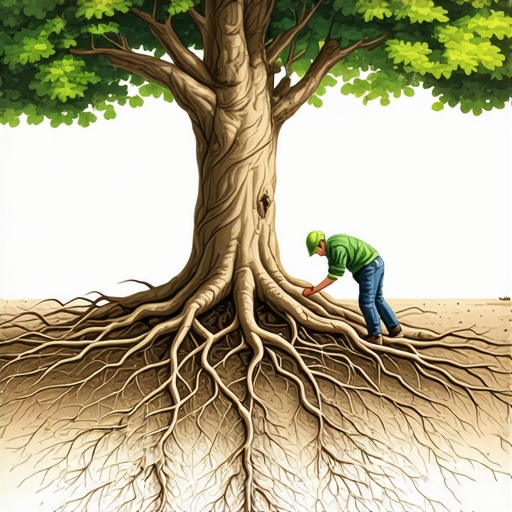
The Anatomy of a Surface Root Crisis
You see them every time you mow. Those grey, knobby knuckles of maple or oak roots snaking across your lawn, destroying your mower blades and making any sod install a nightmare. To the average homeowner, it looks like the tree is trying to escape the ground. To a veteran landscaper, it is a glaring red flag of soil compaction and anaerobic conditions. These are not just eyesores. They are the tree’s desperate attempt to breathe in a suffocating environment. If you do not understand the gas exchange happening in the upper six inches of your soil, you are going to kill your canopy while trying to save your lawn.
I always drill into my new crew members: if you dont fix the soil grading first, every plant you put in the ground is just expensive compost. I remember an apprentice who thought he could just dump six inches of heavy clay fill over a maples surface roots to level a yard for a yard cleanup project. Within two years, that majestic tree was dropping limbs. Within three, it was a $4,000 removal job. He did not understand that roots do not just grow down; they grow where the oxygen and water live. If the soil is too tight, they head for the surface. It is biology, not a choice.
Why do tree roots grow on top of the ground?
Tree roots grow on the surface primarily because of soil compaction and oxygen deprivation which prevent the roots from performing necessary gas exchange at deeper levels. When the bulk density of soil exceeds 1.6 grams per cubic centimeter, most roots cannot penetrate the earth, forcing them to stay within the top two inches of the rhizosphere where oxygen levels are highest. This is often exacerbated by poor irrigation habits that keep only the very surface of the soil damp.
The Science of Geotropism and Hydrotropism
Plants generally exhibit positive geotropism, meaning roots want to grow down. However, hydrotropism (growing toward water) and the absolute requirement for oxygen often override this. In many suburban developments, the topsoil was stripped decades ago, leaving behind heavy subsoil that has been packed down by heavy machinery. This creates a concrete-like barrier. When you run your irrigation for ten minutes every day, you only wet the top half-inch. You are training your tree to stay shallow. It is a physiological response to a localized resource. If the water and air are only at the top, the roots will stay at the top. It is that simple.
The Impact of Soil Bulk Density
Soil is not just dirt; it is a matrix of minerals, organic matter, water, and air. In a healthy landscape, 50 percent of the soil volume is pore space. When you have high foot traffic or heavy mower use, those pores collapse. This is why you see surface roots most often in high-traffic areas of the landscaping. The tree cannot find air down deep, so it pushes secondary thickening roots toward the surface. Once they are exposed to sunlight, they develop a thick layer of bark to protect against desiccation, becoming the woody obstacles you see today.
| Soil Condition | Bulk Density (g/cm³) | Root Health Outlook | Remediation Difficulty |
|---|---|---|---|
| Porous Loam | 1.1 to 1.3 | Optimal Growth | Low |
| Sandy Soil | 1.5 to 1.6 | Moderate Deep Growth | Medium |
| Compacted Clay | 1.7 to 1.9 | Surface Rooting/Stunting | High |
| Urban Concrete/Fill | 2.0 plus | Root Failure/Girdling | Severe |
“A tree’s root system is not a mirror image of its canopy; it is a wide, shallow disc that requires constant gas exchange with the atmosphere to survive.” – International Society of Arboriculture (ISA) Handbook
Can you cover exposed tree roots with dirt?
You cannot simply bury exposed tree roots with standard topsoil or heavy fill because doing so cuts off the oxygen supply to the roots, leading to root rot and systemic tree decline. Adding more than two inches of soil over an existing root system can be fatal for many species, especially Beech, Dogwood, and Maple, which are highly sensitive to root zone changes. If you must cover them, you must use a highly porous organic mulch or a specific compost-sand mix that allows for air penetration. Never use plastic weed barriers or heavy clay.
The Danger of the Mulch Volcano
We see this every spring during yard cleanup season. Some guy with a truck dumps three yards of dyed mulch around the base of a tree, piling it up against the trunk like a volcano. This is a death sentence. It traps moisture against the root flare, which is the part of the tree where the trunk transitions into roots. The flare needs to be exposed to air. When you bury it, you invite fungal pathogens and trunk girdling roots. Girdling roots are roots that grow in a circle around the trunk, eventually choking the tree like a slow-motion noose. Avoid this at all costs.
Strategic Root Remediation
If you are planning a sod install and those roots are in the way, you have three real options. First, you can mulch the area instead of trying to grow grass. This is the healthiest option for the tree. Second, you can add a very thin layer (1 inch) of screened topsoil mixed with compost, then seed it. Third, you can use an air-spade to loosen the soil around the roots without damaging them, then incorporate organic matter. Do not ever just hack the roots off with an axe. You are removing the trees structural stability and its primary nutrient intake system. It will fall over in the next high-wind event.
“Root systems of woody plants extend significantly further than the drip line, often two to three times the width of the crown, and are concentrated in the upper 12 to 18 inches of soil.” – USDA Forest Service Technical Report
How to Fix Surface Roots Without Killing the Tree
The goal is to change the environment, not punish the tree for reacting to it. You need to focus on vertical mulching or radial trenching. This involves drilling holes or digging trenches radiating out from the trunk and filling them with high-quality organic matter. This creates “oxygen chimneys” that allow the tree to breathe deeper in the soil profile. Over time, this can encourage new root growth at lower depths, though the existing surface roots will likely remain. They are permanent structural fixtures now.
Is it safe to cut surface roots?
Cutting any root larger than two inches in diameter is a gamble with the trees life. If the root is a primary structural root, removing it can make the tree a hazard. If you must cut, never remove more than 20 percent of the total root zone in a single season. Always make clean cuts with a sharp saw; never use a dull spade or a hatchet. A clean cut heals; a crushed root rots. If you are doing landscaping renovations, work around the roots. Use a bridge of gravel or a raised deck instead of cutting the lifeblood of your canopy.
Checklist for Safe Root Management
- Locate the root flare: It must be visible at the soil surface.
- Check soil moisture: Use a probe to see if water is reaching 12 inches deep.
- Identify the species: Maples and Willows are naturally shallower than Oaks.
- Call 811: Before any deep digging or trenching for irrigation lines.
- Apply mulch properly: 2 to 4 inches deep, but keep it 6 inches away from the bark.
- Aerated soil: Use a core aerator annually to reduce compaction around the root zone.
How much dirt can I put over tree roots?
You should never add more than one to two inches of soil per year over a trees roots. This incremental approach allows the tree to adapt and move its fine feeder roots upward into the new material without being smothered. Use a mix of 50 percent compost and 50 percent coarse sand to ensure maximum porosity. If you are doing a sod install, use the thinnest sod possible and avoid heavy rolling over the root zone. The weight of a water-filled roller is enough to crush the delicate root hairs that provide the tree with nutrients.
Comments are closed.