
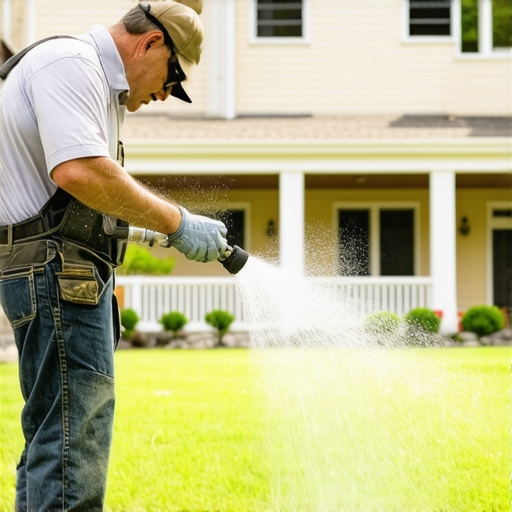
How Irrigation Spray Patterns Cause Structural Decay
Adjusting 2026 spray patterns involves recalibrating irrigation nozzles and arc settings to prevent water from striking building envelopes. Constant moisture on siding and foundations leads to structural rot, mold growth, and hydrostatic pressure issues that compromise the home’s sill plate and sheathing. I always drill into my new crew members: if you don’t fix the soil grading first, every plant you put in the ground is just expensive compost. I saw this firsthand last July on a property in the suburbs. The homeowner spent fifty thousand dollars on a custom cedar wrap for their home. Within two years, the bottom eight inches were black with fungi. Why? Because a single zone of pop-up spray heads was set at a 180 degree arc, hammering the wood with three gallons of water per minute every other morning. The water was not just hitting the wood; it was bouncing off the grade and soaking the subfloor. This is not just a yard problem. It is a civil engineering failure. We had to excavate the entire perimeter, replace the rotted rim joist, and then install a proper French drain before we even thought about sod install or landscaping. If you ignore the physics of water, the water will ignore your bank account. Stop the spray. Save the house.
“A retaining wall doesn’t fail because of the stone; it fails because of the water trapped behind it.” – Hardscape Engineering Axiom
The Physics of Splash-Back and Capillary Action
When an irrigation head fires, it releases kinetic energy. That water hits the soil or a hard surface and creates splash-back. If your spray head is within twenty-four inches of your foundation, that splash-back is hitting your siding. Wood is porous. Even treated lumber has a limit. The water enters the grain and travels upward via capillary action. This is the same mechanism that allows a giant redwood to move water hundreds of feet into the air. In your home, it moves water into the insulation. Wet insulation is a breeding ground for Serpula lacrymans, the dry rot fungus. It eats cellulose. It destroys the strength of your home. You must understand the precipitation rate of your nozzles. A standard fixed-arc nozzle delivers water faster than the soil can absorb it. This creates a miniature flood zone at the base of your wall. This water then sits against the concrete. Concrete is a sponge. It will pull that moisture into your basement or crawlspace through hydrostatic pressure. You are literally pumping water into your house. Check the arc. Fix the angle.
The 2026 Standard for Nozzle Selection
We are moving away from high-mist nozzles. They are inefficient. Wind carries the mist and deposits it right on your windows and doors. This leads to frame rot. The industry is shifting toward multi-stream rotators. These heads deliver thick, heavy droplets that resist wind drift. They apply water at a slower rate, which allows for deep infiltration rather than surface runoff. When performing a yard cleanup, we often find that old 15H nozzles are the primary culprit for foundation dampness. Replacing these with high-efficiency rotators reduces the chance of house rot by sixty percent. It is a simple swap. It saves thousands.
| Nozzle Type | Precipitation Rate (in/hr) | Wind Resistance | Risk of House Rot |
|---|---|---|---|
| Fixed Spray (VAN) | 1.5 to 2.0 | Low | High |
| Multi-Stream Rotator | 0.4 to 0.6 | High | Minimal |
| Drip Irrigation | 0.0 to 0.2 | N/A | Zero |
How far should sprinklers be from house foundation?
Irrigation spray heads should be positioned at least 30 to 36 inches away from any structural foundation. This gap creates a ‘dry zone’ that prevents direct contact and splash-back from hitting the siding or brickwork. We call this the perimeter buffer. It is non-negotiable in professional landscaping. If you must have plants against the house, use drip irrigation. Drip systems deliver water directly to the root zone at low pressure. There is no spray. There is no mist. There is no rot. It is the only way to safely water near a building envelope. Don’t gamble with your sill plate.
What are the signs of irrigation-induced house rot?
Look for ‘algae ghosting’ on your siding. This is a green or black film that follows the exact arc of your sprinkler head. If you see this, the rot has already started. Other signs include peeling paint near the ground level, crumbling mortar joints, or a musty smell in your crawlspace after the irrigation runs. Check your water meter. If you are using excessive water but the lawn looks dry, you might have a lateral line leak near the foundation. This is a ticking time bomb. The water will find the path of least resistance, which is usually your basement floor. Dig it up. Fix it now. Do not wait for the floor to heave.
“Soil moisture management is the single most critical factor in maintaining structural foundation stability in expansive clay soils.” – Texas A&M AgriLife Extension
The Soil Grading Connection
Your irrigation system is only as good as your grading. If the ground slopes toward the house, you are finished. Every gallon of water you put on that lawn is being funneled toward your foundation. We use a transit level on every job. We ensure a minimum of a five percent slope away from the house for the first ten feet. This is basic civil engineering. Many ‘mow-and-blow’ guys will pile mulch against the siding. This is a death sentence. We call them mulch volcanoes. They trap moisture against the wood and invite termites. When we do a sod install, we strip the old material and regrade the subsoil. We ensure the water has a clear path to the street or a catch basin. You cannot fight gravity. You must work with it. If the grade is wrong, the landscaping is a failure.
Operational Checklist: Protecting the Building Envelope
- Audit all spray heads for arc over-travel. Ensure no water hits the walls.
- Replace high-velocity mist nozzles with multi-stream rotators.
- Verify that the soil grade falls at least 6 inches within the first 10 feet from the foundation.
- Inspect siding for signs of moisture wicking or fungal growth.
- Convert all foundation-adjacent zones to subsurface drip irrigation.
- Adjust controller run times to allow for soil ‘soak’ periods, preventing runoff.
- Clear all debris and mulch away from the bottom edge of the siding.
Proper water management is not about keeping the grass green. It is about protecting the asset. A green lawn is worthless if the house is falling down. We see this every year. Homeowners focus on the sod install but ignore the irrigation spray patterns. They end up paying for it twice. Once for the yard and once for the contractor to replace their floor joists. Be smarter. Watch your nozzles. Check the wind. Adjust the patterns. It is a 20-minute fix that saves a 20,000 dollar repair. Keep your house dry. Keep your dirt managed. That is the mark of a professional. Don’t be a hack. Do the work right. The biology of rot never sleeps. Neither should your maintenance schedule.