
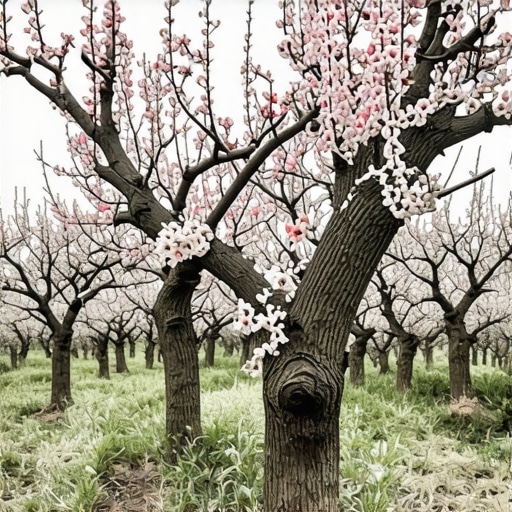
Professional Frost Mitigation for 2026 Fruit Tree Yields
I always drill into my new crew members: if you don’t fix the soil grading first, every plant you put in the ground is just expensive compost. This hard truth applies doubly to managing an orchard for the 2026 season. You can spend thousands on nursery stock, but if your site planning ignores the fluid dynamics of cold air, you are just throwing money into a freezer. In my 20 years of running high-end landscaping firms, I have seen more 2026-bound fruit buds killed by poor site prep than by actual record-breaking cold. Success starts with engineering, not hope.
The Biological Mechanics of Fruit Tree Dormancy
Protecting 2026 fruit trees from early spring frost requires a deep understanding of cellular physiology, specifically the acclimation process where trees move water out of cells to prevent intracellular ice formation. To ensure 2026 production, you must manage soil thermal mass and canopy temperature during the critical bud-break window between March and May.
We are looking at the endodermis and the cambium layer. When temperatures drop below 28 degrees Fahrenheit, the water between cells freezes first. This creates a vapor pressure deficit that sucks water out of the cells. It is dehydration, not just cold, that kills the crop. You need to understand the difference between a radiation frost and an advective freeze. Radiation frost happens on clear, calm nights when the earth loses heat to the sky. Advective freezes are driven by wind and cold air masses. Your 2026 strategy must account for both. Don’t skip the basics. Site your trees on a slope if possible. Cold air behaves like water; it flows downhill and settles in low spots. If your orchard is at the bottom of a basin, you have built a frost pond.
Orchard Floor Engineering: Sod, Soil, and Thermal Conductivity
The engineering of your orchard floor dictates how much radiant heat is captured during the day and released at night, a process controlled by soil moisture levels and surface compaction. A clean, moist, and firm soil surface can be 5 degrees warmer than a yard covered in tall grass or thick mulch.
This is where your yard cleanup and sod install strategy becomes a survival tool. While the internet tells you to mulch everything heavily, a thick layer of wood chips actually acts as an insulator, trapping the heat in the ground and preventing it from rising to the branches at night. For 2026 fruit trees, you want the soil bare or covered with very short, dormant turf during the frost window. We often perform a heavy yard cleanup in late winter specifically to expose the soil. If we are doing a sod install in an orchard area, we ensure the grade is perfect to avoid puddling, as standing water can lead to root rot during the spring thaw. Moisture in the soil is your friend for frost protection, but it must be within the soil matrix, not sitting on top. Wet soil has a higher heat capacity than dry soil. It takes more energy to change the temperature of water-saturated earth. This is a simple law of thermodynamics.
“The temperature of a plant is a balance between the energy it receives and the energy it loses. Moist soil can hold and release significantly more heat than dry, loose soil or soil covered in heavy mulch.” – Agricultural Extension Agronomy Manual
How do I protect fruit tree blossoms from freezing?
To protect fruit tree blossoms, you must maintain a boundary layer of warmth around the pedicel and ovary using active heat sources like irrigation or passive thermal mass like bare, moist soil. Covering trees with breathable frost blankets that extend to the ground is the most effective DIY method.
The Irrigation Leverage: Latent Heat of Fusion
Using an irrigation system for frost protection relies on the latent heat of fusion, which releases 80 calories of heat for every gram of water that turns from liquid to ice. This process keeps the plant tissue at a constant 32 degrees Fahrenheit even if the surrounding air temperature drops significantly lower.
This is high-level landscaping engineering. If you are going to use irrigation for frost protection for your 2026 crop, you need a system that can run continuously. You cannot start it and then stop it once ice forms. If you stop the water, the ice will undergo evaporative cooling and drop the temperature of the wood even faster. It will rot the buds from the inside out. We design irrigation systems with specific frost-nozzles that deliver a consistent 0.1 to 0.15 inches of water per hour. This is a precise calculation. Too little water and you won’t generate enough heat; too much and you will break branches under the weight of the ice. Before you even think about 2026, check your 811 / Dig Safe markings and ensure your lines are buried below the frost line to prevent burst pipes during a late-season snap. Irrigation is a double-edged sword. Use it wrong, and you’ll destroy what you’re trying to save.
| Method | Temp Gain (F) | Technical Requirement | Risk Factor |
|---|---|---|---|
| Bare Moist Soil | 2-5 Degrees | 100% Yard Cleanup | Low |
| Frost Blankets | 4-8 Degrees | Ground-to-Canopy Seal | Medium (Wind) |
| Overhead Irrigation | 5-10 Degrees | Continuous Application | High (Ice Weight) |
| Heaters/Smudge Pots | 3-7 Degrees | Fuel & Monitoring | Medium (Fire) |
When should I uncover fruit trees after a frost?
You should uncover 2026 fruit trees as soon as the ambient air temperature rises above 32 degrees Fahrenheit and the dew point is stable. Leaving covers on during a sunny morning can cause rapid desiccation or trigger premature sap flow, making the tree more vulnerable to the next freeze.
The 2026 Orchard Readiness Checklist
Planning for a 2026 harvest starts now. Do not wait until the local news warns of a freeze to buy your supplies. You need a structured approach to landscaping and tree care that emphasizes structural integrity and chemical balance.
- Conduct a soil pH test; most fruit trees prefer a range between 6.0 and 7.0 for optimal nutrient uptake.
- Perform a deep yard cleanup to remove fungal vectors and expose the soil for thermal absorption.
- Inspect the root flare; if you see a mulch volcano, dig it out immediately to prevent bark rot.
- Check the calibration of your irrigation system to ensure uniform coverage for frost protection.
- Prune for airflow; a dense canopy traps moisture, which leads to ice crystal formation on the buds.
“Structural stability in a landscape is not achieved through the finishing materials, but through the compaction and drainage of the sub-base materials.” – Hardscape Engineering Axiom
This engineering axiom applies to your trees too. If you haven’t prepared the “sub-base”—the soil health, the drainage, and the thermal environment—your 2026 fruit crop is built on a failing foundation. We see it every year. People buy expensive trees, stick them in a hole in the middle of a lawn with poor drainage, and wonder why the frost kills them. It is not bad luck. It is bad engineering. Stop listening to the big-box store employees and start looking at the physics of your yard. Measure your soil moisture. Check your local USDA hardiness zone (6b is not the same as 7a when a late April frost hits). Be pragmatic. Be precise. Your 2026 harvest depends on it.