
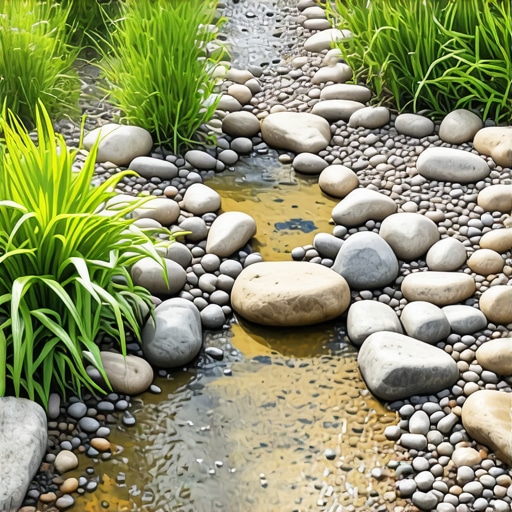
Why Most Residential Dry Creek Beds Fail Within Three Years
Building a natural dry creek bed involves calculating peak water volume, establishing a 2% minimum slope, and utilizing non-woven geotextile fabrics to prevent sub-base erosion. Simply tossing river rock into a trench creates a debris trap that will clog with silt and overflow during the first heavy 2026 storm cycle.
I recently got called out to tear up a $30,000 patio that was sinking because the previous contractor thought they could direct 4,000 square feet of roof runoff into a shallow 4-inch deep ‘decorative’ creek. The water didn’t stay in the channel. It saturated the modified gravel base under the pavers, turned the sub-soil into structural mush, and cost the homeowner a fortune in remediation. This is what happens when you treat landscaping as a hobby rather than civil engineering. A dry creek bed is a hydraulic tool, not a rock garden. If you don’t respect the hydrostatic pressure and the flow rate of your property, the water will eventually win.
The Ground-Up Build: Planning for 2026 Precipitation Patterns
Designing for the next decade of runoff requires looking at 50-year storm data. Most municipalities are seeing increased precipitation intensity, meaning your yard cleanup and drainage strategy must account for higher ‘peak flow’ events. 80% of the work happens before you buy a single stone. You need to identify the low points using a laser level. A visual estimate is a recipe for standing water and mosquito breeding grounds. Check your utility lines by calling 811. Do not skip this. Cutting a fiber optic line or a gas main turns a weekend project into a multi-thousand-dollar disaster.
“A retaining wall or drainage channel doesn’t fail because of the stone; it fails because of the water trapped behind or beneath it.” – Hardscape Engineering Axiom
How deep should a dry creek bed be for heavy rain?
For standard residential runoff, a dry creek bed should be excavated to a depth of 12 to 18 inches, allowing for a 6-inch structural base and 6-10 inches of stone. The width should be twice the depth to ensure the water velocity remains manageable and doesn’t scour the banks.
Material Selection: Why Nursery Stock and River Jack Beat Big-Box Alternatives
You cannot use standard landscape plastic for a drainage project. It is impermeable and will cause the rocks to slide. You need 4oz or 6oz non-woven geotextile fabric. This allows water to infiltrate the soil slowly while preventing the heavy stone from sinking into the clay or loam. When selecting stone, use a mix of sizes. Uniform 2-inch river rock looks fake and moves too easily. You want a ‘graded’ mix ranging from 1-inch pebbles to 12-inch anchor boulders to mimic a natural riparian environment.
| Material Type | Function | Average Cost (per ton) | Longevity |
|---|---|---|---|
| River Jack (3-5″) | Main Channel Bedding | $120 – $180 | High (50+ years) |
| #57 Clean Stone | Sub-base Drainage | $45 – $65 | Excellent |
| Non-Woven Geotextile | Separation Layer | $1.50/sq ft | Critical |
| Native Riprap | Bank Stabilization | $60 – $95 | Medium |
The Action Phase: Excavation and Slope Stabilization
Start your excavation at the lowest point of the property, working your way back toward the source of the runoff (usually a downspout or a hill). Dig a parabolic trench. Vertical walls will collapse. Slope the sides at a 3:1 ratio. Once excavated, compact the sub-grade. The soil should be firm. If you can push a screwdriver into it with ease, it isn’t ready. Lay your fabric, ensuring at least a 12-inch overlap at the seams. Pin it down. Don’t be stingy with the landscape staples.
- Remove all turf and organic debris (yard cleanup) before digging.
- Apply a pre-emergent herbicide to the bare soil to prevent weed breakthrough.
- Install the largest ‘anchor’ stones at the bends of the creek where water force is highest.
- Backfill the main channel with 4-6 inches of rounded river stone.
- Finish the edges with a professional sod install to lock the fabric in place.
Does a dry creek bed need a drain pipe?
While a dry creek bed handles surface runoff, integrating a perforated 4-inch N-12 HDPE pipe (a French drain) beneath the stone bed provides a dual-action system. This manages both the visible surface water and the sub-surface saturation that causes soil instability.
Integrating Landscaping, Sod, and Irrigation
Your irrigation system must be recalibrated after installing a creek bed. You don’t want your spray heads dumping water into the drainage channel—that’s just wasting money. Move your heads to provide ‘head-to-head’ coverage on the new sod install along the creek’s banks. Use deep-rooted plants like Switchgrass or Blue Flag Iris along the margins. These plants thrive in the ‘mesic’ zone where soil moisture fluctuates. Their roots act as biological rebar, holding the soil together when the 2026 runoff hits. Avoid mulch volcanoes around any trees near the creek. It will rot the flare. Keep the mulch back 3 inches. Precision matters. A dry creek bed is not just a pile of rocks; it is the vascular system of your property.