
The Forensic Autopsy: A $40,000 Foundation Failure
I recently stood in a crawlspace where the moisture levels were hitting 32%, effectively turning the structural floor joists into expensive mushrooms because the homeowner ignored their gutters for three seasons. Clearing 2026 gutters with a pressure washer wand fix is the only way to prevent hydrostatic pressure from blowing out your basement walls or causing differential settlement in your foundation. When gutters overflow, water pools at the drip line, saturating the active zone of the soil. This leads to soil expansion and contraction that can snap a concrete footer like a dry twig. It is not just about aesthetics; it is about civil engineering at the residential level. If you do not manage your roof runoff, you are essentially inviting a slow-motion flood into your home’s skeletal structure.
“Excessive moisture near the foundation is the primary cause of differential settlement in residential structures, often exacerbated by poorly maintained drainage systems.” – Foundation Performance Association
How much does a wet gutter weigh?
A standard 5-inch K-style gutter can hold approximately 1.2 gallons of water per linear foot. When those gutters are packed with water-logged oak leaves, pine needles, and shingle grit, the weight exceeds 10 pounds per linear foot. On a 40-foot run, you are hanging 400 pounds of wet sludge from aluminum fascia hangers that were never designed for that load. Eventually, the pitch of the gutter fails, or worse, the fascia board begins to rot through capillary action, pulling the entire system away from the house. This is why a yard cleanup must always start at the roofline and work its way down to the sod install. Without vertical water management, your landscaping is just a temporary decoration waiting to be washed away by the next 100-year storm event.
The Pressure Washer Wand Fix: Engineering Your Approach
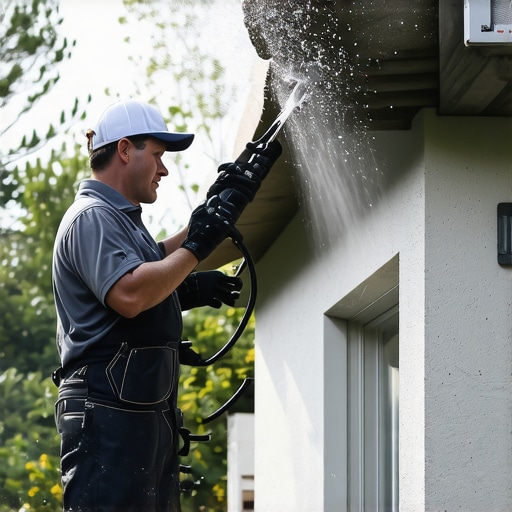
The pressure washer wand fix involves using a specialized telescoping extension pole with a U-shaped 180-degree nozzle attachment to clear debris from the ground. This method is safer and more efficient than ladder-based manual extraction because it utilizes hydraulic force to liquefy organic blockages and flush them through the downspouts. Pressure washer PSI for gutters should be regulated between 1,500 and 2,000 PSI; anything higher risks shearing the rivets off the gutter elbows or stripping the finish from the aluminum. You need a high-flow nozzle—specifically a 40-degree white tip—to provide enough volume to move the sludge without the needle-like precision that punctures metal. Don’t skip the downspout flush; if the vertical pipe is clogged, your horizontal cleaning is useless. It will back up immediately.
What PSI is safe for gutter cleaning?
For most residential aluminum or vinyl gutters, a PSI range of 1,500 to 2,200 is the sweet spot for removing compacted organic matter without damaging the substrate. Professional-grade machines should be throttled down, as a 4,000 PSI stream can easily cut through thin-gauge gutter walls or destroy the polymeric sealant at the miters. The real power comes from the GPM (Gallons Per Minute). You want a machine that pushes at least 2.5 to 3.0 GPM to ensure the volume of water is sufficient to carry the shingle grit and heavy debris all the way to the downspout exit. High pressure with low volume just makes a mess; high volume with moderate pressure actually cleans the system.
| Method | Safety Rating | Efficiency | Risk of Damage | Cost Level |
|---|---|---|---|---|
| Manual (Ladder) | Low | Low | Low | Low |
| Leaf Blower | Medium | Medium | Low | Low |
| Pressure Wand | High | High | Moderate | Medium |
| Vacuum System | High | High | Low | High |
The Landscape Integration: Gutters to Irrigation
Your irrigation system and your gutters are two sides of the same coin: water management. Clogged gutters lead to soil saturation, which makes your irrigation sensors read high, leading to underwatering in other zones of the yard. Furthermore, if you are planning a sod install, the runoff from a clogged gutter will create channelization—deep ruts in your new lawn—before the roots have a chance to knit into the soil. I see it every year: a homeowner spends $5,000 on high-end Tall Fescue sod, only to have a single downspout overflow and wash away the topsoil and seedbed in one afternoon. You must install pop-up emitters or French drains to carry that gutter water at least 10 feet away from the foundation and the primary landscaping beds.
“Gutter systems must be sized to handle the 100-year storm event intensity for the specific geographic region to prevent structural water intrusion.” – International Plumbing Code (IPC)
How do you fix gutter runoff for new sod?
To protect a new sod install, you must install solid-wall PVC underground drainage pipes that connect directly to your downspouts, bypassing the surface-level soil entirely. These pipes should daylight at a lower elevation or into a dry well to ensure that the hydrostatic head does not back up into the gutter system. Using corrugated pipe is a mistake I see ‘hacks’ make constantly; the ridges catch shingle grit and eventually clog, requiring a full excavation to fix. Use Schedule 40 PVC. It is smooth-walled, resists root intrusion, and can be cleared with a drain snake if necessary. Do not compromise on the grade; you need a minimum slope of 1/8 inch per foot to maintain scouring velocity. Anything less and the sediment will settle, eventually blocking the pipe.
Technical Checklist for Gutter Pressure Washing
- Safety First: Wear wrap-around eye protection and a hard hat; falling debris like shingle grit can cause corneal abrasions.
- Wand Assembly: Use a fiberglass telescoping wand with a 180-degree gutter hook attachment and a 40-degree nozzle tip.
- System Check: Inspect all downspout strainers before starting; if they are plugged, remove them so the water has an exit.
- Pressure Calibration: Set your unloader valve to 2,000 PSI max to protect the aluminum finish.
- Chemical Application: If there is heavy algae or ‘tiger striping’ on the exterior, use a sodium hypochlorite solution at a 1% dilution.
- Post-Wash Flush: Ensure the water is exiting the downspout at full volume; a slow trickle indicates an underground blockage.
Landscape health is a game of inches and degrees. A yard that is 2 degrees off-grade will swamp your foundation. A gutter that is 1 inch out of level will overflow. In my 20 years, I’ve learned that the best yard cleanup isn’t about the rake; it’s about the pressure washer and the transit level. If you ignore the mechanics of how water moves across your property, the property will eventually move without you. Keep your gutters clear, keep your downspouts extended, and keep your soil pH balanced. That is the only way to build a landscape that lasts for decades rather than seasons.