
The Forensic Autopsy of a Suffocating Lawn
Your lawn is not dying from a lack of water; it is dying from a lack of oxygen caused by structural soil failure. When you walk across your yard and it feels like a parking lot, or when water beads and runs off the surface rather than soaking in, you are witnessing high-density soil compaction. This mechanical resistance prevents roots from penetrating deeper than the top half-inch of the soil profile, creating a weak, shallow-rooted turf that collapses at the first sign of heat stress. I recently told my new crew members: if you do not fix the soil grading and compaction first, every plant or sod roll you put in the ground is just expensive compost. I have seen homeowners spend thousands on premium irrigation systems only to have their turf rot because the subsoil had the bulk density of a highway base. You cannot hydrate a rock, and you cannot grow grass on a surface that has been compressed into an anaerobic slab.
Why Soil Compaction Destroys Your Turf
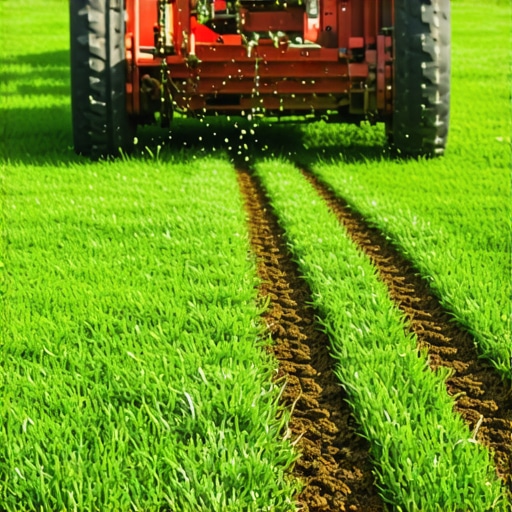
Soil compaction occurs when external pressure forces soil particles together, eliminating the macropores required for the movement of air, water, and nutrients into the rhizosphere. This structural collapse increases bulk density, often reaching levels of 1.6 grams per cubic centimeter or higher, which physically stops root elongation and leads to the buildup of carbon dioxide in the soil. [image_placeholder_1] This gaseous imbalance creates a toxic environment for beneficial soil microbes. Without these microbes, the nitrogen cycle stalls. You can dump nitrogen fertilizer on a compacted lawn all day, but the grass cannot process it if the soil chemistry is fundamentally broken. Compaction also creates a thick layer of thatch, a dense mat of organic debris that further prevents moisture from reaching the roots. If you do not address this with mechanical intervention, your lawn will enter a death spiral of thinning and weed encroachment.
“Compaction reduces the number of large pores (macropores) in the soil, which are essential for the movement of air and water, leading to poor drainage and reduced oxygen availability for roots.” – Penn State Center for Turfgrass Science
How deep should core aeration go?
To be effective, core aeration must penetrate at least 2.5 to 3.5 inches into the soil profile using hollow tines. Any depth less than 2 inches fails to break through the typical compaction zone found in residential yards. High-density hollow tines are required to physically remove a plug of soil. This is not about making holes; it is about removing mass. If you are not seeing 20 to 40 plugs per square foot, the machine is not doing its job. I have watched DIYers use spike aerators that actually make compaction worse. A spike does not remove soil; it pushes it to the sides of the hole, creating a ring of high-density earth that acts like a miniature clay pot, trapping roots in a confined space. Only core aeration provides the lateral expansion room needed for soil to decompress over time.
What is the best time of year for lawn aeration?
The optimal window for core aeration is during the active growth phase of your specific turf species to ensure the grass can recover and colonize the new voids. For cool-season grasses, this means late August through early October. For warm-season grasses, the window is late spring through mid-summer. Timing the aeration correctly allows you to pair the process with overseeding and fertilization, maximizing the uptake of nutrients. If you aerate during a drought or when the ground is frozen, you will damage the crown of the grass and likely break your equipment. The soil must be moist enough for the tines to penetrate but not so wet that the machine leaves ruts. Think of it like a wet sponge; it should be damp but not dripping.
The Engineering Reality: Core vs. Spike Aeration
| Feature | Core Aeration (Professional) | Spike Aeration (DIY Hack) |
|---|---|---|
| Soil Removal | Physically removes soil mass | Displaces soil sideways |
| Compaction Relief | Long-term decompression | Increases side-wall compaction |
| Oxygen Exchange | Immediate and deep | Negligible |
| Root Penetration | Allows 4-6 inch root growth | Limits roots to spike depth |
| Thatch Control | Breaks up thatch layer | Compressed thatch further |
The difference between these two methods is the difference between civil engineering and a hobby. As a professional, I refuse to use spike equipment because it is a temporary cosmetic fix for a structural problem. When we pull a core, we are opening a portal for the soil to breathe. This process also brings beneficial bacteria to the surface, where they can begin breaking down the thatch layer. It is a biological reset for your lawn. If you have heavy clay soil, like the red clay found in many southern regions, you must be even more aggressive with your core spacing. Clay particles are microscopic and flat; they stack like sheets of paper. Aeration is the only way to shuffle the deck and introduce oxygen back into the stack.
The Step-by-Step 2026 Remediation Process
Follow this checklist to ensure your yard cleanup and aeration program actually yields results. Do not skip the utility check. Call 811 before you put a single tine in the ground, or you will be paying me to repair your irrigation lines instead of fixing your grass.
- Flag the Infrastructure: Mark all sprinkler heads, shallow utility lines, and invisible dog fences.
- Moisture Prep: Water the lawn with roughly 0.5 inches of water 24 hours before aeration to soften the soil.
- The Double Pass: Run the aerator in a grid pattern. Go north-to-south, then east-to-west.
- Yard Cleanup & Seed: Leave the plugs on the lawn to decompose; they contain vital microbes. Broadcast seed immediately after.
- Fertilize: Apply a high-phosphorus starter fertilizer to encourage root development in the new holes.
- Hydration: Water deeply and infrequently. Aim for 1 inch per week, delivered in two 0.5-inch sessions.
“A retaining wall doesn’t fail because of the stone; it fails because of the water trapped behind it, much like a lawn fails when compaction traps water on the surface instead of letting it reach the roots.” – Hardscape Engineering Axiom
The Hydraulic Reality of Post-Aeration Irrigation
Once you have opened up the soil, you must change your irrigation habits. The goal of aeration is to force roots to chase water down into the subsoil. If you water for 5 minutes every morning, you are training your grass to be lazy and weak. You must water deeply. This forces the roots to grow 6 inches down into the aerated zones to find moisture. This is how you survive a 100-degree July. A lawn with 6-inch roots can go five days without water; a compacted lawn with 1-inch roots will brown out in 24 hours. Stop the frequent misting and start the deep soaking. Your water bill will actually go down because you are losing less to evaporation. This is science, not guesswork. If you follow this 2026 guide, your lawn will have the structural integrity to withstand foot traffic, drought, and disease for years to come.