
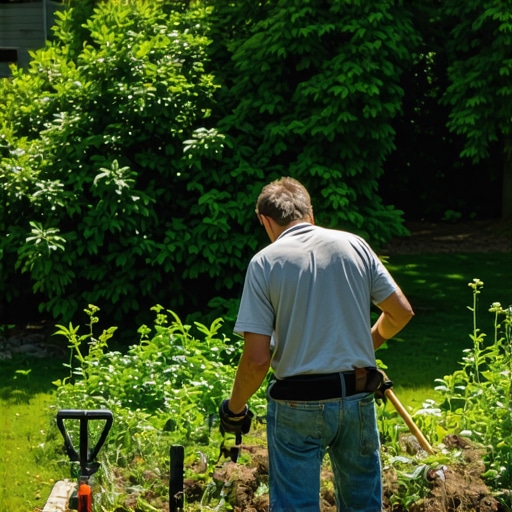
The Blueprint for Professional Site Preparation
Clearing a thicket for a 2026 renovation involves more than just hacking at brush; it requires a systematic soil remediation strategy and topographical grading to prevent future drainage failure. A successful yard cleanup must address subterranean root mass and soil microbiology before you ever consider a sod install or irrigation layout.
I always drill into my new crew members: if you don’t fix the soil grading first, every plant you put in the ground is just expensive compost. I’ve seen $50,000 projects wash away in a single spring rain because some guy with a chainsaw thought ‘clearing’ just meant cutting things flush to the ground. When you’re looking at a 2026 renovation, you have the luxury of time. Time is your best tool for dealing with invasive species like buckthorn, multiflora rose, or oriental bittersweet. If you rush the clearing process, the seed bank in the soil will explode the moment you add water and fertilizer to your new lawn. You need to understand the physics of the site before you buy the first pallet of stone.
The Science of Mechanical Clearing and Soil Compaction
To clear a thicket, you aren’t just removing biomass; you are managing a structural transition. Forestry mulching is often the preferred method for the initial phase. A high-flow skid steer with a vertical-shaft mulching head can reduce six-inch diameter trees to a coarse organic mulch in seconds. However, this mulch creates a high carbon-to-nitrogen ratio. Microbes will lock up all available nitrogen to break down that wood, leaving your future plants starving. If you plan to install sod in 2026, that mulch needs to be integrated or removed to prevent nitrogen immobilization. We aim for a soil organic matter (SOM) percentage of 5 to 8 percent. Anything higher from excessive wood chips will cause the ground to stay too spongy for a stable landscaping foundation.
“Soil compaction is the most common cause of plant failure in urban landscapes. A bulk density greater than 1.6 g/cm³ will physically prevent root penetration in most turfgrass species.” – Agricultural Extension Agronomy Manual
How much does it cost to clear a thicket for landscaping?
Professional thicket clearing typically costs between $1,200 and $4,500 per acre depending on the vegetation density, slope steepness, and equipment access. For a standard residential backyard, expect to pay a day rate for a skid steer operator plus debris haul-off fees. Investing in root grubbing now prevents the $10,000 headache of regrowing invasives piercing through your new hardscape base in two years.
| Clearing Method | Cost Efficiency | Soil Disturbance | Residual Regrowth Risk |
|---|---|---|---|
| Manual Grubbing | Low | Minimal | Very Low |
| Forestry Mulching | High | Moderate | Moderate |
| Excavator/Root Rake | Medium | High | Low |
| Chemical Basal Bark | High | None | Low |
Hydraulic Infrastructure: Designing the Irrigation Grid
Irrigation design for a total renovation requires a static pressure test and a flow rate calculation (GPM) before any pipes go in the ground. You cannot guestimate the water needs of a future sod install. We use Schedule 40 PVC for all mainlines because Class 200 is too thin for the freeze-thaw cycles we see in heavy soils. Every zone must be designed with head-to-head coverage. If your spray patterns don’t overlap 100 percent, you will get brown spots. Period. Don’t blame the sod; blame the physics of the nozzle. We also install master valves to prevent a single cracked lateral from flooding your entire basement while you’re on vacation.
When should I install sod after clearing brush?
You should wait at least six months after a major yard cleanup before a sod install to allow for soil settling and herbicide dissipation. This window allows you to monitor for perennial weed emergence and correct grading issues that appear after the first heavy rains. A 2026 renovation timeline is ideal for soil pH adjustment using lime or sulfur, which takes months to react chemically with the soil profile.
“A retaining wall doesn’t fail because of the stone; it fails because of the water trapped behind it.” – Hardscape Engineering Axiom
Hardscaping and Hydrostatic Pressure Management
When clearing a thicket to make room for a patio or wall, you must account for hydrostatic pressure. Removing deep-rooted brush changes how water moves through the subsoil. We use ASTM D448 No. 57 stone for backfilling any wall over 24 inches. This creates a void ratio that allows water to drop straight down to a 4-inch perforated drain pipe (daylighted to a lower point on the property) rather than pushing against the face of your stone. If you don’t manage the water, the wall will heave. It’s a certainty of civil engineering. We compact our modified gravel base in 4-inch lifts using a vibratory plate compactor until we hit 95% Proctor density. The dirt should be so hard it rings when you hit it with a shovel.
Checklist for the 2026 Renovation Site Prep
- Utility Marking: Call 811 before any excavation to map gas, water, and fiber optic lines.
- Invasive Species Identification: Flag any species requiring specialized herbicide treatment (e.g., Japanese Knotweed).
- Soil Testing: Extract 10-12 core samples at a 6-inch depth for a full nutrient and pH analysis.
- Rough Grading: Establish a minimum 2% slope away from all residential structures to ensure positive drainage.
- Stump Removal: Grub out all stumps over 2 inches in diameter; do not just grind them if a structure will be built on top.
- Sub-base Compaction: Use a 10-ton roller if clearing large areas to identify ‘soft spots’ in the geology.
The 2026 renovation starts today with site stabilization. Once the thicket is gone, the soil is vulnerable. We use erosion control blankets or a temporary cover crop like annual ryegrass to hold the structure together. This prevents your topsoil from ending up in the neighbor’s pool during a thunderstorm. Remember, you are building an ecosystem, not just a backyard. The chemistry of the soil and the physics of the water flow will dictate your success long after the last roll of sod is laid. Do the work now, or pay for it twice later.