
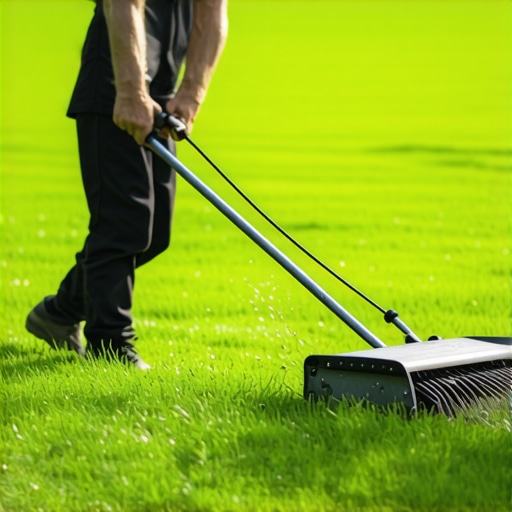
The Anatomy of a Choked Lawn: Why Your Turf is Suffocating
Dethatching and power raking involve the mechanical removal of the organic layer known as thatch, a buildup of dead grass, roots, and debris that accumulates between the soil surface and the green vegetation. For a 2026 lawn to thrive, this layer must stay below 0.5 inches to ensure irrigation, oxygen, and nutrients reach the root zone. When thatch exceeds this limit, it creates a hydrophobic barrier that encourages fungal pathogens and shallow rooting.
I recently walked a property where the homeowner had spent thousands on a professional sod install two years prior. By the time they called me, the grass felt like walking on a wet sponge. This is the chemical nightmare I see too often: they had been dumping high-nitrogen synthetic fertilizers every three weeks, forcing the grass to grow faster than the soil microbes could digest the organic matter. We pulled a core sample and found three inches of solid, grey, anaerobic muck. The lawn was effectively living in its own filth, disconnected from the earth. We didn’t just have to rake; we had to perform a surgical yard cleanup to save the remaining root structures. If you keep pushing nitrogen without considering the decomposition cycle, you are just building a biological tomb for your grass.
“Thatch is a layer of living and dead plant parts that develops between the green vegetation and the soil surface. It is a natural part of a healthy lawn, but it becomes a problem when its rate of accumulation exceeds its rate of decomposition.” – Penn State Center for Turfgrass Science
The Science of Lignin and Soil Microbiology
Thatch is not just grass clippings. Regular clippings are mostly water and break down quickly. True thatch is composed of high-lignin tissues: stems, nodes, and crowns. These organic compounds are resistant to decay. In a balanced ecosystem, Actinomycetes and other beneficial fungi break this down. However, when you over-water or use high-salt fertilizers, you kill these microbes. The result is a dense mat that acts like a roof over your soil. I have seen irrigation systems running for 45 minutes daily where the actual soil was bone dry because the thatch layer was so thick it shed water like a shingle. You are paying for water that never hits the target. This is why landscaping is not just about aesthetics; it is about managing the hydrological cycle of your specific lot.
| Metric | Manual Dethatching | Power Raking | Core Aeration |
|---|---|---|---|
| Thatch Depth | Less than 0.75 inches | 1.0 to 3.0 inches | Any (Supplementary) |
| Mechanical Aggression | Low | Extreme | Moderate |
| Recovery Time | 7 days | 21 to 30 days | 3 to 5 days |
| Equipment Used | Thatch Rake | Flail-Blade Power Rake | Hollow-Tine Aerator |
How do I know if my lawn needs dethatching?
You can diagnose your lawn with the Feel and Measure Test: if the ground feels bouncy or spongy underfoot, you likely have more than an inch of thatch. Use a spade to cut a small wedge out of the turf. Measure the brown, spongy layer between the green blades and the dark soil. If it is thicker than a human thumb, it is time to intervene. Ignoring this leads to localized dry spots and increased susceptibility to pests like chinch bugs. They love the humid, protected environment of a thick thatch mat. It is their fortress. You need to tear it down.
When is the best time to power rake a lawn?
Timing is everything in landscaping. You must power rake only when the grass is in its peak growth phase: early spring or early fall for cool-season grasses like Kentucky Bluegrass or Fescue. For warm-season grasses like Bermuda or Zoysia, wait until late spring when the soil temperature is consistently above 65 degrees. Power raking is a violent process. It involves metal flails spinning at high RPMs to rip out the organic mat. If you do this while the grass is dormant or stressed by summer heat, you will kill the lawn. You want the grass to have at least four weeks of prime growing weather ahead of it to recover from the mechanical trauma.
“Excessive nitrogen fertilization often results in rapid shoot growth and increased thatch accumulation, particularly in high-maintenance turfgrass species.” – Texas A&M AgriLife Extension
The Operational Protocol: Power Raking for 2026 Standards
Before you even touch a power rake, you must ensure your irrigation lines are marked. I have seen too many rookies shred $500 worth of sprinkler heads in ten minutes. Set the blades so they just graze the soil surface. You are not tilling; you are combing. As you move the machine, you will see a staggering amount of debris. For a standard 5,000 square foot lawn, you might end up with 20 to 30 bags of material. This is where the yard cleanup becomes the hardest part of the job. You cannot leave this debris on the lawn. It will smother what is left. Use a heavy-duty lawn vacuum or a power-collection mower to remove every scrap. Once the soil is exposed, this is the perfect window for overseeding and a light application of compost to reintroduce the microbes you have been missing.
- Step 1: Mow the lawn to 1.5 inches to allow the blades to reach the thatch.
- Step 2: Flag all irrigation heads and shallow utility lines.
- Step 3: Run the power rake in one direction, then again in a perpendicular pattern for a cross-hatch effect.
- Step 4: Immediate removal of all loosened thatch debris.
- Step 5: Apply a high-quality starter fertilizer with a 1-2-1 NPK ratio.
- Step 6: Water deeply to settle the soil and kickstart recovery.
If the lawn is more than 50 percent thatch by volume, stop. Do not rake. You are better off performing a full sod install. At that point, the grass is basically hydroponic, growing entirely within the thatch layer. Removing the thatch would leave you with zero living vegetation. In my 20 years, I have had to tell many clients that their lawn is a goner because they let the thatch go for a decade. It is cheaper to maintain the biology now than to replace the entire ecosystem later. Deep, infrequent watering is your best defense. Force those roots to chase water down into the soil. Shallow, daily watering is a recipe for thatch and failure. Don’t be the homeowner who grows a carpet of weeds on top of a pile of dead grass.