
The Anatomy of a Hillside Failure: Why Slopes Eat New Sod
I recently got called out to tear up a $30,000 project that was literally sliding into a municipal storm drain because the previous contractor thought gravity was a suggestion rather than a law of physics. They laid high-end fescue on a 35-degree incline without a single anchor, relying on ‘hope’ as their primary engineering strategy. After the first three-inch rain event, the entire hillside delaminated from the subsoil, creating a massive, muddy carpet at the bottom of the grade. This wasn’t just a sod install failure; it was a fundamental misunderstanding of soil shear strength and hydrostatic pressure. When you are dealing with slopes, you aren’t just gardening; you are performing civil engineering on a biological scale.
The Physics of Hillside Turf and Soil Displacement
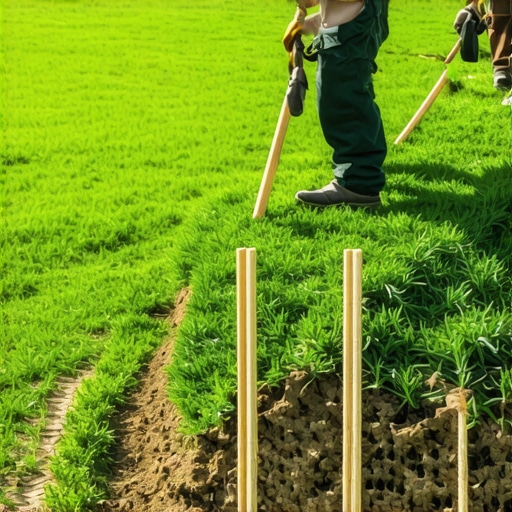
Establishing sod on slopes requires a specialized approach that prioritizes mechanical anchoring and subsurface friction to counteract gravitational pull and water runoff velocity. By using biodegradable stakes or sod staples, you create an immediate physical bond that holds the turfgrass in place while the roots penetrate the compacted subgrade. It is vital to understand that 2026 sod technology focuses heavily on rhizomatous development, meaning the grass is bred to spread horizontally, but that takes time. Until those roots weave into the earth, your stakes are the only thing preventing a catastrophic slide. Don’t skip them. It is cheaper to buy five hundred stakes than to buy five thousand square feet of replacement sod.
“Surface stabilization on slopes greater than 3:1 requires immediate mechanical intervention to prevent rill erosion and mass wasting of the vegetative layer.” – USDA Soil Conservation Service Manual
How do you keep sod from sliding down a hill?
To prevent sod displacement on steep inclines, you must use a staggered ‘brick’ laying pattern and drive sod anchors at a 45-degree angle against the slope. This configuration increases tensile strength across the entire installation, ensuring that each piece of landscaping turf supports its neighbor. I tell my crews that if they can’t jump on the sod without it moving, it isn’t anchored well enough. We use roughly 2 to 3 stakes per square yard on moderate grades, increasing to 5 stakes on anything approaching a 2:1 slope.
Preparation: The Invisible 80 Percent
Before a single pallet of 2026 sod arrives, the yard cleanup must be surgical. You aren’t just raking leaves; you are clearing every piece of organic debris that could create a void space under the sod. If there is a layer of old thatch or loose mulch, the new roots will hit that ‘dead zone’ and stop. They won’t reach the actual soil, and your sod will die of thirst despite your best irrigation efforts. I use a power rake to expose the raw, mineral soil. This is where you test your soil pH. If you are sitting at a 5.5 and you need a 6.5, you apply your lime now, not later. Once that sod is pinned down, your ability to move soil amendments into the root zone drops by 90 percent.
| Slope Gradient | Anchoring Requirement | Stake Frequency | Recommended Sod Type |
|---|---|---|---|
| 0-10 Degrees | Friction Only | 0 per sq/yd | Standard Turf |
| 11-25 Degrees | Light Staking | 1-2 per sq/yd | Rhizomatous Tall Fescue |
| 26-45 Degrees | Heavy Anchoring | 3-5 per sq/yd | Bermuda or Hybrid Zoysia |
| 45+ Degrees | Geogrid Required | N/A (Engineering Required) | Native Grasses / Riprap |
The 2026 Sod Install Protocol: Step-by-Step
The 2026 sod install method starts at the bottom of the hill. You must establish a ‘base course’ of sod that acts as a physical header for the rows above it. If you start at the top, the weight of the upper rows will push the lower ones down the hill during the install. It is basic structural loading. As you work your way up, you must use biodegradable wood stakes—avoid the cheap plastic ones that shatter under a hammer. These stakes should be 6 to 8 inches long to ensure they penetrate past the loose topsoil and into the harder parent material below. This provides the necessary pull-out resistance.
- Initial Grading: Eliminate any ‘birdbaths’ or depressions where water can pool and cause localized soil liquefaction.
- Moisture Prep: Lightly dampen the soil. Applying sod to bone-dry, hydrophobic clay is a death sentence.
- The Vertical Seam Rule: Never align vertical seams between rows. This creates a ‘runway’ for water to pick up speed and erode a trench.
- Tamping/Rolling: Use a water-filled roller. If the sod doesn’t have 100% contact with the dirt, the roots will air-dry and the plant will go dormant.
How long do sod staples stay in the ground?
Most biodegradable sod stakes are designed to maintain mechanical integrity for 6 to 12 months, which is the critical window for root establishment. By the time the stakes break down into organic matter, the 2026 turf varieties have developed a deep, interlocking root matrix that provides natural slope stabilization. In colder climates, the freeze-thaw cycle can push metal staples out of the ground (heaving), which is why I prefer 8-inch wooden stakes that ‘grip’ the soil profile more effectively. Don’t pull them out. Let nature take them.
Irrigation Logistics on Sloped Terrain
Managing irrigation on a slope is a nightmare for the uninitiated. Water follows the path of least resistance, which means the top of your hill will be dry while the bottom is a swamp. To combat this, you must use cycle-and-soak programming. Instead of running a zone for 20 minutes, you run it for 4 minutes, wait 30 minutes for the water to infiltrate the pore space, and repeat this 5 times. This prevents surface runoff from undermining your new landscaping work. If you see water running off the surface, stop. You’ve reached the infiltration capacity of the soil.
“Water management on inclines must account for the localized increase in evapotranspiration and the gravitational migration of the water column within the soil profile.” – International Certified Paver & Hardscape Institute
The Maintenance Reality
Once the sod is pinned and watered, the work isn’t done. You need to monitor for soil shrinkage. In the first 14 days, the sod pieces may shrink slightly, opening up gaps. Fill these gaps with a 50/50 mix of topsoil and sand immediately. If you leave those gaps open, the wind will get under the sod and dry out the roots from the side. It will rot. It’s a binary outcome: either the roots hit the dirt in the first 72 hours, or you’re just growing expensive compost. Avoid mowing for at least 3 weeks. You want maximum photosynthetic surface area to drive energy down into the roots. When you finally do mow, set the blade at the highest setting. Scalping a new slope is the fastest way to kill the vegetative cover and start the erosion process all over again.