
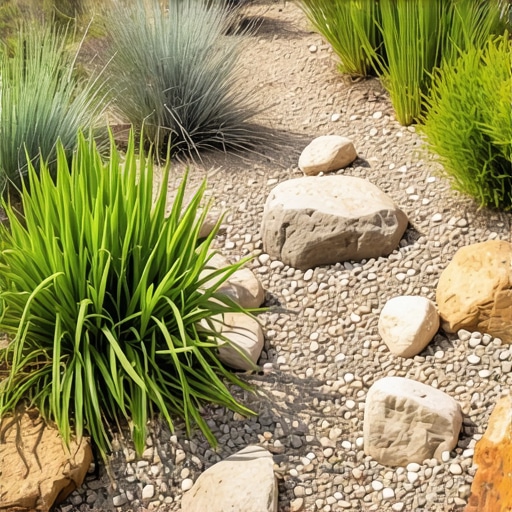
Why Most Rock Gardens Fail by Year Three
Drought-proof rock gardens fail primarily due to poor soil grading, improper geotextile selection, and a lack of sub-surface drainage engineering. To succeed in 2026, you must treat your yard as a hydraulic system where water is directed to deep-root zones rather than allowed to evaporate or pool on the surface. Don’t let a sales rep tell you differently. I recently got called out to tear up a $30,000 patio and rock garden that was sinking because the previous contractor skipped the compaction phase and used cheap plastic liners instead of woven geotextile. The soil turned into a anaerobic soup, the stones migrated three inches into the mud, and the expensive perennials literally suffocated at the root. It was a $30,000 lesson in why physics always wins. If you don’t fix the soil grading first, every plant you put in the ground is just expensive compost. You need to understand the bulk density of your soil before you ever drop a single ton of river rock.
Tip 1: Engineer the Sub-Base for Maximum Drainage
Proper rock garden engineering requires a sub-base excavation of at least 4 to 6 inches, followed by a 2% slope away from all residential structures to prevent hydrostatic pressure buildup. This ensures that seasonal rains infiltrate the lower soil horizons rather than causing surface erosion. I see too many guys just throwing rocks over weeds. That is not landscaping; that is littering. You need to strip the turf, check your soil pH, and address compaction. If your soil is heavy clay, you are looking at a percolation rate of less than 0.5 inches per hour. That is a recipe for a swamp. I use a jumping jack tamper to ensure the sub-grade is solid. The stone should not be the structural element; the earth beneath it is.
“A retaining wall doesn’t fail because of the stone; it fails because of the water trapped behind it.” – Hardscape Engineering Axiom
How much modified gravel do I need for a patio base?
For a standard pedestrian-grade rock garden or patio base, you calculate the volume by multiplying the square footage by the depth (usually 0.33 feet for 4 inches) and dividing by 27 to get cubic yards. Then, multiply by 1.5 to account for compaction density of 21A or 3/4-inch modified gravel. Precision is the difference between a project that lasts and one that heaves during the first freeze-thaw cycle.
Tip 2: Select Stones Based on Thermal Mass and Porosity
Selecting landscape stone for 2026 requires balancing albedo effects (heat reflection) with thermal mass to ensure that your drought-tolerant plants aren’t scorched by radiant heat during 100-degree afternoons. Darker stones like lava rock or basalt trap heat and can raise soil temperatures by 15 degrees, effectively cooking your root systems. I prefer decomposed granite or light-colored river rock. These materials allow for better gas exchange in the rhizosphere.
“Xeriscaping is not just ‘zero-scaping’; it is the strategic management of soil moisture and plant physiology.” – Texas A&M AgriLife Extension
| Material | Drainage Rate | Heat Retention | Ideal Use |
|---|---|---|---|
| Decomposed Granite | High | Moderate | Pathways/In-fill |
| River Rock (1-3″) | Very High | Low | Drainage Swales |
| Lava Rock | Moderate | High | Fire Pits/Accents |
| Bull Rock | Very High | Low | Structural Borders |
Tip 3: The Death of the Plastic Weed Barrier
Geotextile fabric selection must prioritize water permeability and gas exchange over simple weed suppression to maintain soil microbiology and prevent root rot in arid landscapes. Stop buying that black plastic junk from big-box stores. It does not stop weeds; it only stops oxygen. Weeds grow in the dust that settles on top of the fabric. Use a non-woven needle-punched geotextile with a flow rate of at least 90 gallons per minute per square foot. This keeps the stone from sinking into the soil while letting the earth breathe. If the soil dies, your plants die. It is that simple. I have excavated yards where the plastic barrier created a perched water table, killing every native shrub the homeowner spent thousands on. Don’t be that guy.
Tip 4: Smart Irrigation and the 1-Inch Rule
Drought-proof irrigation for rock gardens should utilize pressure-compensating drip emitters buried beneath the rock layer to deliver water directly to the root flare while minimizing evaporative loss. While the internet tells you to water every day, turf grass and rock garden perennials actually need deep, infrequent watering—exactly 1 inch per week—to force roots to chase the water down. This hydrotropism creates a resilient plant. If you shallow-water, your roots stay near the surface where the heat is highest. One 45-minute soak is worth five 10-minute mists. Set your smart controller to a cycle-and-soak program to prevent run-off. Your sod install or rock garden will thank you when the 2026 water restrictions hit.
What is the best rock size for a drought-proof garden?
The optimal rock size for moisture retention and weed suppression is a 1-inch to 3-inch diameter stone, as this size provides enough interstitial space for airflow while being heavy enough to prevent wind erosion. Smaller gravel, like pea gravel, tends to migrate and offers less structural stability for arid-adapted plantings.
Tip 5: Managing Root Flares and Mulch Volcanoes
Arboricultural standards dictate that the root flare—the point where the trunk expands into the root system—must remain visible above the stone and soil line to prevent phloem necrosis and fungal pathogens. I see it every day: mulch volcanoes and rock piles 6 inches deep against the bark. This is a death sentence. It traps moisture against the trunk, causing the bark to rot and inviting borers. When installing your rock garden, keep the stone at least 3 inches away from the base of any woody plants. Use a coarse sand or fines near the trunk if you must, but never heavy stone. Your yard cleanup should include checking these levels annually. [image placeholder]
- Call 811 for utility marking before any excavation.
- Perform a soil ribbon test to determine clay vs. sand content.
- Apply a pre-emergent herbicide before laying the geotextile.
- Use polymeric sand for any structural joints in hardscaping.
- Inspect drip emitters for calcium buildup every six months.