
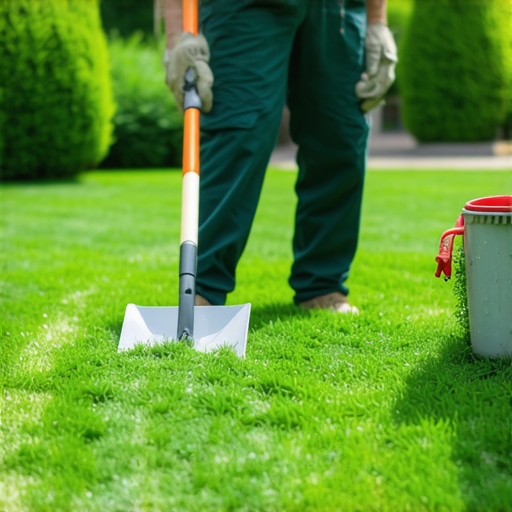
The Foundation of High-Performance Turf
Starter phosphorus is the critical catalyst for root initiation in new sod because it facilitates adenosine triphosphate (ATP) production, providing the necessary energy for cellular division and rhizome expansion. Unlike highly mobile nitrogen, phosphorus remains immobile in the soil matrix, necessitating precise application within the rhizosphere during the initial 2026 planting phase to avoid transplant failure and ensure long-term turf durability.
I always drill into my new crew members: if you don’t fix the soil grading first, every plant you put in the ground is just expensive compost. I remember a job in the spring where a homeowner spent twelve thousand on premium Kentucky Bluegrass sod but refused the soil prep. They laid it over a compacted subgrade that had the density of a highway shoulder. No amount of starter phosphorus can save a lawn where the roots are hitting a brick wall four inches down. We had to rip it all up, till in the proper amendments, and start from the dirt. It is a hard lesson, but biology doesn’t care about your budget or your timeline. The dirt always wins. If you don’t respect the soil structure, you are just throwing money into a woodchipper. Landscaping is civil engineering with a biological component. You have to think about bulk density, pore space, and nutrient availability before you ever unroll a single piece of turf.
The Ground-Up Build: Pre-Installation Engineering
Successful 2026 sod installation begins months before the first pallet arrives on-site with a comprehensive soil analysis and grading plan. You aren’t just laying down a carpet; you are integrating two different biological systems. The ‘interface’ between the sod farm’s soil and your yard’s native soil is where 90% of failures occur. If the textures are too different, water will not move across the boundary, a phenomenon known as a perched water table. This leads to root rot or total desiccation.
“Phosphorus is essential for early root growth and is most effective when incorporated into the top 2 to 4 inches of the soil profile before seeding or sodding, as it moves very little from the point of application.” – Penn State Center for Turfgrass Science
Check your grading. A 1% to 2% slope away from the foundation is mandatory. We use laser levels to ensure there are no birdbaths. If water stands for more than two hours after a rain, your sod will die. Period. Once the grade is set, you need to address the chemical composition. Most ‘new’ construction sites are stripped of topsoil, leaving behind high-alkaline subsoil that locks up nutrients. You need a starter fertilizer with a high middle number (Phosphorus) to overcome this initial deficit. For 2026, we are looking at precision delivery systems that target the root zone rather than broadcast spreading that risks runoff into municipal storm drains.
How much phosphorus do I need for new sod?
For most 2026 sod installations, an application rate of 1.0 to 1.5 pounds of actual phosphorus (P2O5) per 1,000 square feet is the standard engineering benchmark. This should be applied as a starter fertilizer with a ratio like 10-20-10 or 12-24-14, ensuring the nutrient density is highest at the soil-to-root interface to promote rapid anchoring.
[IMAGE_PLACEHOLDER]
2026 Nutrient Management Matrix
The following table outlines phosphorus requirements based on soil texture and existing nutrient levels. This is not a suggestion; it is a calculated requirement for professional-grade results.
| Soil Composition | Phosphorus Retention | Recommended P Ratio | Application Depth |
|---|---|---|---|
| Heavy Red Clay | High (Locked) | 18-24-6 | Surface + 1 inch till |
| Sandy Loam | Very Low | 10-20-10 | Liquid Drench |
| Compacted Silt | Moderate | 12-24-14 | Pre-install granular |
| Glacial Till | Variable | 15-15-15 | Sub-grade incorporation |
Notice the difference in application methods. In sandy soils, phosphorus leaches faster than most people realize. You can’t just dump a bag of big-box ‘Green-Up’ and expect a 20-year lawn. You need slow-release polymers that protect the phosphorus from binding with iron or aluminum in the soil. This is why we charge more than the guy with a pickup truck and a rake. We are managing the chemistry of your land.
Can I apply phosphorus to sod after it is laid?
While you can apply phosphorus after installation, it is highly inefficient because phosphorus is immobile and will not migrate down to the root zone effectively through the thatch layer. For maximum bioavailability, phosphorus must be mechanically incorporated into the soil prior to laying the sod or applied as a highly soluble liquid immediately during the first irrigation cycle.
The Irrigation and Hydrostatic Factor
Once the phosphorus is in the ground and the sod is down, the clock starts. You have about 15 minutes before the roots begin to experience osmotic stress. In 2026, we utilize smart irrigation controllers linked to local weather stations, but the initial ‘soak-in’ phase remains manual and critical. You need to apply enough water to saturate the sod and the top two inches of the native soil. This creates a ‘bridge’ for the phosphorus ions to move into the root hairs.
“A retaining wall doesn’t fail because of the stone; it fails because of the water trapped behind it.” – Hardscape Engineering Axiom
The same logic applies to your yard cleanup and drainage. If your irrigation system is dumping 2 inches of water on a grade that doesn’t move, you are creating a swamp. We see this all the time with yard cleanup ‘pros’ who blow leaves into the French drains. If the drain is clogged, the water backs up, the soil goes anaerobic, and the phosphorus becomes chemically unavailable to the plant. The roots literally drown in the nutrients they need.
2026 Post-Installation Checklist
- Utility Marking: Always call 811. Do not assume your irrigation lines or gas pipes are deep.
- Soil pH Correction: Target a pH of 6.5. Phosphorus is most available in this range.
- Rolling: Use a water-filled roller to ensure 100% contact between sod and soil. No air pockets.
- First Mow: Wait until the roots have ‘tacked’ down. Tug on a corner; if it lifts, don’t mow.
- Micro-Nutrient Boost: In late 2026, supplement with iron and manganese to maintain color without excessive top-growth.
Maintenance and Long-Term Stability
By day 30, your sod should be anchored. This is when the hacks disappear, and the real work begins. You need to transition from frequent, shallow watering to deep, infrequent cycles. This forces the roots to hunt for moisture at deeper levels, where the phosphorus you incorporated earlier is waiting. A lawn that is ‘trained’ to expect water every morning will never develop the root architecture needed to survive a heatwave. We aim for one inch of water per week, delivered in two heavy sessions. This is how you build a resilient ecosystem, not just a pretty picture for the HOA. Yard cleanup in the fall should be meticulous. Do not let organic debris mat down over the new turf. It blocks sunlight and creates a breeding ground for Pythium blight. Keep it clean, keep it fed, and keep the water moving. That is the only way to protect your 2026 investment.