
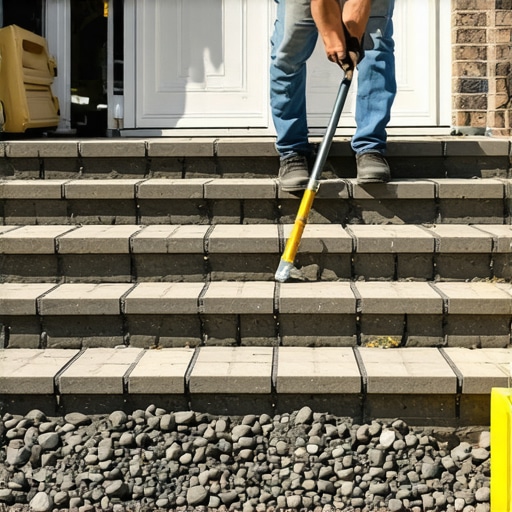
That sickening grind of concrete on concrete is the sound of a structural failure waiting to happen. If you walk onto your front porch and feel your paver steps shift or notice a 1-inch gap forming between the riser and the tread, you are witnessing the physics of poor drainage and inadequate soil compaction. It is not just an eyesore; it is a liability. For twenty years, I have been cleaning up the messes left by contractors who treat landscaping like a decorating project rather than a civil engineering one. Most people think yard cleanup means raking leaves, but in my world, it means excavating the failures of the ‘mow-and-blow’ hacks who don’t know the difference between 21A modified stone and playground sand.
The Anatomy of a Hardscape Failure
Sinking paver steps fail because of the invisible forces of hydrostatic pressure and the lack of a properly engineered sub-base. When water enters the joints of a step system, it must have a clear path to exit; if it gets trapped, it liquefies the bedding layer, causing the units to tilt. I recently got called out to tear up a $30,000 patio that was sinking because the previous contractor used pea gravel for the base instead of a compactable aggregate. Within two years, the round stones acted like ball bearings, shifting under every footstep until the entire structure settled four inches into the clay. This is a classic example of why the ‘cheapest bid’ usually costs the most in the long run.
“A retaining wall doesn’t fail because of the stone; it fails because of the water trapped behind it.” – Hardscape Engineering Axiom
How much modified gravel do I need for a patio base?
To calculate the required modified gravel for a stable landscaping project, you must account for a minimum 6-inch compacted depth for walkways and an 8-to-12-inch depth for steps and landings. You multiply the square footage by the depth in feet, then multiply by 1.35 to account for the compaction factor of the aggregate. Never guess. Don’t skip the math. If you don’t hit the required 98% Proctor density, the ground will reclaim your work. It is inevitable.
The Gravel Hack: Open-Graded Aggregates (OGA)
The ‘hack’ that the pros use to stop 2026 paver steps from sinking isn’t a secret chemical—it’s the transition from traditional dense-graded bases to Open-Graded Aggregates (OGA). While standard 21A or CR-6 modified stone relies on a mix of dust and stone to create a solid mass, it is susceptible to frost heave and saturation. OGA, specifically #57 stone wrapped in a non-woven geotextile fabric, provides 40% void space. This allows water to move through the base vertically and horizontally without washing out the fines. It is the gold standard for irrigation management under hardscapes.
| Material Type | Compaction Required | Drainage Capability | Primary Use Case |
|---|---|---|---|
| 21A / CR-6 Modified | 95-98% Proctor | Low (Frost Susceptible) | Driveways, Heavy Traffic |
| #57 Clean Stone (OGA) | Self-compacting (vibratory) | High (Rapid Shedding) | Retaining Walls, Steps |
| Screened Topsoil | Zero | Moderate | Sod Install, Planting |
| Polymeric Sand | NA | Surface Only | Joint Stabilization |
Why does my sod install affect my paver steps?
If your sod install was performed with a heavy grade toward the house, you are funneling thousands of gallons of runoff directly into the base of your steps. A proper yard cleanup involves checking the pitch of the soil; it should fall at least 2 inches for every 10 feet away from the foundation. When you install new turf, many homeowners over-water to help the roots take. If your irrigation heads are spraying the base of your stone steps, you are effectively pressure-washing the sub-base out from under the pavers. Stop doing it. Redirect the heads.
“Proper sub-surface drainage is the single most critical factor in the longevity of segmental retaining walls and step systems.” – ICPI Tech Spec #2
The Step-by-Step Remediation Process
- Excavate the Failure: Remove all sinking units and dig down at least 12 inches into the native subgrade. Remove any organic material. It will rot.
- Filter Fabric: Lay down a 4-ounce non-woven geotextile. This separates the stone from the soil, preventing the base from ‘disappearing’ into the clay over time.
- The OGA Base: Fill with #57 clean angular stone in 4-inch lifts. Use a plate compactor on each lift. The machine should literally bounce off the stone when it is locked in.
- Setting Bed: Use a 1-inch layer of #8 or #9 stone (clean chips). Do not use sand. Sand holds water and attracts ants.
- Structural Adhesive: Use a high-quality polyurethane hardscape adhesive. Cheap ‘liquid nails’ will brittle and crack in the freeze/thaw cycle.
How do I stop weeds from growing in my paver steps?
Weeds in pavers don’t usually grow from the bottom up; they grow from the top down when organic matter collects in the joints. A thorough yard cleanup and the application of high-performance polymeric sand are the only solutions. This sand hardens like mortar but remains flexible. It blocks the ‘soil’ from forming in the cracks. Keep your irrigation from soaking the joints constantly, or you’ll grow moss regardless of what you do. Biology always wins if you provide the water.
The Micro-Climate Factor
In regions with heavy clay, like the Southeast or the Midwest, the ‘shrink-swell’ capacity of the soil is your greatest enemy. During dry summers, the clay shrinks, creating voids. During wet springs, it expands, pushing the steps upward. This is why a deep gravel base is non-negotiable. If you live in an area with a deep frost line, your steps need to be ‘floating’ on a bed of gravel that can shift without cracking. I see people trying to ‘fix’ sinking steps by pouring concrete over the dirt. That is a fool’s errand. The concrete will crack within one season. Stick to the gravel hack. It works because it respects the laws of physics. “,”image”:{“imagePrompt”:”A detailed cross-section diagram of a paver step installation showing the soil, non-woven geotextile fabric, #57 clean stone base, and the paver unit on top, labeled with technical engineering terms.”,”imageTitle”:”Proper Paver Step Sub-Base Engineering”,”imageAlt”:”Diagram showing the correct gravel layers for fixing sinking paver steps.”},”categoryId”:0,”postTime”:””}