
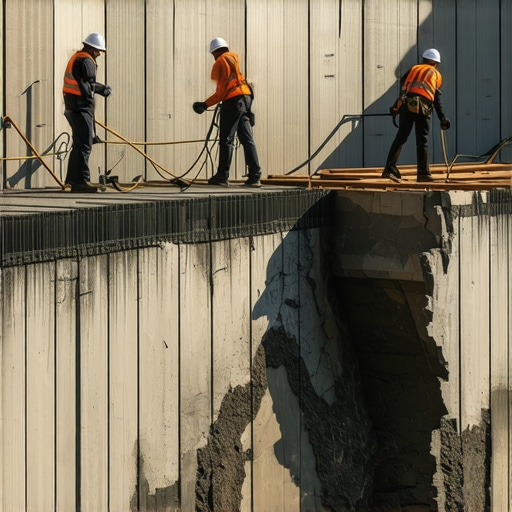
The Anatomy of a Failing Wall: A Forensic Autopsy
I recently got called out to tear up a $60,000 segmental retaining wall that was bowing like a ship’s sail under the weight of a rain-soaked hillside. The homeowner was baffled. They’d paid for ‘top-tier’ pavers, but the contractor skipped the one thing that actually matters: the physics of soil reinforcement. Most guys in this business are just glorified bricklayers who don’t understand that a wall is a structural dam, not a decoration. When you see a horizontal crack or a leaning block in 2026, you aren’t looking at a stone problem; you’re looking at a soil failure. It is a lack of tensile strength in the backfill. It will fall. It is only a matter of when.
How do you fix retaining wall cracks with geo-grid?
Fixing 2026 retaining wall cracks requires excavating the backfill to the depth of the failure, installing high-tenacity polyester geo-grid layers to reinforce the soil mass, and replacing heavy clay with clean, angular aggregate. This process creates a coherent gravity mass that resists lateral earth pressure and eliminates hydrostatic build-up.
The Physics of Hydrostatic Pressure and Soil Failure
Every square inch of soil behind your wall exerts pressure. When that soil gets saturated with water—common in poorly managed irrigation zones—the weight doubles. This is hydrostatic pressure. Most walls fail because they were built as ‘gravity walls’ (relying only on their own weight) when they should have been ‘reinforced walls’ using geo-grid.
“A retaining wall doesn’t fail because of the stone; it fails because of the water trapped behind it.” – Hardscape Engineering Axiom
The crack you see is the wall screaming that it cannot hold the surcharge. If you just patch the crack with mortar, you’re putting a band-aid on a gunshot wound. You have to get behind the wall and fix the engineering. This involves a total yard cleanup of the failed material and a hard reset of the structural base.
Why Geo-Grid is Non-Negotiable in 2026
Geo-grid is a high-strength geosynthetic material used to reinforce soils and similar materials. In my 20 years, I’ve seen 3-foot walls crumble because they lacked a $100 roll of grid. The grid works through ‘interlock.’ When you compact aggregate over the grid, the stones lock into the apertures (the holes in the grid), creating a reinforced ‘mattress’ of soil. This mattress is far harder to push over than a stack of loose blocks. You are essentially turning the earth itself into a structural component. Don’t skip this.
How much modified gravel do I need for a patio base or wall foundation?
For a standard retaining wall foundation, you need 6 inches of compacted 2A modified stone for the base, plus 12 inches of clean 57 stone for the drainage chimney behind the blocks. To calculate the volume, multiply the length by the width by the depth in feet, then divide by 27 to get cubic yards. Add a 20% compaction factor to your final number.
Material Comparison: Biaxial vs. Uniaxial Geo-Grid
| Feature | Uniaxial Geo-Grid | Biaxial Geo-Grid | Woven Geotextile (Bad for Walls) |
|---|---|---|---|
| Primary Strength | One Direction (Roll Length) | Both Directions | Surface Tension Only |
| Best Use Case | High Retaining Walls (>4ft) | Patios and Low Walls | Weed Barrier (Waste of Time) |
| Interlock Quality | High (Aggregates lock in) | High (Aggregates lock in) | Low (Slips) |
| Tensile Strength | Very High (Up to 4000 lbs/ft) | Moderate (Up to 2000 lbs/ft) | Low |
The Step-by-Step Remediation Protocol
If you have cracks, you follow this protocol or you prepare to do it again in three years. First, mark all utilities via 811. Second, dismantle the wall down to the course below the crack. You cannot fix this from the front. Third, excavate the ‘retained zone’ behind the wall. This is usually a distance equal to the height of the wall. Fourth, check your base. If the base has settled even 0.5 inches, the wall will lean.
- Excavate: Remove all native clay or silty soil from the reinforcement zone.
- Leveling Pad: Ensure the base is 98% Proctor density compaction.
- Grid Placement: Lay the geo-grid over the block, extending into the soil. It must be pulled taut. No wrinkles.
- Drainage Chimney: Use clean 1-inch angular stone. Never use round river rock. Round rock rolls like ball bearings.
- Compaction: Compact in 6-inch lifts. If you do 12-inch lifts, the middle won’t compact. It will settle.
How deep should I bury my retaining wall for stability?
The rule of thumb for 2026 engineering standards is one inch of bury for every foot of wall height, with a minimum of 6 inches. If you are building on a slope, you must increase this depth to prevent ‘toe failure.’ A wall is only as strong as the dirt it is sitting in. If the ‘toe’ of the wall slides, the whole system collapses.
“Geo-grid reinforcement creates a coherent gravity mass by interlocking with the aggregate, effectively increasing the soil’s internal friction angle.” – NCMA Design Manual
This is not a suggestion. It is physics.
Common Failures in Sod Install and Irrigation Near Walls
I see it every day. A guy builds a perfect wall, then the sod install crew comes in and puts a heavy irrigation line 12 inches behind the cap. Two years later, a pipe leaks, saturates the backfill, and the hydrostatic pressure blows the wall out. If you are installing irrigation, it must be set back from the wall’s ‘influence zone.’ Additionally, when doing a yard cleanup, never pile mulch or soil higher than the wall was designed for. This is called ‘surcharge loading.’ It adds weight the engineer didn’t account for. The wall will bulge. You will regret it.
The 2026 Sustainability Mandate: Soil Micro-Biology and Drainage
While we focus on the engineering, don’t ignore the biology. Use a non-woven geotextile fabric to separate your clean stone from the native soil. This prevents ‘fines’ (tiny dirt particles) from clogging your drainage. If the water can’t get out of the weep holes, the grid eventually won’t matter. The wall will hydraulicly fail. Keep it clean. Keep it dry. Build it once. If you’re hiring a contractor and they don’t own a plate compactor or a laser level, fire them immediately. They are hacks. You want a foreman with calloused hands and a transit level, not a guy with a shovel and a ‘gut feeling.’ Precision is the only thing that lasts in the dirt. No exceptions.