
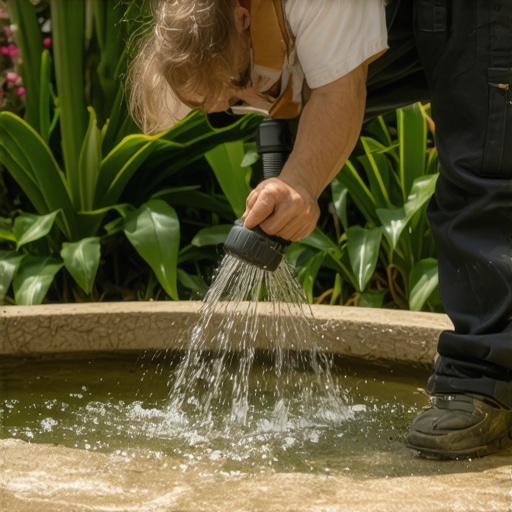
The Anatomy of a Failed Water Feature
Garden fountain repair requires understanding head height, gallons per hour (GPH), and submersible pump mechanics. Fixing a failing feature with a $20 pump is possible if you accurately calculate the vertical lift and ensure the power source is grounded via a GFCI outlet to prevent electrical failure in your landscaping environment.
I recently got called out to tear up a $30,000 patio that was sinking because the previous contractor failed to manage the water spillover from a custom fountain. The hydrostatic pressure turned the base into soup. It was a mess. The homeowner thought it was just a small leak, but the soil was saturated for six inches below the modified gravel base. This is what happens when you ignore the engineering behind water movement. You cannot just drop a pump in a basin and hope for the best. You have to account for the physics of water weight and the integrity of the surrounding sod install. If the water doesn’t stay in the pipes, the ground will swallow your investment. It is that simple.
“A retaining wall doesn’t fail because of the stone; it fails because of the water trapped behind it.” – Hardscape Engineering Axiom
How much water flow do I need for a 3-tier fountain?
To determine the correct GPH rating for a multi-tiered feature, you must measure the vertical distance from the pump to the highest outlet and multiply the weir width by 100 per inch of water. Standard irrigation principles apply here; if the pump is under-sized, the water will barely trickle, leading to algae growth and mosquito breeding in stagnant pools. Most $20 pumps are rated for 200 to 400 GPH, which is sufficient for small 24-inch features but will fail miserably on larger landscaping installs. Check the curve chart on the box. Don’t guess.
The Forensic Diagnosis of Pump Failure
Identifying why a submersible pump failed is the first step in a successful yard cleanup and restoration project. Most pumps die due to impeller blockage, calcium scale build-up, or dry-running, which melts the internal seals and shorts the motor windings within the resin-filled housing. If you hear a hum but see no water, the impeller is jammed. If there is dead silence, the thermal fuse probably blew. This often happens during the transition to 2026 weather patterns where unexpected heat spikes evaporate basin water faster than homeowners anticipate. Use an auto-fill valve. It saves pumps.
| Pump Spec | Typical $20 Model | Commercial Grade | Impact on Feature |
|---|---|---|---|
| GPH @ 0ft | 250 – 350 | 800+ | Total flow volume |
| Max Head Height | 4 – 6 feet | 12 – 20 feet | Vertical lift capability |
| Warranty | 90 Days | 3 – 5 Years | Long-term reliability |
| Cord Length | 6 feet | 20+ feet | Installation safety |
Can a $20 pump really handle a large basin?
A budget pump can only handle large basins if the vertical lift is minimal and the goal is simple circulation rather than a high-volume waterfall. For irrigation efficiency, you want to move the entire volume of the basin once every hour; if your basin holds 50 gallons, a small pump is fine, but for a 200-gallon pond, you need more muscle. Small pumps lack the torque to push water through 1/2-inch tubing over long distances due to friction loss. Every elbow joint in your plumbing adds roughly one foot of effective head height. Calculate it properly. Don’t skip this step.
The Step-by-Step Restoration Protocol
Executing a fountain repair during a yard cleanup requires a methodical approach to ensure the new pump doesn’t meet the same fate as the old one. Start by draining the feature entirely and scrubbing the basin with a stiff brush to remove biofilm and mineral deposits. Check the electrical conduit for any signs of wear; squirrels love to chew on pump cords, and a nicked wire is a death sentence for your GFCI. Replace the old tubing if it is brittle or kinked. A $20 pump often comes with multiple adapters; choose the largest one that fits your tubing to reduce backpressure on the motor.
- Unplug the power and drain the basin completely using a wet-vac.
- Inspect the internal plumbing for calcium carbonate deposits.
- Flush the lines with a high-pressure hose to clear debris.
- Level the pump using shims if the basin floor is uneven.
- Install a pre-filter sponge to protect the impeller from grit.
“The hydraulic conductivity of the soil surrounding a water feature dictates the longevity of the adjacent hardscape.” – Agricultural Extension Bulletin
Engineering the Surroundings: Sod and Drainage
When you fix a fountain, you must also look at the sod install around the base to ensure the irrigation system isn’t over-saturating the area. Excessive splash-out from a poorly calibrated pump will rot tall fescue or bermuda grass within weeks, leading to a muddy mess that undermines the fountain’s foundation. During your landscaping phase, ensure the grade slopes away from the feature at a minimum of 2%. If the ground is flat, you need a French drain or a hidden gravel skirt to catch the overspray. Water is a solvent; it will find a way to destroy your work if you don’t give it a path. Precision matters. Your lawn depends on it.