
Fixing 2026 Sod Peeling: The Soil Scarification Secret
You pull up to a job site and the homeowner is frantic. They spent five figures on a sod install last month, and now they can literally grab a corner of the turf and peel it back like a cheap bathroom rug. It is brown, it is heavy, and it is dying. Most hacks will tell the client they just need to water it more. They are wrong. This is a mechanical failure at the soil-to-root interface. As a professional, I can tell you exactly why this happened: your contractor treated your yard like a floorboard instead of a living biological system. They skipped soil scarification, and now the roots are suffocating in a perched water table.
Why Your New 2026 Sod Is Peeling Up Like Old Wallpaper
Sod peeling occurs when root systems fail to penetrate the native soil due to surface compaction or a hydrophobic barrier. By failing to perform soil scarification, you create a perched water table that drowns roots and prevents sub-surface anchoring, leading to turf desiccation and eventual systemic failure.
I always drill into my new crew members: if you don’t fix the soil grading and surface texture first, every plant you put in the ground is just expensive compost. Last spring, I had a new hire think he could skip the mechanical prep on a 5,000 square foot Kentucky Bluegrass install. Within three weeks, the homeowner called because the turf was sliding down a three percent grade. When I arrived, I could slide my hand between the sod and the clay. The soil was as smooth as glass. The roots had nowhere to go. We had to rip the whole thing up, scarify the hardpan, and start over at my expense. It was a $7,000 lesson in soil physics that he, and I, will never forget. Don’t be that guy.
“A successful sod installation is 90 percent soil preparation and 10 percent laying the actual product. Without breaking the surface tension of the subgrade, the roots will never leave the peat mat.” – Agronomy Manual for Professional Turf Managers
How do I know if my soil is too compacted for sod?
To determine if soil density is preventing root penetration, perform a screwdriver test or a bulk density sample. If a standard 6 inch screwdriver cannot be pushed into the native soil with moderate hand pressure, your bulk density likely exceeds 1.6 grams per cubic centimeter. This level of compaction is impenetrable for emerging root hairs, which require pore space for oxygen exchange and capillary water movement.
The Science of Soil Scarification and Root Migration
Soil scarification is the process of mechanically fracturing the top 1 to 2 inches of the soil horizon to create macro-pores. When sod is harvested, it comes with a thin layer of farm soil, usually high in organic matter like peat or muck. If you lay that highly porous mat onto a smooth, compacted clay subgrade, you create a physical barrier. Water will saturate the sod mat but won’t move into the clay. This is called interface tension. The roots stay in the wet mat, never venturing into the dry, hard soil below. Eventually, the mat runs out of nutrients, the water evaporates, and the sod dies because it has no deep-root anchorage.
| Method | Depth of Fracture | Equipment Required | Best Case Use |
|---|---|---|---|
| Manual Raking | 0.25 inches | Steel Bow Rake | Small patches under 100 sq ft |
| Power Raking | 0.75 – 1.0 inches | Mechanical Dethatcher | Standard residential lawn cleanup |
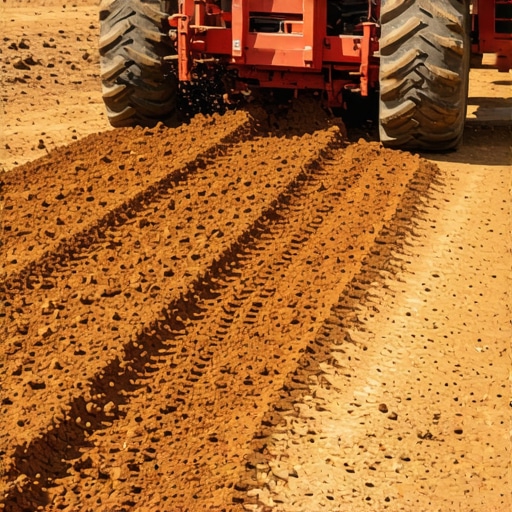
| Harley Raking | 2.0 – 4.0 inches | Skid Steer Attachment | New construction or heavy clay |
| Core Aeration | 3.0 inches | Hollow Tine Aerator | Existing turf with drainage issues |
We use a Harley rake on every landscaping project involving new sod. It doesn’t just level the dirt; it pulverizes the top layer and creates a jagged, receptive surface. Think of it like sanding a piece of wood before you apply glue. You need that mechanical bond. Without it, the sod install is a temporary decoration, not a permanent yard. You must aim for a crumb structure in the soil that allows for gas exchange. Roots need oxygen just as much as they need water.
“Soil compaction reduces the number of large pores, which are essential for water infiltration and air movement. When these are absent, root growth is physically restricted.” – Penn State Extension: Soil Management for Turf
How deep should I scarify before sodding?
You must achieve a fracture depth of at least 1 to 2 inches across the entire installation area to ensure vertical root growth. For heavy clay soils commonly found in new developments, scarification should be combined with soil amendments like calcined clay or compost to prevent the soil from self-sealing after the first heavy irrigation cycle.
The Step-by-Step Recovery for Peeling Sod
If your sod is already peeling, you are in triage mode. You cannot just throw nitrogen at it. You have to fix the substrate. Here is the professional yard cleanup and remediation protocol for a failing sod install. Do not skip these steps or you are wasting your time.
- Stop the Scalping: Raise your mower deck to at least 4 inches. Photosynthesis is the only thing providing energy to those struggling roots.
- Hydraulic Lift: Gently lift the peeling sections and check for grubs or fungus. If the soil underneath is bone dry despite watering, you have a hydrophobic soil issue.
- Liquid Aeration: Apply a surfactant or liquid aerator. This breaks the surface tension of the water, allowing it to penetrate the hardpan.
- Mechanical Spiking: Use a pitchfork or spiking aerator directly through the sod. This is a surgical scarification that creates access channels for roots.
- Top Dressing: Spread a 1/4 inch layer of screened compost over the sod. This adds microbiology and helps the mat bond to the native soil.
Irrigation Logic: Deep and Infrequent
The biggest mistake in irrigation management is the mist-and-run. Watering for 10 minutes every morning keeps the sod mat wet but the subsoil dry. This encourages shallow rooting. To fix peeling sod, you need to force those roots to go looking for a drink. You need exactly 1 inch of water per week, delivered in two heavy sessions. This deep watering saturates the soil profile and draws the roots down through the scarified layer. Use a tuna can to measure your sprinkler output. It is not rocket science; it is civil engineering for your grass.
Check your irrigation heads for head-to-head coverage. If one spot is peeling while the rest is stable, you likely have a pressure drop or a clogged nozzle in that zone. Fix the hydraulics before you blame the grass seed or the sod farm. Most landscaping failures are actually maintenance failures in disguise. It is your job to ensure the soil biology has the infrastructure it needs to thrive.