
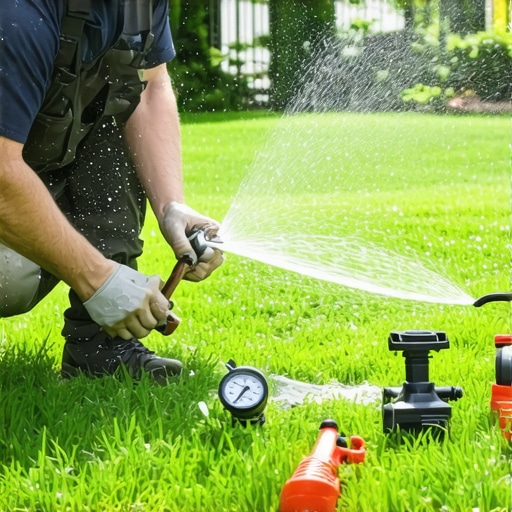
The Anatomy of a Dying Irrigation Zone
To fix low sprinkler pressure, you must determine if the pressure loss is isolated to a single head or a systemic failure across the entire zone. Common culprits include a clogged internal filter screen, a weeping valve diaphragm, or a ruptured lateral line that causes a massive drop in dynamic PSI (pounds per square inch) and GPM (gallons per minute) flow rates.
I always drill into my new crew members: if you don’t calculate your dynamic pressure at the furthest head, every yard cleanup or sod install we do is destined for failure because the grass will be brown before the owner gets their first water bill. Most irrigation systems are designed on the edge of failure. A simple change in municipal water pressure or a bit of sediment can push a functional system into a state of total failure. When I see a zone with heads that won’t pop up, I don’t see a ‘broken’ sprinkler; I see a hydraulic system that has lost its equilibrium. We are dealing with fluid dynamics, not just plumbing. If you have 60 PSI at the street but only 12 PSI at the nozzle, you have a major friction loss issue or a physical obstruction. This isn’t magic; it is physics. Stop looking for a quick fix and start looking for the source of the pressure drop.
“Effective irrigation management requires an understanding of the relationship between pressure and flow; a 10% reduction in pressure can lead to a 20% reduction in water distribution uniformity.” – Texas A&M AgriLife Extension
The Five-Minute Forensic Diagnostic
Start with the most common failure point: the nozzle filter. Unscrew the head or pull up the riser and check the small plastic mesh screen located directly under the nozzle orifice. These screens are designed to catch sediment before it ruins the spray pattern, but they frequently clog with mineral deposits or fine sand. Rinse it out. If the pressure doesn’t return, move to the zone valve. A valve that doesn’t open fully—often due to a faulty solenoid or a tear in the rubber diaphragm—will choke the flow of water before it ever reaches the lateral lines. Check the manual bleed screw. If the zone pops up with full pressure when the manual bleed is turned, your problem is electrical or internal to the solenoid’s plunger. If it still doesn’t pop, you likely have a physical break in the pipe or a massive obstruction. One common issue we see during a fresh sod install is a crushed lateral pipe caused by heavy equipment. The pipe isn’t fully severed, but the internal diameter is reduced to a fraction of its original size, killing the GPM down the line.
How much modified gravel do I need for a patio base?
While the question seems unrelated to irrigation, it highlights the importance of site prep. For a standard 4-inch compacted base, you need approximately 1 ton of modified gravel per 50 square feet. This same engineering mindset applies to irrigation: you need the right volume of water (GPM) to support the pressure (PSI). In 2026, we are seeing more systems utilizing high-efficiency rotary nozzles like the MP Rotator series. These require a consistent 40 PSI at the head to operate correctly. If your pressure drops to 25 PSI, the heads won’t rotate, and you will get localized dry spots that look like fungus but are actually just thirst. Yard cleanup isn’t just about leaves; it’s about checking every head for physical damage after the mowers have passed through.
| Nozzle Type | Optimal Pressure (PSI) | Flow Rate (GPM) | Common Pressure Failure Symptom |
|---|---|---|---|
| Fixed Spray (15H) | 30 | 1.8 – 2.5 | Misting or ‘fogging’ at high pressure; low radius at low pressure. |
| Rotary (MP1000) | 40 | 0.25 – 0.55 | Head fails to rotate or ‘stutters’ during cycle. |
| Impact Rotor | 50 | 3.0 – 5.0 | Internal drive gears fail to trip the return spring. |
The Critical Role of Static vs. Dynamic Pressure
Static pressure is the measurement of PSI when no water is moving. Dynamic pressure is what remains when the zone is actually running. Many homeowners make the mistake of measuring their pressure at an outside hose bib and assuming that 60 PSI will translate to the sprinkler heads. It won’t. Friction loss is the enemy. Every foot of 1-inch PVC pipe, every elbow, and every valve consumes energy. By the time the water travels 100 feet and passes through three 90-degree turns, you might have lost 10 PSI. If your system was designed with 3/4-inch pipe to save a few dollars, that friction loss is doubled. This is why we see ‘low pressure’ in 2026 systems that were installed by low-bid contractors. They didn’t account for the velocity of the water. If the water is moving faster than 5 feet per second inside the pipe, the pressure drop becomes exponential. Don’t be a hack. Use a pressure gauge with a pitot tube to measure the actual pressure at the nozzle while the zone is running. That is the only number that matters.
“Irrigation valves should be sized based on the flow rate of the zone, not the size of the supply pipe, to ensure proper opening and closing speed.” – ICPI Hardscape and Irrigation Standards
Irrigation Maintenance Checklist
- Monthly: Check for ‘donuts’ or dry rings around heads which indicate a clogged nozzle filter.
- Quarterly: Inspect the backflow preventer for leaks or reduced flow; verify the main shut-off is 100% open.
- Bi-Annually: Adjust the arc and radius of all heads to ensure 100% head-to-head coverage.
- Annually: Conduct a catch-can test to verify distribution uniformity (DU).
How to find an irrigation leak underground?
If you have low pressure across one zone but the others are fine, you have a leak. Look for ‘wet spots’ that stay muddy even when the system is off. Often, a leak occurs at the ‘swing pipe’ or ‘funny pipe’ connection where the head meets the lateral line. These are high-stress points. During a sod install, if the soil wasn’t properly compacted around the heads, the first time a heavy mower drives over it, the head will tilt and crack the fitting. It is a slow death for your turf. Fixing this requires excavating the head, cutting out the damaged tee, and installing a new marlex street-ell. It is a ten-minute job that saves a thousand-dollar lawn. Information gain: Most people think a leak always shows up as a geyser. False. A lateral line leak under a thick layer of clay soil will often just manifest as low pressure at the heads, as the water stays trapped in the heavy soil profile, never reaching the surface. You have to listen for the hiss of water underground. It will rot the roots of nearby plants if left unchecked. Get it fixed.