
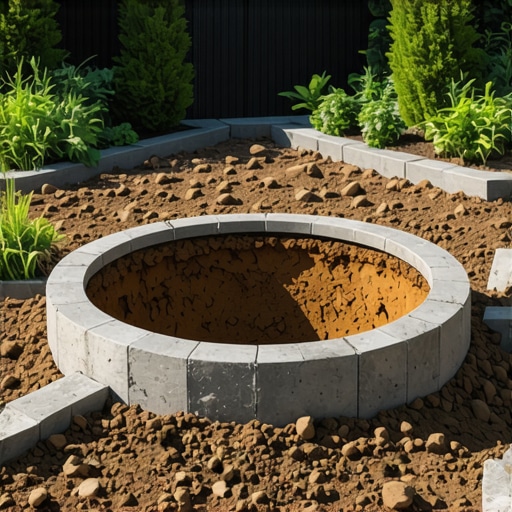
The Physics of Saturated Soils: Why Surface Solutions Fail
A dry well is an underground structural chamber or stone-filled pit designed to collect stormwater runoff and slowly infiltrate it into the local soil. By managing hydrostatic pressure and directing backyard flooding into the subsoil, you prevent foundation damage, erosion, and the anaerobic conditions that kill expensive sod installs and landscaping projects. Surface fixes are just bandages for systemic drainage failures.
The Hardscape Autopsy: A $30,000 Lesson
I recently got called out to tear up a $30,000 bluestone patio that was sinking and heaving like a frozen lake. The previous contractor, a classic mow-and-blow hack, had ignored the 2% grade toward the foundation. They simply laid the pavers on a thin bed of screenings over native clay. When the spring rains hit, the water had nowhere to go. It sat under the patio, saturated the base, and the resulting hydrostatic pressure literally lifted the stones during the freeze-thaw cycle. We had to excavate the entire mess, install a 50-gallon structural dry well, and rebuild the base from the dirt up. Don’t be that guy. If you don’t account for where the water goes, your hardscape is on a countdown to failure.
“A retaining wall doesn’t fail because of the stone; it fails because of the water trapped behind it.” – Hardscape Engineering Axiom
How much modified gravel do I need for a dry well base?
Calculating the modified gravel and drainage stone for a dry well requires a volume-to-void ratio calculation. For a standard 50-gallon structural chamber, you typically need a 12-inch perimeter of 3/4-inch clean crushed stone, which offers a 40% void space for additional water storage. This ensures the well doesn’t just hold water but acts as a distribution hub for the surrounding soil profile.
| Material Type | Storage Capacity (Void Space %) | Infiltration Rate | Best Use Case |
|---|---|---|---|
| NDS Flo-Well (Chamber) | 100% (Inside Chamber) | High | High-volume roof runoff |
| 3/4″ Clean Crushed Stone | ~40% | Medium | Perimeter fill / Small pits |
| Pea Gravel | ~25% | Low | Decorative only (Avoid for wells) |
| AASHTO #57 Stone | ~35-40% | High | Professional drainage layers |
Site Analysis and Soil Porosity Math
Before you touch a shovel, you must perform a percolation test. Dig a hole 12 inches deep, fill it with water, and time how long it takes to drain. If it takes more than 24 hours, you aren’t building a dry well; you’re building a subterranean pond. In heavy clay environments, you may need to increase the well’s surface area or install a series of interconnected wells. We use Darcy’s Law to understand how fluid moves through a porous medium. You are looking for a soil permeability that can handle at least 1 inch of rainfall per hour across your collection area. For every 1,000 square feet of impervious surface (like your roof), a 1-inch rain event generates approximately 623 gallons of water. A single 50-gallon dry well won’t cut it for a whole roof; you need a system.
The Technical Build: Step-by-Step Engineering
1. Excavation: Dig a pit approximately 4 feet deep and 4 feet wide. Ensure you are at least 10 feet from any building foundation to prevent basement seepage. 2. Geotextile Lining: Line the pit with non-woven 4oz or 6oz geotextile fabric. Do not use woven landscape fabric; it lacks the flow-through rate required for drainage. This fabric prevents soil fines from migrating into your stone and clogging the system. 3. Base Layer: Install 6 inches of 3/4-inch clean crushed stone (AASHTO #57). Level it and compact it slightly with a hand tamper. 4. Chamber Placement: Place your structural dry well chamber (like an NDS Flo-Well) in the center. Knock out the side ports for your inlet pipes. 5. Piping: Connect your 4-inch PVC or corrugated irrigation pipe from the downspouts or French drain to the well. Ensure a minimum 1% slope (1/8 inch per foot). 6. Stone Backfill: Fill the space around the chamber with more clean stone. This stone acts as a secondary reservoir. 7. Fabric Wrap: Fold the geotextile over the top of the stone. This is the most critical step. If dirt gets in, the well dies. 8. Soil and Sod: Cap with 6-12 inches of native soil. If you are doing a sod install, ensure the soil is tamped to prevent a depression from forming later.
Why Irrigation and Sod Installation Require Drainage Integration
Many homeowners spend thousands on sod install and a high-end irrigation system, only to wonder why their yard is a swamp. If your irrigation clock is set to run 20 minutes every morning, you are keeping the soil at field capacity. When a storm hits, the soil has zero remaining storage. A dry well acts as an emergency relief valve. During your yard cleanup and seasonal maintenance, check the overflow emitters. If you see silt or debris, your landscaping is eroding into the system. Keep your gutters clean to prevent organic matter from entering the well and fermenting into a thick sludge that seals the soil pores.
How deep should a dry well be for backyard flooding?
A dry well should be deep enough to sit below the frost line to prevent the water from freezing and cracking the chamber or causing ground heave. Typically, a depth of 4 to 6 feet is sufficient for residential backyard flooding, provided the bottom of the well remains above the local water table. In areas with high groundwater, shallow, wide dry wells are safer and more effective than deep pits.
“Infiltration systems must be designed based on the site-specific soil texture and the peak flow rate of the design storm.” – USDA NRCS Engineering Field Handbook
The Post-Installation Checklist
- Verify that all inlet pipes have a consistent downward slope toward the well.
- Install a “pop-up emitter” as an overflow for when the well reaches capacity.
- Ensure the geotextile fabric is overlapping by at least 12 inches at all seams.
- Schedule a yard cleanup to remove leaf litter that could clog the inlet grates.
- Check the well after the first three major rain events to ensure it is draining within 72 hours.
Stop looking at surface water as a landscaping problem and start seeing it as a civil engineering challenge. A well-built dry well is invisible, silent, and the only thing standing between your basement and a disaster. It will save your yard. Don’t skip the stone.