
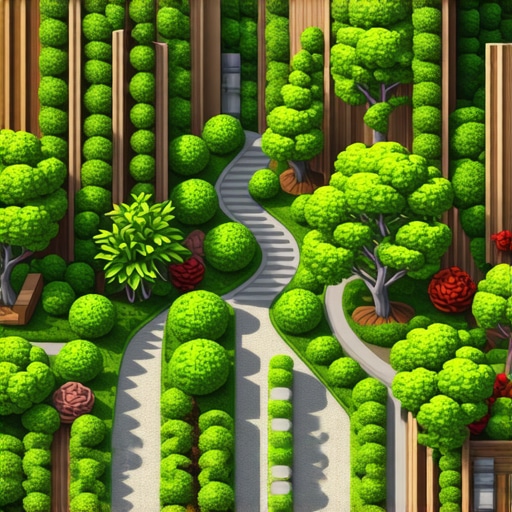
The Planning Phase: Why Site Analysis Dictates Spatial Perception
Designing a small backyard requires a surgical approach to site analysis and topographical grading to manipulate the visual horizon. By utilizing forced perspective, vertical layering, and precision drainage, you can expand the perceived boundaries of a property while ensuring structural integrity and hydrological efficiency across the entire site footprint.
I always drill into my new crew members: if you don’t fix the soil grading first, every plant you put in the ground is just expensive compost. I remember an apprentice who thought he could skip the laser level on a 400-square-foot lot because it ‘looked flat enough.’ Two weeks later, after a three-inch rain event, the client had a standing pond against their foundation and two thousand dollars worth of boxwoods drowning in anaerobic soil. We had to rip it all out. Landscaping is not about decorating; it is about managing gravity and biology. In a small space, mistakes are magnified. A one-inch deviation in grade can be the difference between a functional patio and a swamp. We start with the dirt. We look at the compaction rates, the percolation speed, and the hydrostatic pressure from neighboring lots. If the foundation isn’t right, the finish doesn’t matter.
How much modified gravel do I need for a patio base?
To calculate the required modified gravel for a stable paver base, multiply the square footage by the depth in feet (typically 0.33 feet for a 4-inch base), then divide by 27 to get cubic yards. Add a 20 percent compaction factor to ensure the final sub-base meets ICPI standards.
Hardscape Material Selection: Engineering the Optical Illusion
To make a space feel larger, you must manage visual weight through material geometry and jointing patterns. Small pavers in a tight grid make a space feel like a cage. Large-format slabs, perhaps 24 by 36 inches, reduce the number of visible joints, which tricks the eye into seeing a continuous surface rather than a series of small units. This is fundamental hardscape engineering. The polymeric sand choice also matters; matching the sand color to the stone minimizes the ‘grid effect.’ If you use high-contrast joints, you are drawing a map of how small the yard is. Stop doing that. Use long, linear lines to draw the eye toward a focal point at the furthest property edge.
| Material Type | Typical Dimensions | Visual Impact | Engineering Consideration |
|---|---|---|---|
| Large Format Pavers | 24×36 inches | Expansive, open feel | Requires perfectly leveled 1-inch bedding sand layer. |
| Plank Pavers | 6×24 inches | Directional elongation | Increases perceived depth when laid parallel to sightlines. |
| Natural Flagstone | Irregular | Organic, breaks boundaries | Higher labor cost due to manual stone fitting and leveling. |
| Permeable Pavers | Varies | Functional drainage | Mandatory for high-density lots with strict runoff codes. |
“A retaining wall doesn’t fail because of the stone; it fails because of the water trapped behind it.” – Hardscape Engineering Axiom
Turf and Sod Installation: The Biology of Small Space Carpeting
A successful sod install in a confined area depends entirely on rhizome health and soil gas exchange. In small backyards, air circulation is often restricted by fences and walls, leading to increased humidity and fungal pathogens like Rhizoctonia solani. You cannot just throw down some Kentucky Bluegrass and hope for the best. You need to ensure the subgrade is tilled to 6 inches, amended with organic matter to improve cation exchange capacity, and leveled to prevent ‘scalping’ during mowing. The sod must have 5/8 inch of soil contact to avoid air pockets that lead to localized dry spots and root desiccation.
How do you calculate irrigation head spacing for a small lot?
For small lot irrigation, use head-to-head coverage calculations where the spray from one sprinkler head reaches the base of the next. In tight quarters, utilize MP Rotators or low-trajectory nozzles to reduce wind drift and prevent overspray onto hardscapes or building foundations.
Yard Cleanup and Soil Remediation: The Invisible Foundation
Before any landscaping occurs, a thorough yard cleanup must involve more than just hauling away debris. You are performing a forensic site prep. This means removing the organic duff layer, extracting invasive root systems that will compete with new nursery stock, and testing the soil pH. If your soil is at a 5.5 and you’re planting species that require a 6.5, you are wasting the client’s money. Most urban soils are heavily compacted from construction; we use mechanical aeration or radial trenching to break up the plow pan and allow oxygen infusion into the rhizosphere.
- Step 1: Clear all surface biomass and non-native invasive species.
- Step 2: Locate and mark all underground utilities via 811.
- Step 3: Conduct a percolation test to determine drainage requirements.
- Step 4: Rough grade the site to a 2 percent slope away from structures.
- Step 5: Amend soil with composted leaf mulch to restore microbial activity.
“Turfgrass health is directly proportional to the pore space available for gas exchange in the rhizosphere.” – Agronomy Extension Manual
Irrigation Systems: Controlling Hydrology in Tight Quarters
In a small yard, every drop of water counts. Over-watering causes root rot and nutrient leaching, while under-watering in a reflected-heat environment (near stone walls) will kill ornamental plants in days. We install smart controllers paired with soil moisture sensors. For the garden beds, drip irrigation is the only logical choice. It delivers water directly to the root zone at a rate of 0.5 to 2.0 gallons per hour, minimizing evaporation. High-pressure spray heads are a disaster in small yards; they coat the windows, rot the fence, and create surface runoff that carries your nitrogen fertilizer straight into the storm drain. Control the water, or the water will control your profit margin.
The Installation Process: A Ground-Up Narrative
We start at the lowest point of the property. The excavation depth for a patio is non-negotiable: 4 inches of compacted 21A or CR-6 gravel, 1 inch of bedding sand, and the thickness of the paver. If you hit heavy clay, we go deeper and add a geotextile fabric. This fabric prevents the aggregate from migrating into the clay subgrade. When we run the plate compactor, the sound should change from a dull thud to a metallic ring. That is when you know you have reached the proper Proctor density. The tamper should literally bounce off the compacted base. Next comes the screeding. We use 1-inch O.D. pipes to create a perfectly flat bedding layer. This is where the magic happens. We lay the pavers, sweep the polymeric sand, and then vibrate them into the sand. This locks the interlocking pavement system into a monolithic slab that can withstand freeze-thaw cycles without heaving. Once the hardscape is set, we move to the softscape. We don’t dig holes; we dig ‘bowls’ twice the width of the root ball. We ensure the root flare is visible at the soil surface. Planting too deep is a death sentence for a tree; it suffocates the vascular system. We finish with a 2-inch layer of double-shredded hardwood mulch, keeping it away from the trunk to prevent bark decay. The system is complete. It is a machine designed to grow. In the first year, the client needs to monitor settling. A small yard will move as the disturbed soil regains its structure. Deep, infrequent watering is mandatory to force roots to chase the water down into the subsoil. If you water every day for five minutes, you get weak roots and dead plants. Dig deeper. Work harder. Use your head. [{“@context”:”https://schema.org”,”@type”:”Article”,”headline”:”How to Design a Small Backyard That Feels Twice Its Size”,”author”:{“@type”:”Person”,”name”:”Veteran Horticulturist”},”description”:”Expert guide on maximizing small backyard space through professional grading, hardscaping, and irrigation engineering.”},{“@context”:”https://schema.org”,”@type”:”HowTo”,”name”:”How to Calculate Patio Base Material”,”step”:[{“@type”:”HowToStep”,”text”:”Multiply square footage by depth in feet.”},{“@type”:”HowToStep”,”text”:”Divide by 27 to get cubic yards.”},{“@type”:”HowToStep”,”text”:”Add 20% for compaction.”}]}]