
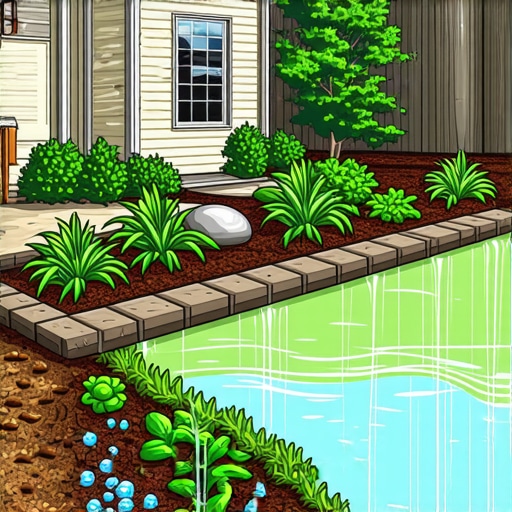
The Engineering Reality of Basement Seepage and Surface Runoff
To stop basement flooding using a rain garden, you must excavate a shallow depression at least 10 feet from your foundation, fill it with engineered soil (sand, compost, topsoil), and plant native deep-rooted species that facilitate bioretention and soil infiltration. This isn’t just a garden; it is a bio-retention cell designed to manage hydrostatic pressure.
I recently got called out to tear up a $30,000 patio that was sinking because the previous contractor ignored the basic laws of physics. They had installed a beautiful stone surface but zero drainage. Every time it rained, the water hit the house, sat against the foundation, and eventually forced its way through the concrete blocks. Hydrostatic pressure is a relentless force. You don’t fight it with more concrete; you fight it by giving the water somewhere to go. We had to excavate the entire perimeter and install a proper infiltration system from the ground up. This is the difference between a ‘mow-and-blow’ guy and a real hardscape engineer.
Why Standard Landscaping Fails to Stop Water
Most residential yards are compacted during construction. This creates a hardpan layer that acts like a parking lot. When you have heavy clay or high compaction, the sod install just sits on top like a sponge that can’t drain. Once that sponge is full, the water follows the path of least resistance: your basement. A rain garden breaks this cycle by creating a vertical column of high-porosity soil that pulls water deep into the aquifer before it reaches your walls. If your grading is wrong, your basement is doomed. It is that simple.
“A retaining wall doesn’t fail because of the stone; it fails because of the water trapped behind it.” – Hardscape Engineering Axiom
The Planning Phase: Siting and Perc Testing
Before you touch a shovel, you need a percolation test. Dig a hole 12 inches deep, fill it with water, and see how fast it drains. If it takes more than 24 hours, your soil is too heavy for a standard rain garden without a French drain overflow. You also need to stay away from your septic field and utility lines. Call 811. Don’t be the idiot who cuts a fiber optic line because they wanted to plant some sedges. Your rain garden should be at least 10 feet away from the foundation to ensure that the water you are infiltrating doesn’t just loop back into your sump pump basin.
| Material | Purpose | Recommended Ratio |
|---|---|---|
| Coarse Sand | Drainage / Porosity | 50% |
| Leaf Compost | Nutrient Cycling | 25% |
| Topsoil | Structural Integrity | 25% |
| River Rock | Energy Dissipation | Inlet/Outlet points |
How deep should a rain garden be?
A professional rain garden is typically excavated to a depth of 18 to 36 inches, though the surface ponding depth should only be 6 to 12 inches. This depth allows for a thick layer of engineered soil that can store water during peak storm events while the plants work to transpire that moisture back into the atmosphere. Any deeper and you risk creating a safety hazard or a stagnant pond; any shallower and the system won’t have the volume to manage significant irrigation or runoff.
The Ground-Up Build: Excavation and Soil Media
Once you’ve marked your area, excavation begins. You aren’t just digging a hole; you are building a filter. Remove the existing soil entirely. Do not try to ‘amend’ the clay in the hole; you will just end up with a clay bowl that holds water like a bathtub. The bottom of your excavation should be level to allow for even infiltration. If the bottom is sloped, the water will pool at one end, drowning those plants while the other side stays bone dry. Precision matters here.
- Identify the primary downspout contributing to the flood risk.
- Calculate the drainage area (Square footage of the roof feeding that pipe).
- Size the garden to be roughly 20% of that drainage area for sandy soil, or 30% for clay-heavy regions.
- Install a 4-inch PVC or HDPE pipe from the downspout to the garden.
- Use a flared end section and river rock at the inlet to prevent soil erosion.
Selection of Native Species and Root Architecture
Forget the big-box store annuals. You need plants that can survive being submerged for 24 hours and then endure a two-week drought. Native plants like Asclepias incarnata (Swamp Milkweed) or Panicum virgatum (Switchgrass) have root systems that can reach 10 feet deep. These roots create ‘macropores’ in the soil—microscopic tunnels that allow water to bypass the surface. This is biological engineering. Without these roots, your soil media will eventually clog with silt.
“Infiltration rates in bio-retention cells are significantly enhanced by the presence of deep-rooted perennial vegetation which prevents soil compaction over time.” – USDA NRCS Agronomy Manual
Which plants survive in a rain garden?
The best plants for a rain garden are native perennials with deep taproots or fibrous root systems that tolerate fluctuating moisture levels. Look for species native to your specific USDA Hardiness Zone that naturally occur in floodplains or meadows. These plants provide the yard cleanup benefits of filtering pollutants while maintaining the structural integrity of the soil through their aggressive root growth. Avoid invasive species that will choke out the system.
Maintenance and Long-Term Performance
A rain garden is not ‘set it and forget it.’ The first two years are critical for plant establishment. You will need to weed and monitor the irrigation needs during dry spells. Once the plants fill in, the system becomes self-sustaining. Every autumn, perform a thorough yard cleanup to remove excess leaf litter that could clog the inlet. If you see standing water for more than 48 hours, your mulch layer is likely too thick and has developed a ‘biocrust.’ Scrape it off and replace it with shredded hardwood mulch. It will rot if you use cheap pine nuggets. Don’t skip this.