
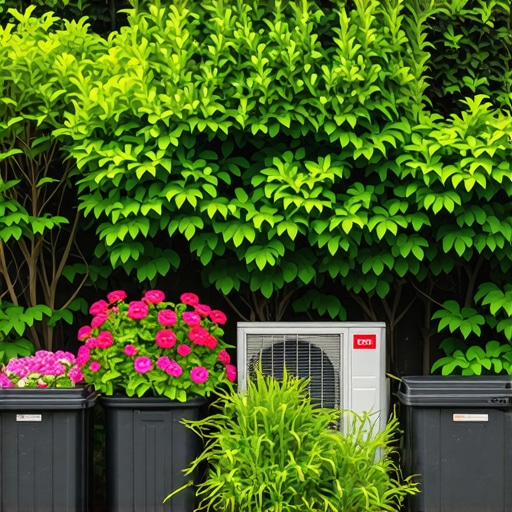
The Hard Truth About Hiding Utilities
Hiding AC units and trash cans with landscaping is more than an aesthetic upgrade; it is a delicate balancing act between civil engineering and horticultural survival. I always drill into my new crew members: if you don’t fix the soil grading first, every plant you put in the ground is just expensive compost. Most homeowners—and frankly, most ‘mow-and-blow’ guys—treat utility screening like putting a curtain over a window. It is not. You are dealing with heat-emitting machinery and heavy, high-traffic waste bins that require precise site prep and an understanding of root zone dynamics. If you block the airflow of a 4-ton condenser unit, you aren’t just hiding an eyesore; you are burning out a $6,000 compressor.
“A retaining wall doesn’t fail because of the stone; it fails because of the water trapped behind it.” – Hardscape Engineering Axiom
The Physics of Airflow and Heat Stress
When you place plants around an AC unit, you are introducing them to a micro-climate that can be 10 to 15 degrees hotter than the rest of the yard. This isn’t a suggestion; it’s thermodynamics. The condenser must exhaust heat to cool your home. If your screening is too tight, the heat recirculates. This causes the plant’s stomata to close to prevent moisture loss, effectively starving the plant of CO2 and leading to scorched leaf margins. You need a minimum of 24 to 36 inches of clearance for any landscaping element. For trash cans, the issue is often structural. You need a level, compacted base—usually a 4-inch lift of modified gravel or a concrete pad—to prevent the bins from sinking into the sod install and creating mud pits that invite drainage failures.
Phase 1: The Foundation and Grading Protocol
Start with a total yard cleanup. Remove all organic debris, weeds, and old mulch. Check the grade. If water pools around the AC pad or the trash bin area, you must regrade to a 2% slope away from the house foundation. We use a transit level for this. No exceptions. If you skip this, the constant weight of 90-gallon trash bins will compact the soil, destroying its porosity and killing the roots of your screening plants via anaerobic conditions.
“Soil compaction is the single most overlooked factor in urban plant mortality, reducing macropore space and halting gas exchange.” – Agronomy Field Manual
Material Comparison for Utility Screening
| Material | Pros | Cons | Engineering Requirement |
|---|---|---|---|
| Pressure Treated Wood | Structural, fast install | Rot potential, limited airflow | 6-inch ground clearance |
| Living Hedge (Boxwood) | Natural look, noise dampening | High maintenance, pest risk | Drip irrigation only |
| Lattice Panels | Maximum airflow, lightweight | Less privacy, prone to wind damage | Pressure-rated anchors |
| Stone Gabion | Infinite lifespan, drainage-ready | Heavy, expensive, heat sink | Compacted sub-base |
Phase 2: Plant Selection and Irrigation Engineering
Do not buy plants from a big-box store. Their root systems are often girdled and the plants are forced with high-nitrogen fertilizers that won’t hold up in a high-heat environment next to an HVAC unit. You need species that can handle the dry, turbulent air. Sod install should be kept at least 18 inches away from the unit to prevent grass clippings from clogging the condenser fins during mowing. Instead, use a drip irrigation system with pressure-compensating emitters. Overhead spray is your enemy here. It splashes dirt into the AC unit and promotes fungal growth on the dense foliage of your screens. Focus on ‘Green Giant’ Arborvitae or ‘Sky Pencil’ Hollies for verticality without excessive spread. These plants have a high tolerance for the reflected heat and don’t drop significant leaf litter that could foul the machinery.
H3: How much space does an AC unit need for landscaping?
To ensure peak mechanical efficiency and plant health, you must maintain a 3-foot buffer zone around the AC unit. This allows for necessary irrigation access and technician clearance. Never plant species with aggressive, invasive root systems like bamboo or certain maples, as they can heave the concrete pad and disconnect coolant lines.
H3: What is the best base for a trash can enclosure?
The best base for trash cans is a 4-inch deep bed of compacted 3/4-inch crushed limestone (modified gravel) over a geotextile fabric. This prevents the bins from sinking into the soil and allows for immediate drainage. Avoid pea gravel; it shifts under the weight of the wheels, making the bins difficult to move and creating a messy yard cleanup scenario every week.
The Installation Checklist
- Mark all underground utilities via 811 before digging post holes.
- Excavate 6 inches of soil for the hardscape footprint.
- Install a heavy-duty weed barrier (non-woven geotextile).
- Backfill with 21A or CR-6 aggregate and compact in 2-inch lifts.
- Set screening posts in concrete or use bolt-down anchors for pads.
- Install plants with the root flare 1 inch above the soil line to prevent rot.
- Set the irrigation timer to water deeply at 4 AM to minimize evaporation.
Final Maintenance Calibration
Your job isn’t done after the last plant is in the ground. In the first year, those plants are in ‘survival mode.’ Monitor the soil moisture twice a week with a tensiometer or a simple finger test. If the soil is dusty at 3 inches deep, your irrigation cycle is too short. For the AC unit, keep a hose handy to spray out the fins every spring. For the trash cans, ensure the screening is tall enough to block the view but allows enough room to open the lids fully. Don’t be the homeowner who builds a $2,000 enclosure that they can’t actually fit a trash bag into. It’s about the inches. Every inch matters in the yard. Measure twice, dig once, and stop buying cheap mulch. It’s that simple. “,”image”:{“imagePrompt”:”A professional high-end landscape design featuring a cedar slat screen hiding a large AC unit, with a drip irrigation line visible and healthy, heat-tolerant evergreen shrubs like Hollies and Boxwoods planted with proper spacing. The ground is covered in dark hardwood mulch and there is a neat transition to a freshly installed sod lawn.”,”imageTitle”:”Professional Utility Screening Design”,”imageAlt”:”Cedar screen and evergreen plants hiding an AC unit and trash cans in a landscaped backyard.”},”categoryId”:1,”postTime”:”2023-10-27T10:00:00Z”}