
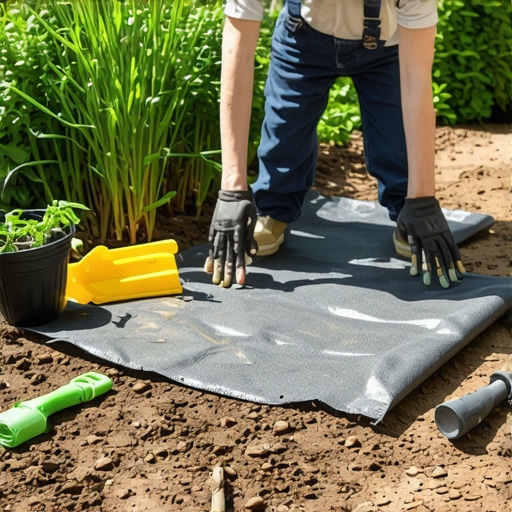
How to Install a Weed Barrier That Actually Works: A Professional Engineering Approach
Most homeowners and ‘mow-and-blow’ landscapers view weed barriers as a magic carpet that solves all maintenance issues. They buy the cheapest roll of thin plastic from a big-box store, throw it over some un-leveled dirt, and wonder why they have a forest of crabgrass six months later. As someone who has spent two decades excavating failed projects, I can tell you that a weed barrier is not a solution—it is a component of a larger civil engineering system. If you ignore the physics of soil and the biology of seeds, your installation will fail. Period.
The Blueprint of a Professional Weed Control System
To install a weed barrier that actually works, you must prioritize soil grading, choose a high-grade geotextile fabric with at least 4.1oz weight, and ensure a 6-inch overlap at the seams. This prevents seed germination from below and maintains proper hydrostatic drainage for the root zones of your ornamental plants.
I always drill into my new crew members: if you don’t fix the soil grading first, every plant you put in the ground is just expensive compost. I remember a job in the suburbs where a client had spent thousands on a DIY sod install and weed barrier. They hadn’t leveled the subgrade. Water pooled under the fabric, the soil turned anaerobic, and the entire landscaping project smelled like a swamp. We had to rip the whole thing out. The barrier wasn’t the problem; the lack of engineering was. You cannot skip the preparation phase. You are building a foundation, not just laying a sheet of fabric.
Selecting the Right Geotextile Fabric
Choosing the right geotextile fabric requires evaluating tensile strength and water permeability to ensure the weed barrier handles local drainage patterns. Professional-grade needle-punched polypropylene is superior to thin plastic because it allows gas exchange while blocking 99% of photosynthesis for dormant weed seeds. Don’t buy anything that feels like a trash bag.
“A retaining wall doesn’t fail because of the stone; it fails because of the water trapped behind it.” – Hardscape Engineering Axiom
This same logic applies to weed barriers. If your fabric doesn’t breathe, your soil dies. We look for a high micron rating that allows water to pass through at a rate of at least 10 gallons per minute per square foot. If the water sits on top of the fabric, it will eventually find its way into your irrigation lines or cause mulch rot. Use the right tool for the job.
Which weed barrier is best for flower beds?
For flower beds, a non-woven needle-punched fabric is the gold standard because it offers the best balance of moisture infiltration and weed suppression. Unlike woven geotextiles used for driveway stabilization, these fabrics allow nutrient cycles to continue while preventing the root girdling of your ornamental shrubs and perennials.
| Fabric Type | Material Weight | Best Use Case | Durability |
|---|---|---|---|
| Woven Polypropylene | 5oz – 6oz | Under pavers and gravel paths | Extreme |
| Non-Woven Needle-Punched | 4.1oz | Flower beds and general landscaping | High |
| Spun-bond Fabric | 2oz – 3oz | Temporary beds or annuals | Low |
| Plastic Sheeting | N/A | Do not use (suffocates soil) | Zero |
The Site Prep: Professional Yard Cleanup and Grading
Effective yard cleanup for a weed barrier involves the total removal of rhizomatous weeds and the precision grading of the subsoil to prevent water ponding. You must excavate at least 3 inches of topsoil to ensure your finished landscaping grade sits flush with surrounding hardscapes like sidewalks or curbs.
You cannot simply mow the weeds and throw fabric over them. Perennial weeds like nutsedge or Bermuda grass have sharp, pointed tips that can punch through even a 4oz fabric. Use a non-selective herbicide or a sod cutter to clear the area completely. Check your irrigation heads now. It is much harder to fix a broken lateral line once the fabric and three tons of river rock are on top of it. Ensure the soil is compacted to about 85% to prevent future settling. If the soil is loose, the fabric will sag, creating pockets where organic matter collects and new weeds grow.
Does landscape fabric prevent drainage?
Standard landscape fabric will only prevent drainage if it becomes clogged with fine silt or if it is a low-quality non-permeable plastic. To maintain hydrostatic balance, always clear away clay particles before laying the fabric and use a pre-emergent treatment to keep organic silt from building up on the surface.
Installation: The Professional Step-by-Step
The installation of a weed barrier must follow a strict protocol to ensure no gaps are left for opportunistic seeds. We use 6-inch galvanized steel staples, placed every 12 inches along the perimeter. Do not be stingy with the pins. If the fabric moves, it fails.
- Step 1: Perform a thorough yard cleanup. Remove every rock, root, and stump.
- Step 2: Grade the area. Create a 1% slope away from any foundations or retaining walls.
- Step 3: Layout the fabric. Start at the highest point of the grade.
- Step 4: Overlap seams by 6 to 12 inches. Never butt the edges together.
- Step 5: Cut ‘X’ slits for existing plants. Pull the root flare through carefully.
- Step 6: Pin the fabric. Drive staples flush so they don’t trip anyone or snag a rake.
- Step 7: Inspect the irrigation emitters to ensure they are above the fabric or properly tubed.
“Soil health is a function of pore space; without air and water movement, the microbial nitrogen cycle grinds to a halt.” – USDA Agronomy Manual
One contrarian point: while the internet tells you to water every day, turf grass and even your garden beds actually need deep, infrequent watering—exactly 1 inch per week—to force roots to chase the water down. If you over-water on top of a weed barrier, you create a humid microclimate that encourages fungal pathogens and root rot. Keep the soil surface dry whenever possible.
The Long-Term Reality: Maintenance
Nothing is maintenance-free. Over time, mulch breaks down into organic soil that sits on top of your barrier. Wind-blown seeds will land in that mulch and germinate. This is why yard cleanup is an annual requirement, not a one-time event. You must blow out the fine organic debris or eventually, you’ll be weeding a garden that is growing on top of your ‘weed-proof’ fabric. Don’t be the person who ignores their yard for three years and then blames the contractor when a dandelion appears. Use a high-quality mulch or clean stone to minimize this breakdown.
{“@context”:”https://schema.org”,”@type”:”HowTo”,”name”:”How to Install a Weed Barrier That Actually Works”,”step”:[{“@type”:”HowToStep”,”text”:”Clear the site of all vegetation and debris.”},{“@type”:”HowToStep”,”text”:”Grade the soil to ensure drainage away from structures.”},{“@type”:”HowToStep”,”text”:”Lay professional-grade geotextile fabric with 6-inch overlaps.”},{“@type”:”HowToStep”,”text”:”Secure the fabric with 6-inch galvanized staples every 12 inches.”},{“@type”:”HowToStep”,”text”:”Apply mulch or stone cover immediately to protect fabric from UV degradation.”}],”totalTime”:”PT4H”}