
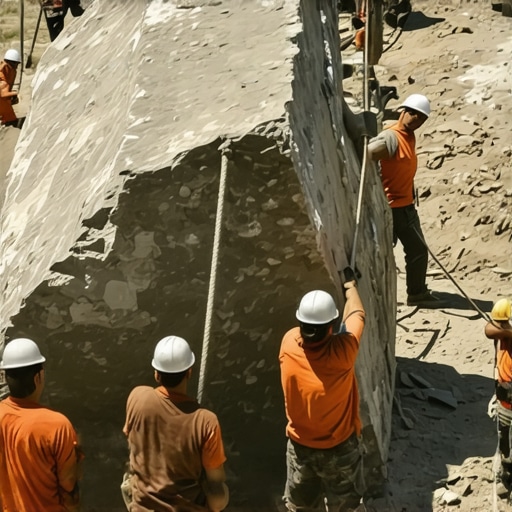
The Physics of Stone: 3 Tactics for Moving Heavy Boulders Without a Backhoe
I have spent twenty years watching rookie contractors blow out their L4-L5 vertebrae because they thought they could out-muscle a 600-pound piece of granite. You cannot. Stone is indifferent to your ego. I always drill into my new crew members: if you do not understand the center of gravity and the mechanical advantage of leverage, you are not a landscaper; you are a liability. In this business, moving heavy materials like boulders during a yard cleanup or a landscaping overhaul requires more brain than brawn. If you skip the physics, you do not just hurt yourself; you ruin the sod install you just finished or crush the irrigation lines buried four inches deep. We treat every stone move as a controlled engineering event.
1. The Pivot and Pinch Point Method (The Slate Bar Lever)
To move a heavy boulder using the pivot and pinch point method, you must utilize a forged steel slate bar at least 60 to 72 inches long to create a Class 1 lever, allowing you to lift and shift the stone’s center of mass with minimal physical output. This tactic relies on a solid fulcrum, often another smaller stone or a block of wood, to multiply the force applied by the operator. It is the most precise way to nudge a stone into its final ‘face’ during a high-end install.
The secret lies in the metallurgy. A cheap pry bar from a big-box store will flex or snap when you put 200 pounds of downward pressure on it. I use a 17-pound high-carbon steel bar with a pencil point. You find the ‘seat’ of the boulder. You dig that point into the soil or under the stone’s edge. By applying downward pressure, you can lift a stone that weighs five times your body weight. You do not lift the whole rock. You lift one edge, pivot it two inches, and repeat. It is slow. It is methodical. It is safe. When working near a fresh sod install, you must place a sacrificial piece of 3/4-inch plywood under your fulcrum. Without it, the pressure will exceed 500 PSI in a concentrated spot, obliterating the soil structure and leaving a permanent depression that will cause drainage issues later. Soil compaction is the silent killer of healthy root systems. If you crush the macropores in the soil, the grass will die, no matter how much irrigation you provide.
“A retaining wall or boulder placement doesn’t fail because of the stone; it fails because of the water trapped behind it or the unstable base beneath it.” – Hardscape Engineering Axiom
2. The Egyptian Roller System (Pipe Conveying)
The Egyptian roller system moves boulders by placing the stone on a rigid sled or directly onto Schedule 40 PVC pipes, which act as a mobile conveyor belt to redistribute the weight across a larger surface area. This prevents the stone from sinking into soft landscaping beds and allows a single person to move several hundred pounds across a flat surface with a simple push. As the stone moves forward, you take the trailing pipe and move it to the front.
This is my preferred method when we are doing a yard cleanup and need to move decorative rocks across an established lawn. You cannot just drag a rock. Dragging creates friction and heat, and it will scalp your turf down to the dirt. I use three or four 4-inch diameter pipes. The pipe must have a high enough wall thickness to prevent ‘ovaling’ under the load. If the pipe deforms, it will not roll. For stones over 800 pounds, we swap PVC for galvanized steel rollers.
How heavy of a rock can one person move?
One person can realistically move a stone weighing up to 1,000 pounds on a flat, hard surface using the roller method, provided they use a stone sled and a 3:1 mechanical advantage ratio with levers or a come-along winch. However, on soft soil or inclines, that capacity drops significantly without additional anchors. Below is a comparison of movement tactics based on stone weight and terrain.
| Method | Max Recommended Weight | Best Terrain | Impact on Sod |
|---|---|---|---|
| Slate Bar Pivot | 600 lbs | Tight spaces / Planting beds | High (needs protection) |
| PVC Rollers | 1,200 lbs | Flat Lawns / Driveways | Low |
| Stone Sled / Drag | 800 lbs | Mud / Rough Grade | Extreme |
3. The Stone Sled and Friction Reduction
Moving a boulder with a stone sled involves strapping the rock to a heavy-duty polyethylene or timber sled to create a smooth bottom surface, which reduces the coefficient of friction against the ground. This is the primary tactic for moving stones over uneven terrain where rollers would fail or where you need to protect irrigation heads from being crushed by direct stone contact. The sled acts as a protective shield for both the stone and the substrate.
I have seen guys try to drag a boulder with a chain. The chain slips. The stone rolls. Someone loses a toe. Instead, we use a ‘stone boat.’ It is essentially a low-profile platform. If we are working on a slope, we use a come-along winch anchored to a stable tree or a truck hitch. You move the stone six inches at a time. This is where you have to be careful about your landscaping layout. If you are dragging a sled over a zone where you just did an irrigation install, you are begging for a cracked lateral line. Most residential 1-inch lateral pipes are only buried 8 to 12 inches deep. A 1,000-pound boulder on a sled can exert enough point-load pressure to shear a PVC fitting through the soil. You must map your lines before you move the weight.
What is the best lever for moving rocks?
The best lever for moving rocks is a 72-inch forged steel pinch-point bar, often called a ‘San Angelo bar’ or ‘slate bar,’ because the long handle provides maximum torque while the hardened tip allows for precise placement in small gaps. Never use a wood-handled shovel or a standard crowbar, as they lack the tensile strength required for heavy stone work.
“Soil compaction from heavy loads reduces infiltration rates and increases surface runoff, often leading to anaerobic conditions in the root zone.” – Agricultural Extension Service Manual
Before you even touch a stone, run through this checklist to ensure you aren’t about to destroy your yard or your body.
- Check for 811 utility markings (Gas, Electric, Water).
- Identify all irrigation head locations and mark them with flags.
- Lay down 3/4-inch plywood ‘roads’ for any path over 10 feet.
- Inspect your lifting straps for frays or UV damage.
- Ensure the landing zone is graded and compacted to prevent settling.
The biggest mistake people make in landscaping is thinking the job is done once the stone is in the hole. It is not. You have to backfill and compact. If you leave air pockets under a heavy boulder, the first heavy rain will cause the stone to shift. This is basic civil engineering. If the stone shifts, it could sever a nearby irrigation line or create a trip hazard. We use a hand tamper to reach 95% compaction around the base of the stone. Then, and only then, do we proceed with the sod install or final mulching. This is the difference between a pro job and a ‘mow-and-blow’ hack. Precision matters. Gravity never sleeps.