
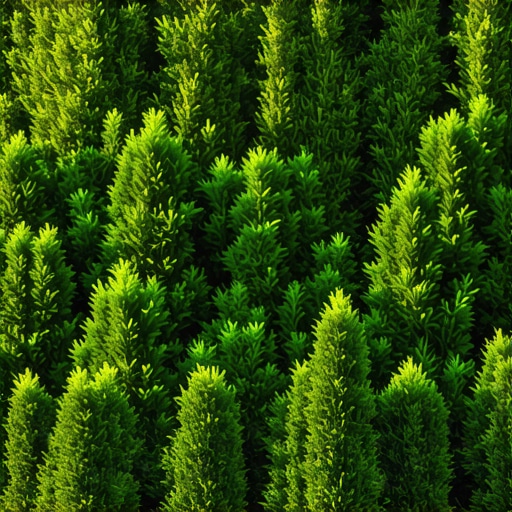
Planning the Foundation of a Privacy Screen
The best shrub for a high-privacy natural fence is the Thuja Standishii x Plicata ‘Green Giant’ or the Ilex opaca (American Holly), selected based on USDA Hardiness Zones, local soil pH, and sunlight exposure. Success depends on proper site grading, soil density, and the installation of a high-efficiency drip irrigation system to support root establishment.
I always drill into my new crew members: if you don’t fix the soil grading first, every plant you put in the ground is just expensive compost. I have seen too many homeowners spend $15,000 on nursery stock only to watch the roots drown in a bathtub of clay because they didn’t understand hydrostatic pressure or surface runoff. Landscaping is not about aesthetic placement; it is about civil engineering with living organisms. Before you even look at a plant catalog, you need to understand the compaction levels of your soil. If your ground has a bulk density higher than 1.6 grams per cubic centimeter, your shrubs will never thrive. You are essentially planting them in a brick. You must address the sub-base. Yard cleanup is more than just raking leaves; it involves removing the organic debris that can harbor fungal pathogens like Phytophthora, which will decimate a privacy hedge in a single season.
How far apart should I plant Thuja Green Giant?
For a dense, opaque screen, plant Thuja Green Giant 5 to 6 feet apart on center. If you have the space, a staggered double row with 8 feet between rows provides the fastest coverage and the best windbreak performance. This spacing prevents the canopy from becoming so crowded that airflow is restricted, which leads to interior needle drop and spider mite infestations. You need to account for the mature width, which often reaches 12 to 15 feet. Don’t be the guy who plants them 3 feet apart because he’s impatient; you will just end up with a dead, brown wall in five years. You must measure exactly from the center of the root ball.
| Shrub Species | Growth Rate (Annual) | Mature Height | Sun Requirement | Soil pH Preference |
|---|---|---|---|---|
| Thuja ‘Green Giant’ | 3-5 Feet | 40-60 Feet | Full Sun/Part Shade | 6.0 – 7.5 |
| American Holly | 1-2 Feet | 30-50 Feet | Full Sun/Part Shade | 5.0 – 6.5 |
| Skip Laurel | 2-3 Feet | 10-15 Feet | Full Shade/Sun | 5.5 – 7.0 |
| Leyland Cypress | 3-4 Feet | 60-70 Feet | Full Sun | 6.0 – 8.0 |
“Trees and shrubs should be planted so that the root flare is at or slightly above the soil surface to allow for proper oxygen exchange.” – Penn State Extension
The Engineering of the Planting Hole
Proper installation requires a hole that is at least twice as wide as the root ball but no deeper. I see hacks digging deep, narrow holes every day. It is a death sentence. The roots need lateral expansion into uncompacted soil to stabilize the plant. When we perform a sod install, we always check the soil profile. The same applies here. If you are dealing with heavy clay, you need to scarify the walls of the hole. A smooth, glazed hole wall acts like a ceramic pot, preventing roots from penetrating the surrounding soil. We use a 1-inch layer of modified gravel at the very bottom only if drainage is severely compromised, but typically, we rely on grading to move water away. Your soil pH should be tested using a calibrated meter, not a cheap color-strip kit. If your pH is 8.0 and you are trying to grow American Holly, you are fighting a losing battle against iron chlorosis. You will need to amend with elemental sulfur six months before planting.
What is the best evergreen for privacy in shade?
The Skip Laurel (Prunus laurocerasus ‘Schipkaensis’) is the superior choice for high-privacy screens in shaded environments. It maintains a dense, broad-leaf foliage profile even with limited UV exposure and is significantly more resistant to deer than the common arborvitae. Ensure the soil is well-drained, as laurels are susceptible to root rot in standing water. Plant them 4 feet apart for a continuous hedge. They can reach 15 feet in height, making them ideal for suburban property lines where a 60-foot Thuja would be overkill.
- Conduct a 24-hour percolation test to check drainage.
- Mark all utility lines via 811 before mechanical excavation.
- Remove all synthetic burlap and wire cages from the top third of the root ball.
- Set the root flare 1 to 2 inches above the finish grade.
- Install 2 GPH (gallons per hour) drip emitters at the root zone.
Irrigation and Long-Term Maintenance
Watering is where most people fail. You cannot rely on a lawn sprinkler to water a privacy hedge. Turf irrigation is designed for shallow roots; shrubs need deep saturation. We install dedicated drip lines with pressure-compensating emitters. For a new 6-foot shrub, you need approximately 10 gallons of water per week, delivered in two deep sessions. This forces the roots to chase the moisture down into the soil profile. Shallow, daily watering keeps the roots at the surface, making the plant vulnerable to heat stress and winter desiccation. If you are doing a sod install at the same time, ensure your zones are separated. Grass and shrubs have different hydraulic requirements. I also tell my clients to avoid the big-box store fertilizers. Use a slow-release organic granular with a 10-10-10 NPK ratio in early spring. Don’t touch the plants with a hedge trimmer until they reach their target height. You want to encourage vertical leader growth, not side-branching density in the first two years. Use hand pruners to remove deadwood and maintain airflow. If you see browning from the inside out, check your irrigation timing. It is usually a sign of over-watering or poor soil drainage, not a lack of fertilizer.
“A retaining wall doesn’t fail because of the stone; it fails because of the water trapped behind it.” – Hardscape Engineering Axiom
The same logic applies to your yard cleanup and privacy screens. If water pools at the base of your hedge, the soil oxygen is displaced, and the roots die. This is why we often install a French drain behind a privacy screen if the property slopes toward the planting line. We use a 4-inch perforated pipe wrapped in filter fabric, buried in a trench of 3/4-inch clean stone. This manages the sub-surface water flow and protects your investment. High-end landscaping is about managing the environment so the plants can manage themselves. It is a science of 1-inch increments and specific pH levels. Get the biology right, and the privacy follows. Get it wrong, and you are just looking at a row of expensive firewood in twelve months.