
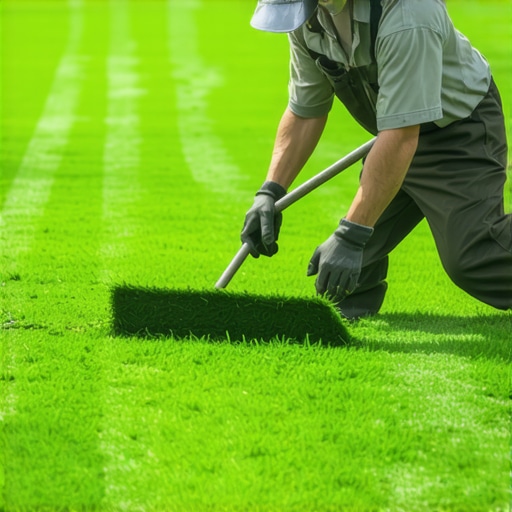
The Horticultural Engineering Behind a Perfect Lawn Install
Laying 2026-grade sod requires focusing on soil-to-root contact, precise moisture management, and existing nitrogen levels rather than immediate fertilization. Freshly harvested sod from a reputable turf farm is already saturated with high-nitrogen fertilizers to ensure rapid growth for harvest; adding more chemicals immediately after delivery causes osmotic stress and root desiccation.
I always drill into my new crew members: if you don’t fix the soil grading first, every plant you put in the ground is just expensive compost. Last season, I watched a neighbor install $8,000 worth of premium Zeon Zoysia over a yard that hadn’t been leveled. Three weeks later, he had ‘puddle rot’ in the low spots and scorched patches on the high mounds. He thought he needed more fertilizer. I had to tell him he needed a bobcat and a better understanding of hydrostatic pressure. You cannot out-fertilize a drainage failure. It just doesn’t work. The biology of the grass depends on the physical structure of the earth it sits on.
The Myth of Starter Fertilizer
Most DIYers and ‘mow-and-blow’ outfits reach for a bag of 10-10-10 the moment the last piece of sod hits the dirt. This is a fundamental mistake. The turf you just bought was likely fed a heavy regimen of liquid urea or ammonium nitrate less than ten days before it was cut. Adding more synthetic salts to the rhizosphere of a plant that just had 90% of its root system sliced off is an invitation for disaster. High salt indexes in cheap fertilizers pull water out of the remaining root hairs, leading to what we call ‘fertilizer burn.’ You don’t need a chemical boost; you need a biological bridge.
“Phosphorus is often the most misunderstood nutrient in turf establishment; while it aids root growth, excessive levels in high-CEC soils lead to runoff and do little for the actual establishment of a cut-root system.” – Penn State Center for Turfgrass Science
The 2026 Prep Protocol: Beyond Yard Cleanup
Before you even call the farm to schedule a delivery, your yard cleanup must involve more than just raking leaves. You need a clean slate. This means removing all debris, old thatch, and weed seeds. If you have heavy clay, you are looking at a compaction issue. If you don’t core aerate or till in organic amendments like leaf compost or sand to improve the cation exchange capacity (CEC), your sod will suffocate. Roots need oxygen just as much as they need water. If the soil is too tight, the roots will sit on top, never ‘knitting’ into the ground. It will rot.
How much modified gravel do I need for a patio base?
A standard hardscape base requires roughly 4 to 6 inches of compacted modified gravel (CR6 or 21A), which translates to approximately 1 ton of material for every 50 square feet at a 4-inch depth. For sod borders or hardscape-adjacent turf, ensuring this base is sloped at a 2% grade away from the foundation is the only way to prevent stagnant water from killing your new grass. Drainage is the silent killer of the perfect lawn.
| Feature | The DIY Hack Method | The Pro Engineering Method |
|---|---|---|
| Soil Prep | Raking the surface only | Tilling to 6 inches, pH adjustment |
| Fertilization | Heavy nitrogen at install | Wait 4-6 weeks for first feeding |
| Watering | Hand spraying once a day | Deep irrigation cycles, 1 inch/week |
| Edge Prep | Overlapping edges | Butted tight, staggered seams |
The Irrigation Infrastructure: Precision vs. Saturation
Irrigation is not just about getting the ground wet. It is about head-to-head coverage and ensuring you are putting down exactly the amount of water the species requires. New sod needs to be kept moist, not submerged. If you see water pooling in the seams, you are drowning the aerobic bacteria in the soil. You need to monitor the evapotranspiration (ET) rate. In high-heat scenarios, light syringing during the day can cool the leaf blade without saturating the soil profile to the point of hypoxia.
“Successful turfgrass establishment depends on maintaining the field capacity of the soil without inducing anaerobic conditions that lead to Pythium blight and other fungal pathogens.” – Texas A&M AgriLife Extension
The 8-Step Sod Installation Checklist
- Soil Test: Determine your N-P-K levels and pH. Target 6.5 for most cool-season grasses.
- Grade for Drainage: Ensure a 2% slope away from structures to prevent hydrostatic buildup.
- Mechanical Compaction: Use a water-filled roller on the bare dirt to find soft spots before laying.
- Staggered Seams: Lay sod like bricks. Never align the vertical seams.
- Edge Tucking: Use a spade to tuck edges against hardscapes to prevent drying.
- Post-Lay Rolling: Roll the sod again after laying to eliminate air pockets. Air kills roots.
- Initial Saturation: Water immediately. The first 30 minutes are the most critical.
- The ‘Wait Period’: Stay off the grass for at least 14 days. Don’t even think about a mower.
Why the First Mow Matters More Than Fertilizer
When you see the grass reaching 4 inches, your instinct is to scalp it. Don’t. You should only remove the top 1/3 of the leaf blade. This is the one-third rule. If you cut more than that, you shock the plant, forcing it to divert energy from root development back into leaf repair. Use a sharp blade. A dull blade tears the grass, leaving a jagged edge that is a highway for fungal infections. Don’t skip this. Your mower blade should be sharp enough to shave with.
How do I know if my new sod is rooting?
Gently attempt to lift a corner of a sod slab after 10 days; if you feel significant resistance, the white primary roots have begun to penetrate the soil horizon. Do not pull hard. If the sod lifts easily and the underside is slimy, you are over-watering and the roots are dying from a lack of oxygen. Check this. It is the only way to know if your prep work paid off.
The Maintenance Horizon
Once the sod is established, you move into a deep and infrequent watering schedule. This forces the roots to chase the moisture down into the soil, creating a drought-resistant lawn. The ‘mow-and-blow’ guys will tell you to water every day for 5 minutes. They are wrong. That creates a shallow, weak root system. Give it an inch once a week. Be precise. Use rain gauges. This is engineering, not gardening. Manage the biology or the biology will manage you.