
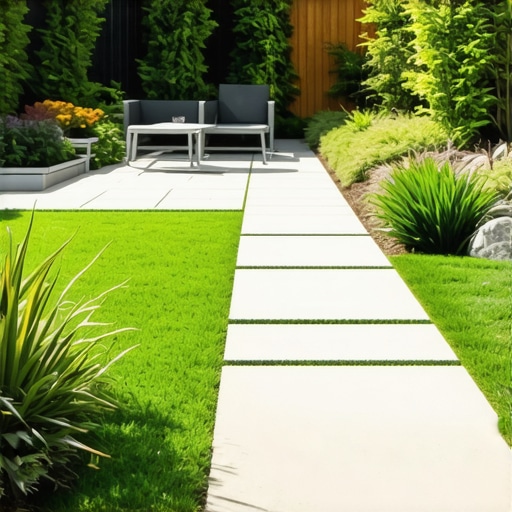
The Blueprint for a Modern Low-Maintenance Front Yard
Low-maintenance front yard solutions for 2026 focus on xeriscaping, native groundcovers, and permeable hardscapes that eliminate traditional turf grass. By replacing high-input sod with clover, micro-clover, or decomposed granite, homeowners reduce water consumption by 60% and eliminate weekly mowing requirements entirely.
I always drill into my new crew members: if you don’t fix the soil grading first, every plant you put in the ground is just expensive compost. I have watched $50,000 installations rot in a single season because the foreman ignored a 2% slope leading toward the foundation. Landscaping isn’t about the aesthetics you see on social media; it is about managing water, gravity, and soil biology. If you do not respect the physics of the yard, the yard will reclaim your investment. Most ‘mow-and-blow’ hacks will just throw down some mulch and call it a day, but they are not thinking about the long-term hydrostatic pressure building up behind your retaining walls or the root girdling caused by improper planting depths.
The Planning Phase: Why 80% of the Work Happens Before Excavation
Success in a no-mow front yard is determined in the survey phase. You must map your yard’s micro-climates. A north-facing slope in USDA Zone 7 behaves differently than a south-facing flat lot. We start by testing the soil pH and Cation Exchange Capacity (CEC). If your soil is heavy clay with a pH of 8.2, your dreams of a Mediterranean lavender garden are dead on arrival unless you undergo a massive soil remediation process. We use a penetrometer to check for compaction layers. If the soil is tighter than 300 PSI, roots cannot penetrate, and water will simply sheet off, causing erosion and flooding. [IMAGE_PLACEHOLDER]
“Soil compaction is the silent killer of urban landscapes, reducing pore space and suffocating the rhizosphere.” – Cornell University Agricultural Extension
The Materials Breakdown: Quality Engineering vs. Big-Box Shortcuts
When selecting materials for a low-maintenance install, the cheapest option is almost always the most expensive over a five-year horizon. For hardscape bases, we avoid ‘dirt-fill’ and stick to 2A modified crushed limestone, compacted in 2-inch lifts. For no-mow groundcovers, we source nursery-grade micro-clover (Trifolium repens L. var. ‘Pipolina’) which stays low to the ground and fixes nitrogen directly into the soil. This eliminates the need for synthetic fertilizers. Unlike sod install projects that require 1-inch of water daily for the first three weeks, these alternatives are resilient once established.
| Material | Installation Cost (per sq ft) | Maintenance Level | Water Requirement |
|---|---|---|---|
| High-End Sod | $1.50 – $2.50 | High (Mowing/Fertilizing) | High |
| Micro-Clover | $0.40 – $0.80 | Low (Minimal Mowing) | Low |
| Decomposed Granite | $2.00 – $4.00 | Very Low (Weeding) | None |
| Native Sedge (Carex) | $3.00 – $6.00 | Low (Annual Trim) | Medium-Low |
How much modified gravel do I need for a patio base?
To calculate your modified gravel needs, multiply the square footage by the desired depth in feet (minimum 4-6 inches for pedestrian walkways), then divide by 27 to get cubic yards. Always add a 20% compaction factor to your final number. For a 100-square-foot area at a 6-inch depth, you need roughly 2.3 cubic yards of material. Do not skip the plate compactor. A base that isn’t vibrated into a solid state will settle unevenly, leading to polymeric sand failure and weed intrusion. We use a minimum of 4,000 lbs of centrifugal force on our compactors to ensure the base is rock-solid.
Are no-mow lawns really low maintenance?
No-mow lawns are lower maintenance than traditional turf, but they are not ‘zero’ maintenance. Yard cleanup is still required to remove leaf litter that can smother groundcovers and cause fungal outbreaks like Rhizoctonia solani. Irrigation systems should be converted from spray heads to Netafim drip lines to target the root zone directly. This prevents weed seeds from germinating in the dry surface soil while keeping your groundcover hydrated. It is a strategic shift from constant labor to seasonal management.
“A retaining wall doesn’t fail because of the stone; it fails because of the water trapped behind it.” – Hardscape Engineering Axiom
The Installation Process: Precision and Sensory Checks
The installation of a no-mow front yard begins with the complete removal of existing turf. We use a sod cutter set to 2 inches to strip the biomass. Next, we address the subgrade. If we are installing a permeable gravel path, we lay down a non-woven geotextile fabric with a 140-lb grab tensile strength. This prevents the gravel from migrating into the soil. When we run the tamper, it should literally bounce off the compacted base. That sound—a high-pitched ‘ring’—tells me the density is right. For planting, we ensure the root flare of every shrub is visible above the soil line. Planting too deep is a death sentence; it leads to stem-girdling roots that will kill the plant in three to five years.
- Call 811 to mark all underground utilities before any excavation begins.
- Install a 4-inch perforated PVC drain pipe behind any retaining walls.
- Apply a pre-emergent like Prodiamine if you are using organic mulches to prevent weed flushes.
- Use a 50/50 mix of compost and topsoil for clover seeding to ensure high germination rates.
- Check irrigation PSI; most drip emitters require a pressure regulator to stay below 25-30 PSI.
The Settling-In Period: Year One Management
The first twelve months are the ‘establishment phase.’ Even a no-mow yard needs attention here. You must monitor the soil moisture at a 4-inch depth. If it feels dry, run the irrigation. By year two, the native plants and clovers will have developed deep enough root systems to tap into subsoil moisture. You will see a shift in the local ecosystem—more pollinators and less runoff. This is the goal of 2026 landscaping: creating a functional, engineered environment that works with the land rather than fighting it with a lawnmower every Saturday morning. Don’t expect it to look perfect in week two. Biology takes time. Give it a season to knit together. It will happen. Be patient and watch the pH levels.