
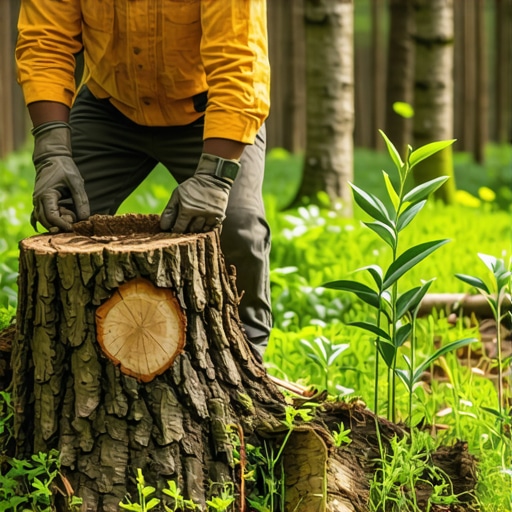
The Biology of Failure: Why Your Stump Is Still Sprouting in 2026
I always drill into my new crew members: if you don’t fix the soil grading first, every plant you put in the ground is just expensive compost; but if you don’t kill the vascular system of a felled tree, you’re just inviting a ghost to haunt your yard for the next five years. Most homeowners and ‘mow-and-blow’ outfits think that once the trunk is gone, the battle is over. It isn’t. By 2026, many trees cut down a year or two ago are pushing up ‘zombie’ sprouts, also known as epicormic shoots or suckers. These aren’t just weeds; they are a desperate biological response from a massive underground energy reserve. To effectively remove 2026 stump sprout re-growth, you must disrupt the tree’s hormonal balance by applying systemic triclopyr to the living cambium layer or performing a full-depth mechanical excavation of the lateral root system. Simply cutting the green shoots back only serves to stimulate apical dominance release, which triggers even more aggressive growth from the root crown.
The Forensic Autopsy: Why Traditional Methods Failed
When I walk onto a property and see a 3-foot wide ring of leafy sprouts encircling a rotting stump, I’m looking at a failed execution. The visual symptom is a cluster of thin, flexible branches that grow 4 to 6 inches in a single week. Sensorially, you’ll notice the ground around the stump feels spongy. This happens because the previous contractor likely did a shallow stump grind—maybe 4 inches deep—and called it a day. They left the lateral roots intact. Those roots are packed with stored starches and sugars. Without a trunk to feed, that energy has nowhere to go but up.
“A tree stump doesn’t die when the tree is felled; it dies when the carbohydrate reserves in the root system are exhausted or the vascular cambium is chemically neutralized.” – USDA Forest Service Management Guide
The science here is simple: Auxins, the hormones produced in the top of the tree, usually travel down the trunk to suppress the growth of buds lower down. When you cut the tree, you remove that ‘brake’ system. The cytokinins in the roots then take over, pushing new growth from adventitious buds. If you just keep mowing these down, you are essentially ‘pruning’ the root system, making it tougher and more resilient. You aren’t killing it; you’re training it to survive.
How long does it take for a tree stump to stop sprouting?
Without intervention, a vigorous species like Oak, Silver Maple, or Crepe Myrtle can continue to produce sprouts for 3 to 7 years. The timeline depends entirely on the diameter of the original root spread and the nutrient density of the soil. In heavy clay soils where drainage is poor, the stump may rot faster due to anaerobic bacteria, but in well-aerated loam, the root system can remain viable and aggressive for nearly a decade if the sprouts are allowed to photosynthesize even for a few weeks each spring.
The 2026 Remediation Protocol: Systematic Eradication
To stop the cycle, we have to talk about chemical warfare and mechanical force. If you’re planning a sod install or new landscaping over this area, you cannot skip these steps. Any sprout that pushes through new sod will create a localized dead zone in your turf and ruin the grading.
| Method | Success Rate | Tools Required | Best For |
|---|---|---|---|
| Frill/Hack-and-Squirt | 95% | Hatchet, 8% Triclopyr | Large stumps with active sprouts |
| Full Excavation | 100% | Mini-Excavator, Root Saw | Immediate landscaping/Sod prep |
| Basal Bark Treatment | 85% | Oil-based herbicide | Young sprouts and thin-bark species |
| Mowing/Manual Cutting | 10% | Loppers | Temporary aesthetic fix only |
The “Frill” Technique: Chemical Precision
If you want to avoid digging up your entire yard, the frill technique is the foreman’s choice. You don’t just spray the leaves; that’s amateur hour. You take a hatchet and make downward cuts into the remaining stump or the largest lateral roots, creating ‘pockets’ in the wood. You then immediately—within 60 seconds—saturate those cuts with a concentrated systemic herbicide like Garlon 4 or a high-percentage Glyphosate (41% or higher). The tree’s own vascular system, specifically the xylem and phloem, will pull the chemical down into the root tips. This is the only way to ensure the entire biological engine is shut down.
“Herbicide translocation is most effective during the late summer or early fall when the tree is naturally moving sugars from the leaves down into the root system for winter storage.” – Penn State Agricultural Extension
Preparing for New Life: Yard Cleanup and Sod Install
Once the chemical kill is confirmed—usually indicated by the sprouts turning brittle and black within 14 to 21 days—you can proceed with the physical yard cleanup. Don’t just throw dirt over it. You need to address the soil pH and structure. Rotting wood consumes nitrogen, which means the soil surrounding a dying stump is often nitrogen-deficient. If you lay sod directly over a rotting root system, your grass will turn yellow and stunted.
- Step 1: Excavate the stump core to at least 12 inches below grade.
- Step 2: Sever all lateral roots larger than 2 inches in diameter using a reciprocating saw or axe.
- Step 3: Remove the wood chips. Do not mix them into the backfill soil; they will cause nitrogen heist.
- Step 4: Backfill with a 70/30 mix of screened topsoil and organic compost.
- Step 5: Compact the soil in 3-inch lifts to prevent future settling and ‘sinkholes.’
Does Epsom salt kill tree stumps?
No. This is a persistent internet myth that drives me crazy. Epsom salt is magnesium sulfate. While a massive overdose can technically dehydrate plant tissue, it is more likely to act as a fertilizer in small doses. If you want to kill a stump, use a registered herbicide or a stump grinder. Don’t waste your time with kitchen pantry ‘hacks’ that just delay your landscaping goals.
Final Grade and Irrigation Integration
The last part of the process is ensuring your irrigation system isn’t contributing to the problem. Over-watering a stump area can actually encourage fungal pathogens that might spread to healthy trees, or conversely, keep the root system hydrated enough to survive the chemical treatment. When we do a sod install over a former stump site, we adjust the irrigation heads to ensure the ‘settling zone’ isn’t getting water-logged. Watch that spot for the first year. As the deep roots decompose, the ground will drop. Keep a few bags of topsoil handy to maintain the grade. It’s a process, not a one-time event. Treat it with the respect the biology demands.