
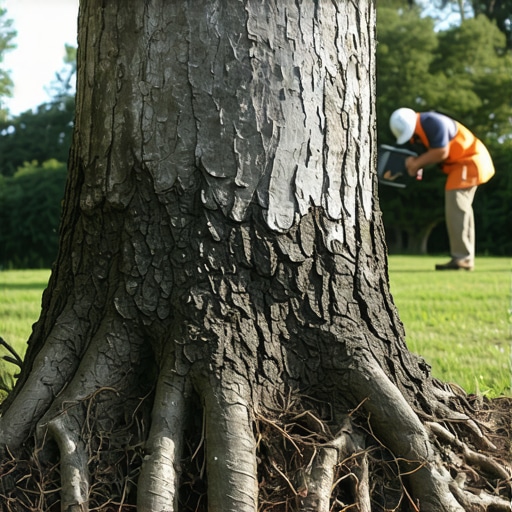
Understanding the Silent Killer: What is Tree Girdling?
Tree trunk girdling occurs when roots grow circularly around the main stem, eventually strangling the vascular system and cutting off nutrient flow. This condition, often caused by improper planting depth or compacted soil, leads to canopy dieback and eventual tree death if not remediated by cutting sucker roots and exposing the root flare.
I always drill into my new crew members: if you don’t fix the soil grading first, every plant you put in the ground is just expensive compost. I once walked onto a job site where a homeowner had spent twelve thousand dollars on mature maples. Within three years, every single one was flagging. Why? The previous contractor had buried the root flares under eight inches of heavy clay soil during a sod install. They didn’t understand that roots need gas exchange. By the time I arrived, the adventitious roots had wrapped around the trunks like a slow-motion noose. We had to excavate every single tree with an air spade just to give them a fighting chance. It was a forensic autopsy of a failed landscape.
“Girdling roots can reduce the lifespan of an urban tree by 50% or more if the root flare is not properly exposed.” – International Society of Arboriculture (ISA) Best Management Practices
The Biology of a Chokehold
To understand girdling, you must understand the cambium. This thin layer of tissue just beneath the bark is the tree’s highway. The xylem moves water up; the phloem moves sugars down. When a root crosses the trunk, it applies constant pressure. As the tree grows in diameter, that pressure increases. Eventually, the PSI (pounds per square inch) exerted by the root exceeds the internal pressure of the vascular cells. The highway is blocked. Nutrients stop moving. The tree starves while standing in a yard full of fertilizer.
Why Sucker Roots Are a Red Flag
Sucker roots, or adventitious shoots, are not just a nuisance for your yard cleanup routine. They are a physiological distress signal. When a tree is stressed by deep planting or girdling, it produces auxins and cytokinins in a desperate attempt to create new pathways for growth. These suckers pull energy away from the main canopy. If you see a cluster of small, weak stems sprouting from the base of your oak or maple, the tree is telling you its primary system is failing. Don’t just prune them off; find out why they are there.
“Adventitious roots, or suckers, are often a physiological response to stress, signaling that the primary vascular pathway is compromised.” – Texas A&M AgriLife Extension
Comparing Root Health and Soil Conditions
| Condition | Visual Symptom | Structural Cause | Remediation Priority |
|---|---|---|---|
| Healthy Flare | Wide, buttressed base | Proper planting depth | Annual mulch (2 inches) |
| Girdled Trunk | Straight ‘telephone pole’ look | Circling roots / Compaction | Root pruning / Air excavation |
| Sucker Growth | Dense shoots at base | Vascular stress / Nitrogen spike | Identify trunk obstruction |
| Surface Roots | Roots visible above sod | Irrigation frequency issues | Deep watering cycle adjustment |
How do I identify a girdling root?
Identification starts at the soil line. Look for a flat side on the trunk of the tree. A healthy tree should widen as it meets the ground. If the trunk goes straight into the dirt like a telephone pole, you have a problem. Gently brush away the soil or mulch. If you see a root crossing the main stem or circling the trunk, that is a girdling root. You may also notice that one side of the tree’s canopy is thinning or turning yellow earlier in the fall than the rest of the tree. This localized dieback often corresponds directly to the side of the trunk being strangled.
When is the best time to prune tree suckers?
Prune suckers the moment you see them, but perform major root surgery during the dormant season (late winter or early spring). Cutting roots during the heat of summer puts too much stress on the irrigation demands of the plant. Use a sharp wood chisel and a mallet for a clean cut. Do not use a chainsaw; the dirt will dull the blade instantly and leave a ragged wound that invites fungal pathogens. Always aim for a clean, flush cut against the parent root or trunk without damaging the bark of the main stem.
The 2026 Tree Health Audit Checklist
- Locate the root flare (the point where the trunk widens).
- Remove excess mulch ‘volcanoes’ from the base.
- Inspect for roots crossing the trunk at or below the soil line.
- Check for irrigation emitters spraying directly against the bark (this causes rot).
- Audit your landscaping crew’s mower height; mechanical damage to the flare leads to suckers.
- Verify 811 / Dig Safe markings before any deep excavation near utility lines.
Correcting the Damage: A Step-by-Step Guide
First, clear the area. If you recently had a sod install, ensure the grass isn’t creeping up the trunk. Use a hand trowel to carefully remove soil until you find the first set of structural roots. If you find a girdling root, you must remove a section of it, not just cut it. Removing a 2-inch chunk ensures the root cannot graft back together. Be conservative. Never remove more than 25 percent of the total root system in one year. If the root is too large and already embedded in the trunk, stop. At that point, you’re better off managing the tree’s decline than causing an immediate structural failure. Proper landscaping is about long-term engineering, not quick fixes. Keep your tools sharp. Keep your soil loose. Stop burying your investment.