
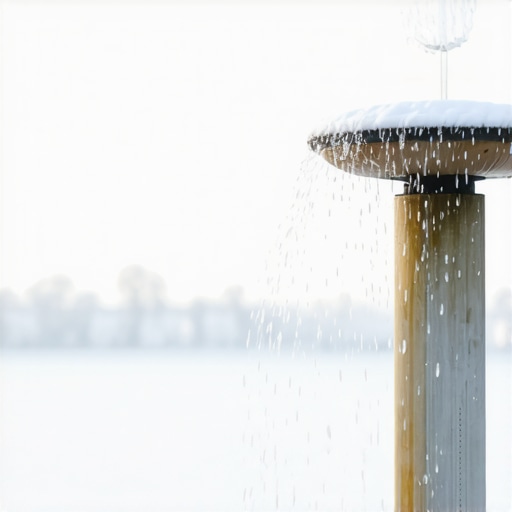
Stopping Winter Ice Damage in Your Concrete Fountain
Stopping winter ice damage in your concrete fountain requires a complete removal of moisture, the application of breathable protective barriers, and mechanical isolation of the pump. Concrete is naturally porous; if water remains in the capillary pores during a freeze-thaw cycle, the 9 percent expansion of ice creates internal tensile stress exceeding 30,000 PSI, which causes structural cracking and spalling.
The Hardscape Autopsy: A Expensive Lesson in Thermal Expansion
I recently got called out to tear up a custom-built, $30,000 stone and concrete water feature that was literally shearing apart at the base. The homeowner thought that simply turning off the pump was enough. It was not. Because they left three inches of water in the lower basin, the ice expanded outward against the vertical walls while simultaneously driving downward into the micro-fissures of the floor. By January, the hydrostatic pressure had snapped the rebar reinforcement. We had to excavate the entire site, haul away three tons of debris, and start over from the gravel base. It was a total loss caused by a twenty-minute oversight. This is why I tell my crew: water is the most destructive force in any landscaping project. If you do not control where it goes, it will control your bank account. You cannot fight physics. You can only plan for it.
“Concrete is a porous material that acts like a sponge, drawing in moisture through capillary action. When this moisture freezes, the internal pressure can easily exceed the tensile strength of the concrete, leading to catastrophic structural failure.” – International Concrete Repair Institute (ICRI) Guidelines
The Engineering of Freeze-Thaw Destruction
Concrete is not a solid, inert block; it is a complex chemical matrix. In a typical landscaping environment, concrete fountains are subjected to constant moisture. When the temperature drops below 32 degrees Fahrenheit, the water trapped in the concrete pores transitions to ice. This is not just about the surface water. We are talking about the moisture inside the material itself. If you do not perform a proper yard cleanup that includes drying these features, the moisture stays trapped. The resulting spalling is often the first sign of failure. This is where the surface of the concrete flakes off in thin layers. Once the surface is compromised, the internal rebar is exposed to oxygen and moisture, leading to rust. Rust expands, creating even more internal pressure. It is a death spiral for your fountain.
Technical Comparison of Winterization Methods
Choosing the right protection level depends on your USDA hardiness zone and the specific density of your fountain material. Do not treat a GFRC (Glass Fiber Reinforced Concrete) fountain the same way you treat a heavy cast stone piece.
| Method | Effectiveness | Required Effort | Primary Risk |
|---|---|---|---|
| Simple Drainage | Low | Minimal | Standing water in pump lines |
| Breathable Cover | High | Moderate | Condensation trapping |
| Full Dismantling | Maximum | High | Mechanical damage during transport |
| Immersion Heaters | Medium | Low | Electrical failure/Fire risk |
How Much Drainage Is Actually Necessary?
Drainage is not just about the basin. You must evacuate every irrigation line and internal tube within the fountain. If a single check valve holds water, that valve will shatter. When we handle a sod install or a full landscape build, we always install a low-point drain for water features. If yours doesn’t have one, you need to use a wet-dry vacuum to pull every drop out of the internal plumbing. This is the difference between a fountain that lasts 50 years and one that lasts three. You must also consider the pump. Never leave a pump in a dry fountain. The seals will dry out and crack. Remove it, submerge it in a bucket of water in a frost-free garage, and keep those seals supple.
The Proper Winterization Checklist
- Total Evacuation: Use a siphon or pump to empty all basins. Use a shop vac for the final inch.
- Pump Removal: Disconnect the pump and store it in a bucket of water indoors to prevent seal dry-out.
- Cleaning: Scrub away algae and mineral deposits now; they hold moisture against the concrete.
- Absorbent Placement: Place an old blanket or burlap inside the dry basin to absorb any stray condensation.
- Covering: Use a dedicated fountain cover. Avoid tight plastic wraps that trap moisture and cause mold.
“A retaining wall or concrete structure doesn’t fail because of the stone; it fails because of the water trapped behind or within it.” – Hardscape Engineering Axiom
Can I use an immersion heater in my concrete fountain?
Immersion heaters are a risky band-aid for poor planning. While they prevent the water from freezing, they create a massive temperature gradient between the heated water and the freezing air. This thermal shock can cause the concrete to crack along the waterline. I never recommend them for decorative concrete. It is far more efficient to drain the system. If you must keep it running for birds, you are essentially gambling with the structural integrity of the cast stone.
Why is my fountain crumbling even when it is covered?
If you use a non-breathable plastic tarp, you are creating a greenhouse. During the day, the sun hits the plastic and warms the air inside, drawing moisture out of the ground. At night, that moisture condenses on the fountain and freezes. You are effectively putting your fountain through a freeze-thaw cycle every single day. Always use a breathable material or ensure there is a gap at the bottom for airflow. Air movement is your best friend in landscaping maintenance. It prevents the moisture buildup that leads to the very damage you are trying to avoid.
The Long-Term Impact of Salt and De-icers
Whatever you do, keep rock salt away from your concrete fountain. If you are doing a yard cleanup and salting your walkways, be careful. Sodium chloride and calcium chloride chemically attack the concrete paste. They also increase the number of freeze-thaw cycles by lowering the freezing point of water, which sounds good but actually leads to more frequent internal pressure changes. Use sand for traction near your water features instead. It is a messier cleanup in the spring, but it won’t eat your fountain.