
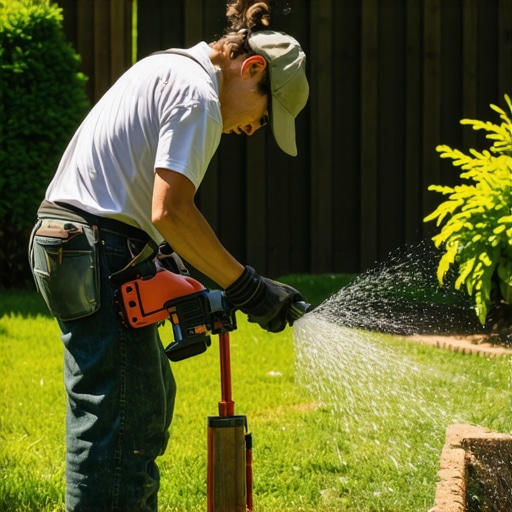
Why Homeowner Compressor Blowouts Usually Fail
Sprinkler winterization prevents catastrophic pipe failure by removing standing water that expands by 9% when frozen. Without high CFM air volume, water lingers in low spots, leading to cracked PVC and ruptured backflow preventers that cost thousands to replace during your spring landscaping refresh.
I recently got called out to tear up a $30,000 patio that was sinking because the previous contractor failed to properly winterize the irrigation lines running underneath. The homeowner used a small 3-gallon pancake compressor to blow out the lines. It didn’t have the volume to clear the low-point bellies in the pipe. Over the winter, those pipes burst. By May, the leaking water had undermined the modified gravel base of the pavers. The entire hardscape was a total loss. This is the reality of irrigation physics. It is not about how hard you blow; it is about how much air you move. If you do not understand the difference between PSI and CFM, you are going to destroy your yard.
“Residual water in irrigation systems accounts for nearly 70% of early spring hardscape and turf damage in northern climates.” – Irrigation Association Standards
The Physics of Air Volume vs Pressure
Successful irrigation blowout requires high volume air at low pressure to maintain a constant wall of air that pushes water out of the heads. High pressure at low volume merely blows a hole through the water, leaving half of it behind to freeze and shatter your lateral lines. We call this the slug flow vs mist flow problem.
How much air pressure do I need for a sprinkler blowout?
You should never exceed 50 PSI for PVC pipe or 80 PSI for polyethylene pipe when blowing out an irrigation system. Excessive pressure creates friction that melts internal plastic components and creates a water hammer effect that can shatter valve diaphragms instantly.
| Compressor Type | CFM Rating | Suitability | Risk Level |
|---|---|---|---|
| Pancake Compressor | 2.0 – 4.0 | Low (Only for single short runs) | High – Leaves water in low spots |
| Twin Stack | 4.0 – 6.0 | Moderate (Requires tank buffering) | Medium – Requires patience |
| Commercial Tow-Behind | 185.0+ | Professional Standard | Low – High volume clearing |
| Dual Home Compressors | 8.0 – 10.0 | High (When bridged together) | Low – DIY Gold Standard |
The Multi-Compressor Bridge Technique
If you refuse to rent a 185 CFM Sullair, the only professional way to do this is by bridging two home compressors. You need a high-volume air manifold. By connecting two compressors to a single T-junction, you double your CFM. This provides enough volume to lift the water out of the sprinkler heads and prevent it from draining back into the pipe bellies. This is critical for a successful yard cleanup before the first hard freeze hits your region.
Can a small compressor blow out a sprinkler system?
A small compressor can blow out a sprinkler system only if you use a large auxiliary air tank to buffer the volume. You must charge the tanks to 100 PSI, then use a regulator to drop the output to 50 PSI, allowing for a sustained burst of air that lasts at least 60 seconds per zone.
“A Pressure Vacuum Breaker (PVB) must be completely drained or blown dry; even a thimble of water can crack the internal brass poppet.” – ASSE Backflow Prevention Manual
- Step 1: Main Water Isolation. Locate the shut-off valve inside the basement or crawlspace and close it tight.
- Step 2: Backflow Prep. Open the test cocks on your PVB or RPZ valve to 45 degrees. Do not leave them fully open or fully closed.
- Step 3: Compressor Connection. Attach your air lead to the blowout port using a galvanized or brass nipple. Avoid plastic fittings.
- Step 4: Zone Cycling. Start with the zone furthest and highest from the compressor. Open the valve manually via the controller.
- Step 5: Monitoring. Watch the heads. When the water spray turns to a fine mist, move to the next zone. Never run air for more than 2 minutes per zone to avoid melting the pipe.
Impact on Sod Install and Landscaping Health
Failure to clear lines properly has a direct impact on your sod install investments. When a pipe bursts beneath new sod, the resulting leak creates an underground cavern. By the time you see the surface start to squish, the root system of your expensive turf is already rotting. Proper irrigation maintenance is the foundation of any professional landscaping plan. If the pipes are not clear, the soil microbiology suffers from anaerobic conditions caused by winter saturation. It will rot. Don’t skip the blowout. Use a moisture meter to verify the soil near the heads is not oversaturated after your DIY attempt. If you see water bubbling back into the valve box after the compressor is off, you have failed. The water is back-flowing from a high point. Repeat the cycle until the lines are bone dry. This is the only way to protect your infrastructure without a commercial rental.