
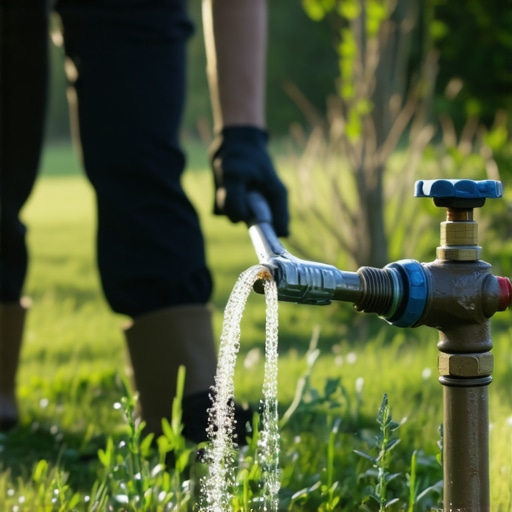
The Physical Implosion of a Frozen Garden System
Blowing out your garden hoses and irrigation lines prevents catastrophic damage caused by the 9% expansion of water as it transitions into ice. This hydrostatic pressure can exceed 100,000 PSI, which easily shreds brass fittings, splits reinforced rubber hoses, and shatters the internal valves of your outdoor spigots. Don’t wait for the first hard freeze.
I always drill into my new crew members: if you don’t fix the soil grading first, every plant you put in the ground is just expensive compost. The same logic applies to winterization. I’ve seen rookies think they can just disconnect a hose and call it a day. Then, come April, they turn the water on and realize the pipe burst inside the wall because of a siphon effect. It’s a mess. It costs thousands. It’s entirely avoidable. Proper landscaping isn’t just about the sod install or the yard cleanup; it is about protecting the mechanical infrastructure that keeps the biology alive.
“A retaining wall doesn’t fail because of the stone; it fails because of the water trapped behind it. In irrigation, the same principle of trapped water governs the destruction of valves during a freeze.” – Hardscape Engineering Axiom
The Microscopic Reality of Ice Expansion
When temperatures drop below 32°F, the hydrogen bonds in water molecules rearrange into a crystalline lattice. This isn’t just a change in state; it’s a structural expansion. If that water is trapped inside a 50-foot landscaping hose or an irrigation manifold, it has nowhere to go. It will find the weakest point—usually the threading or the O-ring—and obliterate it. It will rot your gaskets. It will crack your brass.
The Anatomy of a Bursted Sillcock
A burst sillcock or outdoor faucet occurs when a garden hose is left attached during a freeze, preventing the ‘frost-proof’ valve from draining its internal chamber. This trapped water expands, splitting the copper pipe located several inches inside the heated envelope of your home, leading to hidden basement floods. The hose acts as a plug. Even if the hose is ’empty,’ the residual moisture at the connection point is enough to cause a seal that traps water in the ‘danger zone’ of the pipe.
| Hose Material | Freeze Risk Level | Failure Mechanism |
|---|---|---|
| Reinforced Vinyl | High | Becomes brittle and splits along the seam |
| Heavy-Duty Rubber | Medium | Expansion fatigue leads to pinhole leaks |
| Polyurethane | Low | Maintains flexibility but fittings remain vulnerable |
| Expandable ‘Pocket’ Hoses | Extreme | Inner latex core snaps instantly when frozen |
How much pressure do I need to blow out an irrigation line?
To safely blow out irrigation lines without melting the plastic pipes, you need a high-volume, low-pressure air compressor capable of delivering at least 20-50 CFM (cubic feet per minute). Setting the pressure between 50 and 80 PSI is the sweet spot. Too much pressure creates friction heat. It will melt the PVC. Too little pressure won’t clear the low spots in the line where water pools.
The Step-by-Step Winterization Protocol
Winterizing your outdoor water systems requires a systematic approach to ensure every drop of standing water is evacuated from the irrigation zones and hose bibs. Follow this sequence to protect your sod install and landscaping hardware before the ground frost depth reaches your pipes.
- Shut off the main interior water supply valve leading to the outdoor spigots.
- Open the outdoor faucet completely to drain the initial volume.
- Disconnect all garden hoses, nozzles, and splitters.
- Open the ‘bleeder’ cap on the indoor shut-off valve to drain the remaining vacuum-locked water.
- If you have an in-ground system, hook the compressor to the blowout port and cycle through each zone until only mist remains.
“Proper winterization of irrigation systems in cold climates is the single most effective maintenance task to extend the lifespan of PVC and PE piping.” – Texas A&M AgriLife Extension
Can I leave a garden hose out in the winter?
Leaving a garden hose outdoors during winter is a recipe for internal fatigue and UV degradation. Even if you drain it, the fluctuating temperatures cause the material to expand and contract, weakening the structural integrity of the hose walls. Bring them into a shed or garage. Don’t be lazy. Coil them loosely to avoid permanent kinks. If you leave them out, they will fail by year three.
The Hidden Danger to Your New Sod
If you just finished a sod install, you might be tempted to keep the water running late into the fall. This is a mistake. Irrigation lines buried only a few inches deep are the first to freeze. If a line bursts underground, you won’t know until spring when you turn the system on and create a subterranean lake. This will drown your new grass roots and lead to fungal pathogens like Pythium blight as soon as the weather warms up. It’s a total loss scenario. You must balance hydration with the hard reality of the thermometer.
How do I know if my outdoor faucet is frost-proof?
A frost-proof faucet is identified by a long stem—usually 8 to 14 inches—and a mounting flange that is angled slightly downward to allow gravity to drain the water. However, the ‘frost-proof’ designation is only valid if the hose is removed. If the hose stays on, the physics change. The water can’t drain. The pipe will burst. Every time. No exceptions.
The Final Word on Fall Cleanup
A proper yard cleanup is more than just raking leaves; it is a mechanical audit of your entire property. Check the landscaping beds for proper mulch levels to insulate root zones, but keep the water away from the foundation. Ensure your hoses are bone-dry and stored. If you treat your gear like an engineer, it will last a lifetime. If you treat it like a ‘mow-and-blow’ hack, you’ll be writing a check for new plumbing in April. Make your choice.