
The Hardscape Autopsy: Why Physics Always Wins
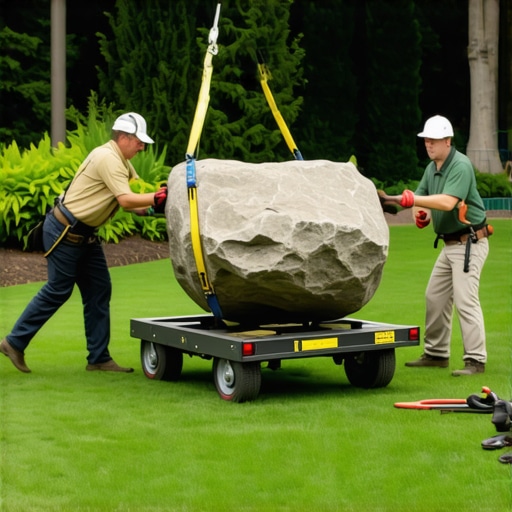
Moving heavy boulders requires mechanical advantage through levers, friction reduction using rollers or sleds, or hydraulic power like a skid steer to prevent soil compaction and personal injury. I recently performed a hardscape autopsy on a property where a DIYer tried to move a 1,800-pound granite boulder using a chain and a pickup truck. He didn’t just ruin his transmission; he dragged the stone across a fresh sod install, severing three irrigation lateral lines and compacting the subsoil to 300 PSI. The result was a drainage nightmare and $5,000 in repairs. Don’t be that guy. Boulders are not just decorations; they are multi-ton engineering challenges that require respect for gravity and soil structural integrity. If you ignore the physics, the rock wins every time. It will not negotiate.
“A retaining wall doesn’t fail because of the stone; it fails because of the water trapped behind it, or a base that cannot support the dead load.” – Hardscape Engineering Axiom
The Engineering of Weight: Calculating Your Load
Calculating the weight of your material is the first step in landscaping logistics to ensure your equipment and path can handle the hydrostatic pressure and dead weight. Most igneous rocks like granite weigh approximately 165 to 175 pounds per cubic foot. A boulder that is roughly 3 feet by 3 feet by 3 feet isn’t just ‘big’—it’s a 4,500-pound monster. Before you even touch a pry bar, you must calculate the load-bearing capacity of the ground you’re crossing. Standard residential turf can rarely support the point-load of a multi-ton rock without significant deformation. This is where yard cleanup becomes a reconstruction project if you aren’t careful. You must account for the ‘A’ horizon of the soil. This top layer is full of pore space for oxygen and water. Squash those pores, and you kill the microbiology. The grass will die. The soil will sour.
How do you move a rock that is too heavy to lift?
To move a rock that exceeds your lifting capacity, you must utilize mechanical advantage via a Class 1 lever or reduce the coefficient of friction using a heavy-duty stone sled or PVC rollers. For stones in the 500-pound range, a 6-foot steel san angelo bar provides the leverage needed to ‘walk’ the stone. For anything heavier, you are looking at a skid steer with a 2,500-pound Tipping Operating Capacity (ROC). Never use a wooden 2×4. It is a toothpick. It will snap. It will hurt you. You need 1-inch thick steel. This is non-negotiable for safety.
| Method | Weight Limit | Soil Impact | Required Tools |
|---|---|---|---|
| Steel Pry Bar (Leverage) | Up to 800 lbs | Moderate | 6ft San Angelo Bar, Pivot block |
| PVC Rollers & Plywood | Up to 2,000 lbs | Low | 4-inch Schedule 40 PVC, 3/4″ Plywood |
| Skid Steer (Hydraulic) | Up to 4,000 lbs | High | Track Loader, Rock Bucket |
| Stone Sled (Drag) | Up to 1,200 lbs | Extreme | Steel Plate, Winch, Tow Strap |
The Roller and Plywood System: The Professional Secret
Reducing the coefficient of friction is the most efficient manual way to move massive stones across a yard without destroying your irrigation system or expensive sod install. By laying down 3/4-inch CDX plywood, you distribute the boulder’s weight across a larger surface area, preventing the stone from sinking into the loam. We call this ‘planking.’ You use three pieces of 4-inch Schedule 40 PVC pipe as rollers. As the stone moves forward over the first roller, you take the one that pops out the back and move it to the front. It’s ancient Egyptian technology because it works. It keeps the stone’s center of gravity low. This is critical. A high center of gravity leads to tip-overs. Tip-overs lead to broken ankles.
“Soil compaction from heavy equipment can reduce water infiltration rates by up to 90%, leading to increased runoff and plant stress.” – Penn State Agricultural Extension
What is the best tool for moving large stones?
The best tool for moving large stones is a skid steer with tracks (not wheels) because the tracks distribute the weight over a larger footprint, minimizing soil compaction and protecting irrigation lines. If manual movement is required, a steel rock dolly with pneumatic tires or a Burke bar are the industry standards. A Burke bar has a curved head that provides a higher pivot point than a standard pry bar. This allows for more vertical lift with less horizontal effort. Every inch of lift counts when you’re trying to clear a root flare or a curb.
Integrating Boulders into Existing Landscaping
Successful landscaping requires that boulders look like they grew from the earth, which means burying at least one-third of the stone’s height below the finished grade. When we do a sod install around a new boulder, we first excavate a ‘footing’ of 6 inches of compacted 3/4-inch minus gravel. This prevents the stone from settling unevenly over time. If you just drop a rock on top of the grass, it will eventually tilt as the organic matter beneath it rots. Furthermore, you must map your irrigation heads before placement. A 2,000-pound rock on top of a PVC junction box is a ticking time bomb. Use marking paint. Flag everything. Check the 811 marks for gas and electric. Digging a hole for a boulder ‘seat’ is still digging. Don’t be the guy who knocks out the neighborhood’s fiber optic line.
- Step 1: Scout the path and mark all irrigation heads and valve boxes.
- Step 2: Lay 3/4-inch plywood ‘roads’ to protect the turf from compaction.
- Step 3: Use a 5:1 leverage ratio (6-foot bar) to nudge the stone onto the sled or rollers.
- Step 4: Move slowly. Sudden shifts in weight can crush steel and bone alike.
- Step 5: Excavate the ‘pocket’ and backfill with crushed stone for drainage.
- Step 6: Hand-tamp the soil around the base to prevent air pockets that cause settling.
Once the stone is set, perform a yard cleanup to remove the ‘spoils’ (the dirt you dug out). This dirt is often heavy clay or subsoil and should not be spread over your lawn; it will smother the grass. Instead, use it to build up a berm behind the rock or haul it away. Finally, check your irrigation zones. The weight of the equipment or the stone itself may have shifted the soil enough to misalign a sprinkler head. Fix it now, or you’ll have a dead spot in your lawn by mid-July. Landscaping is 10% art and 90% grunt work and physics. Respect the math, and the results will last a century.