
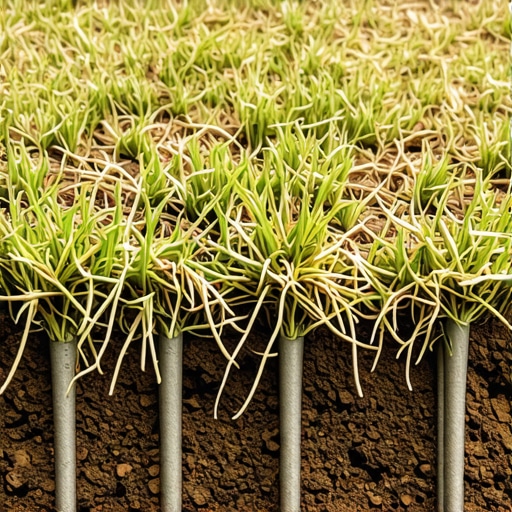
Why Aeration Fails to Green Up Your Lawn
The primary reason grass remains brown after aeration is usually localized dry spot (LDS) caused by soil hydrophobicity or a lack of immediate nutrient availability in the root zone. If the soil cannot absorb water or lacks the nitrogen-heavy NPK ratio required for recovery, the grass enters a dormant state rather than a growth phase. Aeration is a mechanical disruption, and without proper follow-up, it acts as a stressor rather than a stimulant.
I always drill into my new crew members: if you don’t fix the soil grading first, every plant you put in the ground is just expensive compost. I remember a job in the suburbs where a homeowner had rented an aerator every year for a decade, yet his lawn looked like a gravel pit. He was punching holes into a 4-inch layer of unmanaged thatch that had become practically waterproof. He was doing the work, but he wasn’t doing the science. He didn’t realize that aeration is only the first step in a biological chain reaction. Without breaking the surface tension of the soil or introducing the right microbial life, those holes are just wounds in the turf that allow more moisture to escape. If you aren’t seeing green within fourteen days, your system is broken.
“Core aeration is most effective when the soil is moist enough to allow for deep penetration, ideally reaching a depth of 2.5 to 3 inches to properly relieve sub-surface compaction.” – Agronomy Manual of Turfgrass Management
The Physics of Soil Compaction and Hydrophobicity
When soil becomes compacted, the bulk density increases, which collapses the macropores necessary for oxygen and water movement. You might see the holes from the aerator and think the job is done. It is not. If your soil has a high clay content, the sidewalls of the holes can actually become glazed by the tines of the aerator. This creates a tiny, hardened silo that prevents roots from spreading. This is why yard cleanup must include a detailed assessment of soil texture. If you have waxy organic matter buildup, you are dealing with hydrophobicity. Water will bead on the surface and run off into the gutter instead of sinking into the root zone. You need a surfactant or a wetting agent to break that polar bond. Stop guessing and start measuring your soil’s infiltration rate. It is the difference between a thriving lawn and a brown waste of time.
Why is my grass brown after core aeration?
Your grass is likely brown because the evapotranspiration rate is exceeding the water uptake capacity of the damaged root system. Aeration exposes the root zone to air. While oxygen is good, too much dry air hitting the roots without immediate irrigation causes desiccation. This is essentially freezer burn for your lawn. You must calibrate your irrigation system to deliver exactly one inch of water per week, split into two deep sessions, to force those roots to chase the moisture downward. If you are just misting the surface for ten minutes every morning, you are training your grass to stay shallow and weak. Shallow roots die in the sun. Deep roots survive the heat.
The Nutrient Gap: NPK and Microbial Activity
After you pull those cores, the lawn is in a state of metabolic hunger. This is the optimal window for a sod install or heavy overseeding, but most people skip the fuel. You need a high-nitrogen starter fertilizer to kickstart the recovery. I prefer a 3-1-2 ratio for established turf. This provides the nitrogen for blade growth, phosphorus for root development, and potassium for cellular health. Without this, the grass doesn’t have the energy to heal the holes you just punched in it. You are basically performing surgery on the lawn and then refusing to give it any food. It will rot if you don’t act fast.
| Amendment Type | Function | Best Application Time | Expected Result |
|---|---|---|---|
| Humic Acid | Increases CEC (Cation Exchange Capacity) | Immediately Post-Aeration | Better nutrient retention |
| Nitrogen (Quick Release) | Forces Chlorophyll Production | 48 Hours Post-Watering | Rapid green-up |
| Wetting Agents | Breaks Soil Surface Tension | During Heat Stress | Uniform moisture distribution |
| Pelletized Lime | Adjusts Soil pH | Late Fall or Early Spring | Reduces acidity, unlocks nutrients |
How much water does a lawn need after aeration?
A lawn needs at least 0.5 inches of water immediately following aeration to settle the soil and hydrate the exposed root flares. Following this initial soak, you should maintain a schedule of 1 to 1.5 inches of total water per week. Use a rain gauge or an empty tuna can to measure this. Do not trust your timer; trust the volume. If you see puddling, your soil has reached its saturation point, and you are risking anaerobic conditions which lead to root rot. If the soil is hard as a rock two days later, you didn’t water enough. It is a binary reality. There is no middle ground in irrigation.
“A retaining wall doesn’t fail because of the stone; it fails because of the water trapped behind it, much like a lawn fails not because of the grass, but because of the soil structure beneath it.” – Hardscape Engineering Axiom
The Forensic Cleanup Checklist
If your lawn is still brown, go through this checklist. Do not skip any steps. One missing piece of the puzzle will ruin the entire project.
- Check Tine Depth: Did the aerator actually pull 3-inch plugs? If the plugs are less than 2 inches, you didn’t reach the compaction layer.
- Monitor Plug Breakdown: Are the cores melting back into the soil? If they are sitting on top like hard rocks for weeks, your soil biology is stagnant. You need to add organic matter or compost tea.
- Audit the Irrigation: Perform a catch-can test. Are there dry spots where the sprinklers aren’t hitting? Aeration makes these gaps even more obvious.
- Soil pH Testing: If your pH is below 6.0, your grass cannot even “see” the fertilizer you’re putting down. It’s chemically locked away.
- Inspect for Thatch: If your thatch is thicker than 0.5 inches, you need a power rake, not just an aerator. Thick thatch acts like a sponge that steals water before it reaches the dirt.
The Long Game: Maintenance and Recovery
Professional landscaping is about the 52-week cycle, not a single afternoon with a rented machine. Once the aeration is done and the green returns, you have to maintain the soil structure. This means no heavy equipment on wet grass and varied mowing patterns to prevent ruts. If the grass stayed brown this time, take it as a lesson in soil physics. Your yard isn’t a carpet; it’s a living, breathing respiratory system. Treat it with the engineering respect it deserves. Stop using cheap, synthetic quick-fixes from the big-box store. Buy quality seed, use professional-grade surfactants, and watch the moisture levels like a hawk. Your grass will respond when the environment is right. It has no choice. It is biology.