
The Surface Tension Trap: Why Silt Soil Refuses to Let Seed Breathe
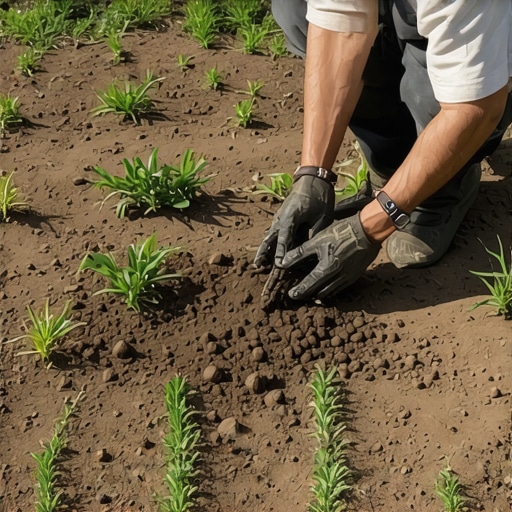
Silt soil prevents seed sprouting primarily through surface crusting, where fine particles consolidate into a concrete-like layer after rain or irrigation. This physical barrier blocks oxygen and prevents the coleoptile from breaking through, essentially suffocating the germinating seed before it ever sees daylight. If you are staring at a bare patch of ground that feels hard as a rock yet looks like fine powder, you are dealing with a mechanical failure of the soil structure, not a ‘bad batch’ of seed. Professional landscaping starts with understanding that silt is a liar. It looks soft when dry, but it is a structural nightmare for new turf.
A homeowner recently called me in a panic after they completely torched their front lawn by applying forty pounds of high-nitrogen starter fertilizer on top of raw, un-aerated silt. I walked onto the property and the ground looked like a salt flat. The chemical burn had sterilized the top inch of the soil profile, creating a toxic saline environment where the seed’s osmotic pressure was reversed. Instead of the seed absorbing water, the high salt concentration in the silt was literally sucking the moisture out of the embryonic plant. They didn’t just kill the seed; they nuked the microbes that make growth possible. This is the ‘Chemical Nightmare’ scenario that happens when you treat your lawn like a laboratory experiment without knowing the chemistry of your medium.
Why is my grass seed turning into mush?
Grass seed turns to mush in silt soil because the microscopic particles, which range from 0.002 to 0.05 millimeters, collapse into the soil’s pore spaces, cutting off all oxygen. Without oxygen, anaerobic bacteria take over the seed coat, rotting the embryo before it can establish a root system. This is a common issue during a failed yard cleanup where the soil is left exposed to heavy rain. Silt lacks the structural stability of sand and the chemical binding properties of clay. It exists in a purgatory of particle sizes that is prone to ‘hydrostatic lock’ when saturated. When you see that white or grey fuzz on your seed, it isn’t growth; it is the funeral shroud of a plant that couldn’t breathe.
“Silt-dominated soils are prone to compaction and crusting because they lack the structural stability of sand and the chemical binding properties of clay.” – USDA Soil Survey Manual
The Engineering of Silt: Compaction and Bulk Density
Silt particles are like tiny plates that stack perfectly on top of one another. When water is added, it acts as a lubricant, allowing these plates to slide into a configuration that maximizes density and minimizes air. In the world of civil engineering and high-end landscaping, we measure this as bulk density. A healthy lawn needs a bulk density below 1.4 grams per cubic centimeter. Silt can easily spike to 1.7 or higher after a single heavy rain event. At that point, the soil is physically too dense for a tender root to penetrate. The root hits the ‘silt cap’ and turns sideways, eventually drying out and dying. This is why a professional sod install often requires excavating the top four inches of silt and replacing it with a sandy loam mix.
| Soil Property | Silt Soil | Sandy Soil | Clay Soil |
|---|---|---|---|
| Particle Size | 0.002 to 0.05mm | 0.05 to 2.0mm | Under 0.002mm |
| Drainage Speed | Moderate to Slow | Rapid | Very Slow |
| Compaction Risk | Extreme | Very Low | High |
| Seed Germination | Poor (Crusting) | Good (Needs Water) | Moderate (Heavy) |
How do I fix silt soil for grass seed?
Fixing silt soil for grass seed requires breaking the surface tension and introducing organic ‘aggregates’ like compost or peat moss to prevent the particles from re-bonding. You must mechanically aerate the soil to a depth of at least three inches, then top-dress with a material that has a larger particle size to keep those ‘plates’ from stacking. Don’t just throw seed on top. You need to incorporate it into the top quarter-inch of the modified soil profile. This creates the necessary pore space for gas exchange. If you skip this, you are just feeding the birds expensive snacks.
- Core Aeration: Pull 3-inch plugs to break the physical compaction.
- Organic Amendment: Spread 1/2 inch of leaf compost to act as a buffer.
- Seed Selection: Use ‘Aggressive’ species like Turf-Type Tall Fescue that have stronger coleoptiles.
- Top-Dressing: Lightly cover with weed-free straw or a light dusting of peat.
- Irrigation Calibration: Move to frequent, light misting until germination, then switch to deep watering.
The Irrigation Paradox in Silt Landscapes
Your irrigation habits are likely making your silt problem worse. While the internet tells you to water every day, turf grass actually needs deep, infrequent watering—exactly 1 inch per week—to force roots to chase the moisture down. However, during the germination phase in silt, if you apply too much water at once, you trigger the ‘slaking’ effect where the soil structure collapses instantly. You need a smart controller set to ‘pulse’ irrigation. Water for 3 minutes, wait 30, then water for 3 more. This allows the silt to absorb moisture without the surface becoming a slurry. Once the grass is an inch tall, you must stop the frequent misting. If you keep the surface of silt wet, you will develop ‘damping off’ fungus that will wipe out your new lawn in 48 hours. It will rot. Don’t skip the drying cycle.
“A retaining wall doesn’t fail because of the stone; it fails because of the water trapped behind it. The same hydrostatic pressure exists at a micro-level in silt soil, crushing the life out of seeds.” – Hardscape Engineering Axiom
When to Give Up: The Sod Install Pivot
Sometimes, the silt content is so high (over 60%) that seeding is a fool’s errand. This is common in river valley regions where the soil is essentially ‘rock flour’ from ancient glacial movements. If you have failed at seeding three times, it is time for a sod install. Sod provides an instant biomass layer that protects the underlying silt from crusting. The mature root system of the sod has the mechanical force to punch through the silt cap. However, you cannot just slap sod over compacted silt. You must till the top two inches and incorporate gypsum. Gypsum reacts with the soil chemistry to encourage ‘flocculation,’ which is the process of small particles clumping together into larger ones. This opens up the soil for the sod’s roots to take hold. It is a more expensive landscaping choice, but it is the only way to beat high-silt environments in a single season.
The Maintenance Horizon: Year One and Beyond
Once you get that seed to sprout, your job isn’t over. Silt has a memory. It wants to compact. You should plan on core aeration every single fall for the first three years. Avoid using heavy riding mowers when the soil is damp. A 500-pound mower on wet silt is a compaction machine. Use a walk-behind mower and keep the blades sharp. If you tear the grass leaf, you stress the plant, and a stressed plant in silt soil is a dead plant. Watch your pH levels too. Silt often masks acidity. A pH of 6.5 is your target. Anything lower and the nutrients become ‘locked’ in the silt particles, unavailable to the grass roots. Test your soil. Don’t guess. Precision is the difference between a lawn and a weed patch.