
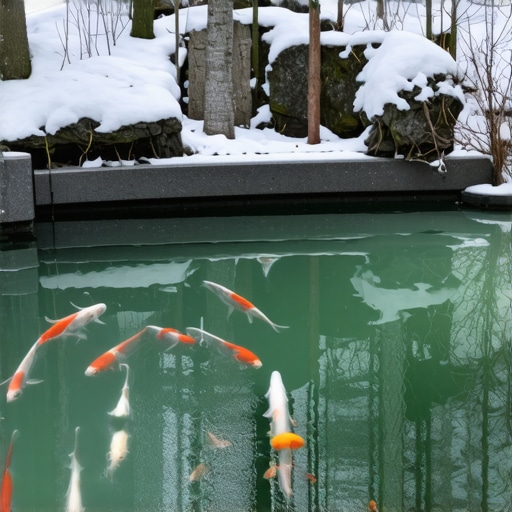
The Forensic Autopsy of a Frozen Disaster
I recently got called out to tear up a $30,000 pond and patio installation that was sinking and smelling of rot because the previous contractor didn’t understand the fundamentals of hydrostatic pressure or biological oxygen demand. The homeowner had found all twelve of their mature koi floating just under the ice. It wasn’t the cold that killed them; it was the engineering failure. The contractor had installed a shallow basin with no bottom drain and used a generic pump that pulled from the deepest, warmest part of the water, effectively flash-freezing the fish by destroying the thermal layers. This is the reality of ‘mow-and-blow’ hacks trying to do high-end aquatic engineering. It’s a mess. Don’t be that person. Understanding pond physics is the only way to keep your investment alive when the mercury drops.
Why Koi Fish Die in Winter
Koi mortality in winter is almost always caused by gas entrapment, ammonia spikes, or metabolic shock due to improper water circulation. When a pond freezes over completely, it traps toxic gases like hydrogen sulfide—a byproduct of decomposing organic matter—while preventing life-sustaining oxygen from entering the system. The fish don’t freeze; they suffocate in their own waste. This process is accelerated by poor yard cleanup practices that allow excessive leaf litter to accumulate on the pond floor. This organic debris drives up the nitrogen load, depleting oxygen as it breaks down. You need to think about the pond as a closed-loop chemical reactor. If you don’t manage the inputs, the output is death.
“Maintaining a hole in the ice is not primarily about providing oxygen; it is about allowing carbon dioxide and toxic gases to escape the water column before they reach lethal concentrations.” – Iowa State University Extension
How deep should a koi pond be for winter?
To ensure fish survival in zones that experience hard freezes, a pond must be at least 36 to 48 inches deep. This depth provides a stable thermal layer at the bottom, known as the 4-degree-Celsius zone, where water is at its densest and stays warmest. Shallow ponds lack this buffer, making fish vulnerable to super-cooling if the water is agitated. If your pond is only 18 inches deep, you’re not keeping fish; you’re making popsicles. We see this often in amateur landscaping projects where the focus is on the look of the stone rather than the biological requirements of the inhabitants. Real hardscaping requires calculating the frost line for your specific region before the first shovel hits the dirt.
The Critical Role of Aeration and Gas Exchange
Aeration is the heartbeat of a winter pond, but it must be executed with precision. You cannot simply run your summer waterfall. The splashing water will super-cool the pond and potentially create an ice dam that pumps all your water out into the yard, destroying your sod install and burning out your pump. Instead, use a dedicated aeration stone suspended 12 inches below the surface. This creates enough surface tension to prevent ice from closing while leaving the bottom 24 inches of water undisturbed. This allows the koi to enter a state of torpor—a slowed metabolic state—without being stressed by moving water or temperature fluctuations. It’s a delicate balance of fluid dynamics and biology.
Should I feed my koi in the winter?
Stop feeding your koi once the water temperature consistently drops below 50°F (10°C). At these temperatures, a koi’s digestive system practically shuts down. Any food you throw into the pond will sit in their gut and rot, causing systemic infection, or it will sink to the bottom and add to the organic sludge. This sludge is the enemy. It fuels the anaerobic bacteria that produce the gases that kill your fish. This is why a thorough yard cleanup is mandatory before the first frost. Every leaf you pull out of the water now is a gallon of oxygen you’re saving for your fish in February. Don’t be lazy. Clean the skimmer baskets. Use a pond net. Your fish will thank you by not being dead in the spring.
Winter Equipment Comparison Table
| Floating De-Icer | Maintains a 12-inch hole in ice | Reliable gas exchange | High electricity cost |
| Submerged Aerator | Bubbles surface water | Increases dissolved oxygen | Can super-cool if too deep |
| Pond Cover/Netting | Physical barrier for debris | Reduces organic load | Can be heavy under snow |
| Bottom Drain | Removes waste from floor | Prevents sludge buildup | Requires major construction |
“Hydrostatic pressure from freezing soil can collapse pond walls that lack a properly compacted 57 stone backfill and adequate drainage pipes.” – Hardscape Engineering Axiom
Step-By-Step Winterization Checklist
- Test Water Quality: Check pH, Ammonia, and Nitrite levels before the first freeze. Ammonia must be at zero.
- Perform a 20% Water Change: Refresh the mineral content and reduce dissolved organics.
- Install a De-Icer: Place it near the center of the pond, away from the edges to prevent stone cracking.
- Adjust Irrigation: Ensure your yard’s irrigation system is blown out and that no runoff from the lawn (carrying fertilizers) can enter the pond.
- Final Debris Pass: Use a vacuum or net to remove every last bit of sunken organic matter.
If you ignore these steps, you are gambling with high-value livestock. A high-end Nishikigoi can live for 50 years, but only if the environment is engineered for longevity. This isn’t about ‘decorating’ a yard. This is about maintaining a life-support system. When we do a sod install around a pond, we grade the land away from the water. We don’t want nitrogen-heavy runoff hitting that ecosystem. It’s about the whole property’s drainage and biology working together. If your contractor isn’t talking about GPH (gallons per hour) and nutrient loading, they’re in the wrong business. Take the time to do it right. The cost of a good aerator is nothing compared to the cost of replacing a school of mature fish. Clean your filters one last time. Check your seals. Be ready for the freeze.