
Why Professional Site Prep Beats Brute Force Every Time
I always drill into my new crew members: if you don’t fix the soil grading and site biology first, every plant you put in the ground is just expensive compost. Most homeowners and amateur contractors think clearing a lot means renting a Bobcat and scraping everything until the dirt is bare. That is a rookie mistake. Heavy machinery exerts massive pounds per square inch (PSI) on your soil, crushing the pore space that holds oxygen and water. You end up with a compacted, lifeless hardpan that will drown your future sod install. Clearing brush by hand isn’t just about saving money; it is about surgical precision and preserving the delicate soil structure required for high-end landscaping.
The Trick: Mechanical Advantage and Root Physiology
The first step in any professional yard cleanup is identifying the target species’ growth habit. Whether you are dealing with woody perennials or invasive rhizomes, clearing brush by hand requires a surgical approach to the root collar and vascular system to prevent rapid regrowth and preserve the soil structure for future landscaping.
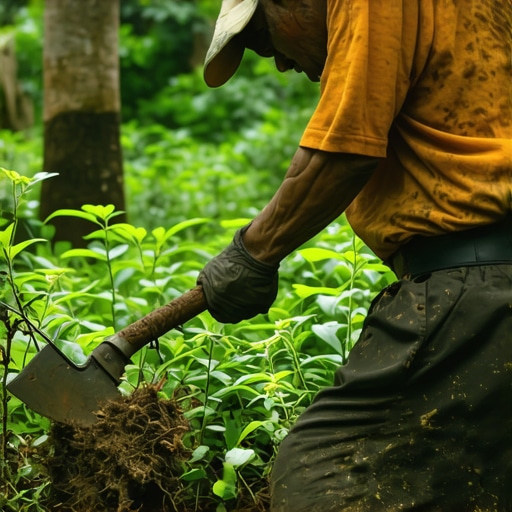
The real secret isn’t muscle; it is physics. Most people hack at the top of a bush. That is a waste of energy. You need to target the root flare. I use the ‘cut and lever’ method. By leaving three feet of the main stem attached to the root ball, you create a lever. When you use a mattock to sever the lateral roots, that three-foot handle gives you the mechanical advantage to pop the entire root system out of the ground. This prevents the ‘hydra effect’ where a single severed root sends up ten new shoots next month. It is hard work. It is slow. But it is permanent.
“Managing woody brush without chemicals requires an understanding of the plant’s carbohydrate reserves, which are typically highest in late spring just after the first flush of leaves.” – USDA Forest Service Handbook
How much manual labor is required for brush clearing?
A single skilled technician can clear approximately 500 to 800 square feet of dense, woody brush per eight-hour shift using manual tools. This estimate fluctuates based on the stem density, the presence of invasive vines like bittersweet, and the moisture content of the soil. Wet soil makes root extraction significantly easier but increases the risk of soil disturbance.
The Essential Tool Kit for Manual Clearing
Forget the cheap loppers from the big-box store. If you are serious about a yard cleanup that actually lasts, you need professional-grade steel. I have seen too many guys snap handles because they didn’t understand the torque required to pull a mature buckthorn. Below is the breakdown of what my crews carry when we aren’t using the heavy iron.
| Tool | Primary Function | Why It Matters |
|---|---|---|
| Bypass Loppers (32″) | Cutting woody stems up to 2 inches | Clean cuts prevent disease and make handling easier. |
| Pulaski/Mattock | Severing lateral roots and grubbing | The dual-head design allows for both chopping and prying. |
| Brush Grubber | Pulling small trees with a vehicle or winch | Provides a chain-link grip that doesn’t slip on bark. |
| Silky KatanaBoy Saw | Large diameter branch removal | Japanese pull-saw tech cuts through 4-inch limbs in seconds. |
| Soil Probe | Checking for rocks and utility lines | Crucial before you start swinging a mattock blindly. |
The Step-by-Step Manual Clearing Protocol
Before you touch a single branch, call 811. I don’t care if you think you know where your irrigation lines are. You don’t. I’ve seen a mattock slice through a 2-inch PVC main like it was butter. Once the utilities are marked, follow this sequence: 1. Perimeter identification; 2. Top-down thinning; 3. Root extraction; 4. Soil remediation.
- Identify the Species: Know what you are cutting. Poison sumac or hemlock requires specific PPE.
- De-limb for Access: Remove the outer branches first to reach the main trunk.
- The Lever Cut: Cut the main trunk at waist height, not ground level.
- Sever Lateral Roots: Use the mattock to dig a 12-inch radius around the trunk.
- Pop the Root Ball: Use the trunk handle to pry the system out.
- Sift the Soil: Remove any remaining rhizomes longer than 2 inches.
What is the best tool for clearing brush without a tractor?
The **Brush Grubber** paired with a heavy-duty hand winch or a high-lift jack is the most effective tool for removing deep-rooted brush without a tractor. This setup allows for thousands of pounds of upward force to be applied directly to the **root collar**, extracting the entire vascular system without destroying the surrounding **topsoil**. It is far superior to digging alone.
Post-Clearing: Soil Chemistry and Remediation
Once the brush is gone, you have a site that is likely nutrient-depleted and acidic. Woody brush, especially conifers, can drop the soil pH to levels where sod install will fail instantly. I’ve seen guys lay $5,000 worth of Bermuda grass on top of cleared brush land only to have it turn yellow and die in three weeks because they didn’t test the soil. You need to check the Cation Exchange Capacity (CEC). Most cleared areas need a heavy application of pelletized lime and a high-phosphorus starter fertilizer to encourage root development of the new turf.
“Soil compaction from heavy machinery can reduce pore space by 50%, suffocating the microbial life necessary for healthy turf and increasing runoff by 70%.” – Cornell Waste Management Institute
Don’t skip the compaction test. Take a screwdriver and try to push it into the ground. If you can’t push it in 6 inches with one hand, your soil is too tight. You’ll need to aerate or till in organic matter before you even think about irrigation or landscaping. Soil is a living organism. If you treat it like dirt, it will act like dirt. If you treat it like a biological engine, your yard will thrive.
The Long Game: Preventing Regrowth
Clearing is only half the battle. Nature hates a vacuum. The moment you open up that canopy, every weed seed in the soil is going to germinate. This is where a sod install is actually a tactical move. Thick, healthy turf is the best herbicide on the planet. By establishing a dense root mat of high-quality grass, you choke out the sunlight and nutrients that the brush needs to return. If you leave the soil bare, you’ll be right back out there with the loppers in six months. It will rot if you don’t manage the moisture. Install your irrigation system with head-to-head coverage to ensure the new grass has the advantage over the deep-rooted weeds. Don’t be cheap. Do it right the first time.