
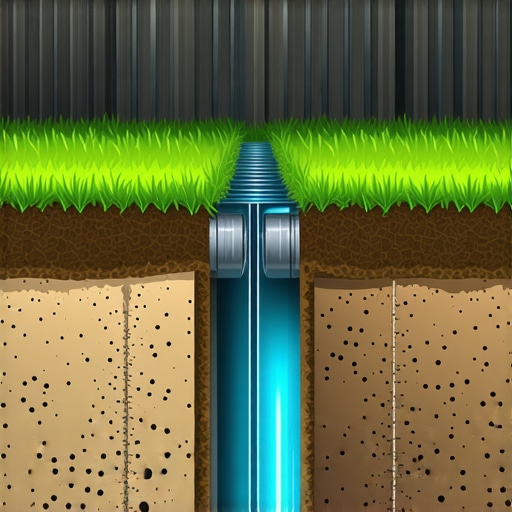
The Failure of the Surface Solution: A Drainage Forensic Autopsy
Standing water on your property is more than an aesthetic nuisance; it is a structural threat caused by hydrostatic pressure and poor soil grading that forces water to saturate the root zone and infiltrate foundations. Solving it requires a sub-surface drainage system built with rigid PVC, washed #57 stone, and non-woven geotextile fabric to ensure long-term hydraulic conductivity.
I recently got called out to tear up a $30,000 patio that was sinking because the previous contractor thought a shallow trench and some corrugated pipe was enough to handle a heavy spring thaw. The pavers were heaving and the base was essentially a soup of wet fines. This is what happens when you treat drainage as an afterthought. Most DIY attempts at a French drain fail within two years because the installer doesn’t understand the physics of water movement. They buy the cheap, black corrugated pipe from a big-box store, throw it in a hole, and wonder why their yard is still a swamp. It is because that pipe is a silt trap. It collapses. It clogs. It fails. In the landscaping world, if you aren’t managing the water, the water is managing you.
“A retaining wall doesn’t fail because of the stone; it fails because of the water trapped behind it.” – Hardscape Engineering Axiom
Why Your Yard Cleanup Must Start Underground
Yard cleanup isn’t just about hauling away brush; it is about restoring the topographical integrity of your land. When you see standing water, you are looking at soil saturation where the pore spaces are completely filled with water, cutting off oxygen to the roots. If you are planning a sod install or a major landscaping renovation, ignoring the drainage is like painting a house while it is on fire. You must address the percolation rate of your soil. Clay-heavy soils hold water through capillary action, while sandy soils drain too fast. A French drain acts as a bypass valve for these natural limitations. Don’t skip the slope. A 1% minimum grade is the law of the land. If you don’t have a laser level, you are just guessing. Guessing leads to mud.
The Engineering Specifications of a True French Drain
To build a drain that lasts 50 years, you need to understand the ‘Burrito Wrap’ method. This isn’t a suggestion; it is the industry standard. You line the trench with non-woven geotextile fabric, not the cheap weed barrier stuff. This fabric allows water through but keeps the soil fines out. Then you add a bed of washed #57 stone, lay your rigid Schedule 40 PVC with the holes facing down, and cover it with more stone before wrapping the fabric over the top. This creates a clean chamber of aggregate that will never clog.
“Effective subsurface drainage requires a filter medium that prevents the migration of fine-grained soils into the drainage aggregate while maintaining high permeability.” – USDA Soil Conservation Service Manual
Material Comparison for Drainage Systems
| Material Type | Expected Lifespan | Flow Capacity | Common Failure Point |
|---|---|---|---|
| Corrugated Perforated Pipe | 3-7 Years | Low (Turbulent Flow) | Silt Accumulation/Crushing |
| Rigid SDR-35 / PVC | 50+ Years | High (Laminar Flow) | Improper Bell-End Connections |
| Channel Drains (Surface) | 10-15 Years | Moderate | Debris Clogging Grates |
| French Drain (Agg-Only) | 5-10 Years | Very Low | Total Soil Infiltration |
How much modified gravel do I need for a patio base?
For a standard residential patio, you need a minimum of 6 inches of compacted 21A or 3/4-inch modified gravel, which usually equates to roughly 1 ton of material per 50 square feet at that depth. For irrigation zones or areas with heavy clay, you may need to increase the sub-base depth to 8 or 10 inches to ensure stability against frost heave and hydrostatic pressure.
Should I use a sock on my French drain pipe?
No. Never use a fabric sock directly on the pipe if you can avoid it. The sock has a very small surface area and will clog with silt quickly, effectively waterproofing your drain pipe. Instead, wrap the entire trench in non-woven geotextile fabric. This creates a much larger surface area for water filtration and prevents the stone from mixing with the surrounding soil. It is a more labor-intensive process, but it is the only way to prevent a total system failure in heavy clay environments.
The Connection Between Drainage and Sod Install Success
If you are investing in a sod install, the health of that grass depends on the oxygen-CO2 exchange in the root zone. Standing water creates anaerobic conditions that rot the roots of new sod within 48 hours. During a yard cleanup, look for ‘indicator species’ like nutsedge or moss; these tell you exactly where your drainage is failing. We often see homeowners spend thousands on irrigation systems only to over-water their lawns because they don’t have a way for the excess to escape. You need a balance. You want deep, infrequent watering—exactly 1 inch per week—to force the roots to chase the moisture down, but you need a sub-surface exit strategy for when the rain doesn’t stop. It is basic biology. It is engineering. Don’t cut corners.
- Verify utility lines via 811 before any excavation.
- Maintain a minimum 1/8-inch drop per foot of pipe.
- Use only washed stone to prevent ‘fines’ from clogging the system.
- Terminate the drain at a daylight exit or a properly sized dry well.