
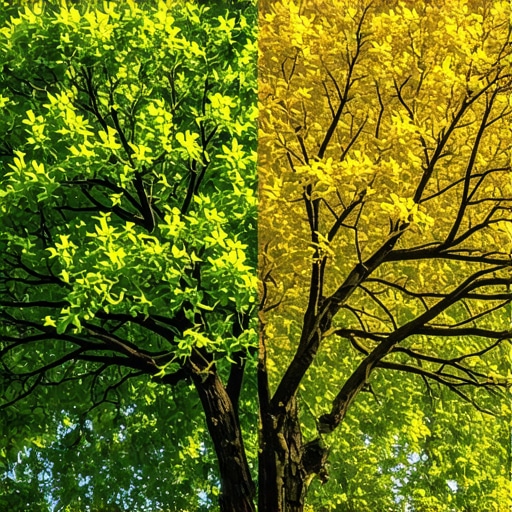
Treating Iron Chlorosis: Why Your Tree Leaves Are Pale Yellow
The visual signature of iron chlorosis is unmistakable and, for a homeowner, deeply frustrating. You see the leaf tissue turning a sickly, pale yellow while the veins remain a stark, mocking dark green. This condition is known as interveinal chlorosis. It is not a simple cosmetic flaw. It is a desperate cry for help from the tree’s internal metabolic system. If left unaddressed, this deficiency leads to stunted growth, dieback, and eventually, the complete structural failure of the specimen. I have spent two decades diagnosing these failures, and the cause is almost never a lack of iron in the dirt itself. It is a chemical lockout.
The Chemical Nightmare: A Cautionary Tale
I recently walked onto a property where a homeowner had spent over $800 on high-nitrogen fertilizers and ‘all-purpose’ garden supplements. They saw their Silver Maples turning yellow and assumed the trees were hungry. They weren’t. By dumping massive amounts of phosphorus and nitrogen into the soil without a pH test, they effectively locked the iron in a molecular cage. The soil was already alkaline, sitting at a pH of 8.2. Adding more synthetic fertilizer increased the salinity and further inhibited the roots’ ability to transport micronutrients. The trees were starving in the middle of a feast. This is why I tell my crew: never treat a symptom until you have a lab report on the soil chemistry. A botched DIY fix is often more expensive to remediate than the original problem.
What is Iron Chlorosis in Trees?
Iron chlorosis is a physiological condition where a tree cannot produce sufficient chlorophyll because it lacks bioavailable iron. This typically occurs in alkaline soils where iron remains in a solid, insoluble form that tree roots cannot absorb, regardless of how much iron is physically present in the ground.
“Iron chlorosis is often not a lack of iron in the soil, but a lack of iron availability due to high soil pH levels that prevent root uptake.” – Texas A&M AgriLife Extension
The Anatomy of a Nutrient Lockout
To understand chlorosis, you have to look at the chemistry of the rhizosphere. Iron is a catalyst for chlorophyll production. Without it, the plant cannot capture sunlight. In many regions, the soil is naturally calcareous, meaning it contains high levels of calcium carbonate. This drives the pH level above 7.0. Once you hit 7.5 or 8.0, iron atoms bind tightly to oxygen and hydroxide ions. They form insoluble compounds. Your tree is essentially trying to eat a rock. This is why a simple yard cleanup that involves only surface-level debris removal is insufficient; the real cleanup needs to happen at the molecular level within the soil pore space. During a sod install, many contractors fail to check the subsoil. They lay beautiful turf over alkaline clay, and within two seasons, the trees in the landscape beds start fading to yellow because the irrigation water, often high in bicarbonates, has pushed the soil pH even higher.
Why are my tree leaves yellow with green veins?
This specific pattern occurs because chlorophyll is lost first in the areas furthest from the primary vascular tissue. The veins keep their green pigment longer as they hold the last remnants of the iron supply. If the yellowing progresses to the point where the veins also turn white or tan, the leaf is nearing necrosis. At that stage, the tissue is dying. You cannot save a leaf once it hits the necrotic stage. You can only save the next flush of growth.
The Professional Remediation Strategy
Fixing iron chlorosis requires a multi-pronged approach. You cannot just spray some ‘green-up’ product and walk away. You have to address the soil pH or bypass the soil entirely through trunk injections.
“A successful treatment for chlorosis must consider the long-term soil chemistry and the specific iron-chelate stability at high pH levels.” – International Society of Arboriculture (ISA) Standards
Iron Supplement Comparison Table
| Treatment Type | Application Method | Longevity | Best Use Case |
|---|---|---|---|
| Iron Sulfate | Soil Drench | Short-term | Acidic soils only (pH below 7.0) |
| Iron EDTA Chelate | Soil Drench | Medium-term | Slightly alkaline soils (pH 7.0-7.5) |
| Iron EDDHA Chelate | Soil Drench | Long-term | Highly alkaline soils (pH 7.5-9.0) |
| Trunk Injection | Direct Vascular | 1-2 Years | Rapid recovery for specimen trees |
The Action Checklist for Recovery
- Conduct a Soil Test: Send a sample to a reputable lab. You need to know the pH and the Cation Exchange Capacity (CEC).
- Check Your Irrigation: Hard water is often the culprit. If your irrigation system is pumping high-alkalinity water, you are constantly fighting a losing battle.
- Apply the Correct Chelate: Use EDDHA (Ethylene Diamine-Di-O-Hydroxyphenyl Acetic Acid). It is the only chelate that remains stable at a pH above 8.0.
- Expose the Root Flare: Many trees suffer from chlorosis because they are planted too deep. This creates stress and reduces oxygen availability, further hindering nutrient uptake.
- Vertical Mulching: Use an air-spade to incorporate organic matter into the root zone. This improves soil structure and helps lower the local pH over time.
How much iron does a tree actually need?
The exact dosage depends on the DBH (Diameter at Breast Height) of the tree. Generally, for soil applications of EDDHA, you apply roughly 0.5 to 2 ounces per inch of trunk diameter. It is not a ‘more is better’ situation. Over-application can lead to salt burn and root desiccation. Accuracy is everything in landscaping and tree care. Don’t guess. Measure.
Long-Term Management and Prevention
If you live in an area with alkaline soil, you are in a permanent state of maintenance. You cannot ‘fix’ the earth’s geology. You can only manage the micro-environment around your trees. Incorporating sulfur to lower pH is a slow process that can take years. In the meantime, consistent use of iron chelates and proper yard cleanup—removing competition from invasive weeds and thinning out dense turf that competes for nutrients—is vital. If you are planning a new sod install, choose a grass variety that thrives in your local soil conditions and won’t require excessive water that could exacerbate iron lockout. It is about balance. It is about biology. It is about the 20-year view, not the 2-week green-up. Stop listening to the big-box store clerks. Start listening to the soil.