
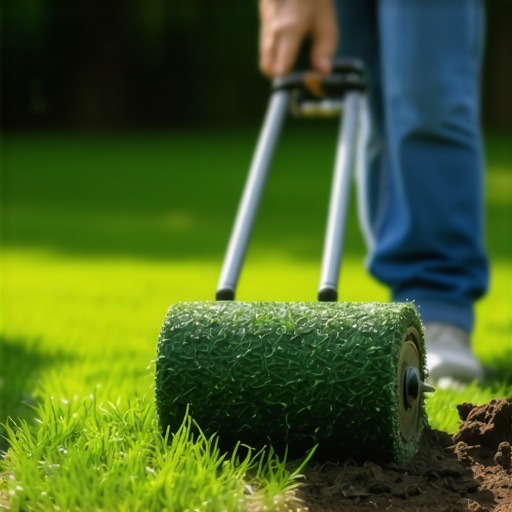
The Hardscape Foremen’s Warning: Why Excess Weight Kills Your Lawn
I always drill into my new crew members: if you don’t fix the soil grading first, every plant you put in the ground is just expensive compost. Last season, I watched a neighbor hire a crew of ‘mow-and-blow’ hacks who thought they could fix a bumpy grade by using a two-ton asphalt roller on fresh Kentucky Bluegrass sod. Within three weeks, that yard didn’t look like a lawn; it looked like a stagnant pond. The grass was yellowing, the roots hadn’t moved an eighth of an inch into the subsoil, and the ground was as hard as a sidewalk. They had effectively turned a living ecosystem into a biological dead zone. Soil is not just dirt; it is a structural matrix of minerals, organic matter, and air. When you roll it too heavily, you destroy the very architecture that allows life to exist.
The Physics of Soil Compaction and Root Asphyxiation
Rolling new sod too heavily crushes soil macropores, leading to increased bulk density and root asphyxiation. This structural collapse prevents water infiltration and oxygen exchange, forcing the roots to remain shallow or rot entirely. Proper installation requires only enough pressure to ensure soil-to-root contact without eliminating the air pockets essential for microbial activity and gas exchange. Roots need air. It is that simple. When you apply excessive weight, you are essentially sealing the lungs of your yard.
How Soil Bulk Density Impacts Turf Health
In the world of agronomy, we measure the ‘heaviness’ of soil through bulk density, calculated as the dry weight of soil per unit volume. For most turfgrass species, once the bulk density exceeds 1.6 grams per cubic centimeter (g/cm³) in clay soils or 1.8 g/cm³ in sandy soils, root growth stops completely. A heavy water-filled roller can easily push a damp loam into these danger zones.
“Soil compaction reduces the number of large pores (macropores) which are responsible for water drainage and aeration, while increasing the number of small pores (micropores) which hold water so tightly that plants cannot use it.” – Penn State Agricultural Extension
The Mechanical Failure of Over-Rolling
Why do people do it? They want a flat yard. But flatness comes from the yard cleanup and grading phase, not the sod install phase. If your base is lumpy, rolling the sod won’t fix the dirt underneath; it just crushes the roots against the high spots. This creates a phenomenon called ‘root girdling’ or ‘J-rooting’ where the roots grow sideways because they cannot penetrate the compacted layer. Below is a comparison of how different rolling pressures affect your long-term landscaping investment.
| Rolling Pressure | Soil Structure Impact | Root Penetration (30 Days) | Oxygen Diffusion Rate |
|---|---|---|---|
| Light (Hand Roller) | Maintains Macropores | 4-6 Inches | High (Aerobic) |
| Medium (Water-filled) | Moderate Compression | 2-3 Inches | Decreased |
| Heavy (Power Roller) | Total Pore Collapse | <1 Inch | Critical (Anaerobic) |
Hydraulic Conductivity and the Anaerobic Trap
When you roll sod too hard, you destroy the hydraulic conductivity of the soil. This is the soil’s ability to transmit water. In a compacted lawn, irrigation water cannot move downward. Instead, it sits at the interface between the sod mat and the soil. This creates a ‘perched water table’ that invites Pythium blight and other fungal pathogens. I have seen thousand-dollar sod jobs turn into a mushy, smelling mess because the water had nowhere to go. The roots literally drown because the oxygen has been displaced by stagnant water.
“A retaining wall doesn’t fail because of the stone; it fails because of the water trapped behind it. Similarly, a lawn doesn’t fail because of the grass; it fails because of the drainage environment beneath it.” – Hardscape Engineering Axiom
How much modified gravel do I need for a patio base?
While this article focuses on turf, the principle of compaction is different for hardscapes. For a patio, you want maximum compaction of a modified gravel base (typically 4-6 inches) to prevent settling. Turf is the opposite. You want structure, not density. Never confuse the two. If you treat your lawn like a patio base, the grass will die. It is a biological certainty.
Can I fix a lawn that was rolled too hard?
Remediation is painful and expensive. If you’ve already crushed your soil, your only hope is core aeration. This involves pulling physical plugs of soil out of the ground to manually re-introduce air and reduce the bulk density. You cannot fix compaction by adding more water or fertilizer. In fact, adding nitrogen to a compacted lawn often makes things worse by forcing top-growth that the suffocating roots cannot support.
The Master’s Sod Installation Protocol
Stop following the advice of big-box store pamphlets. If you want a lawn that lasts twenty years instead of twenty days, follow this technical checklist. Precision matters.
- Soil Test First: Check your pH. If you are below 6.0 or above 7.0, your nutrient uptake is already compromised.
- Grade the Subsoil: Use a landscape rake to achieve a flat plane before the sod arrives.
- Moisten, Don’t Soak: The subsoil should be damp to the touch, not muddy. Muddy soil compacts 10x faster.
- The Perimeter Clip: Lay your edges first and stagger the joints like bricks.
- The 1/3 Roller Rule: If you must use a roller, fill it only one-third full of water. You only want enough weight to press the roots into the dirt.
- Irrigation Calibration: Apply exactly 1 inch of water immediately after the light roll to settle the dust and initiate capillary action.
The Biological Cost of High-PSI Equipment
Every time a heavy machine drives over your yard during a yard cleanup or landscaping project, it exerts pounds per square inch (PSI) that the soil cannot recover from naturally. Soil structure takes years to build through the movement of earthworms and the decay of organic matter. You can destroy ten years of biological progress in ten seconds with a heavy roller. We call this ‘mechanical weathering.’ In heavy clay soils, this creates a ‘slickenside’ effect where the soil particles are polished into a waterproof barrier. Your roots won’t stand a chance against that. You must be protective of your soil structure. It is the most valuable asset on your property. Treat it with respect, or prepare to pay for it twice. Do not roll it. Do not crush it. Let it breathe.