
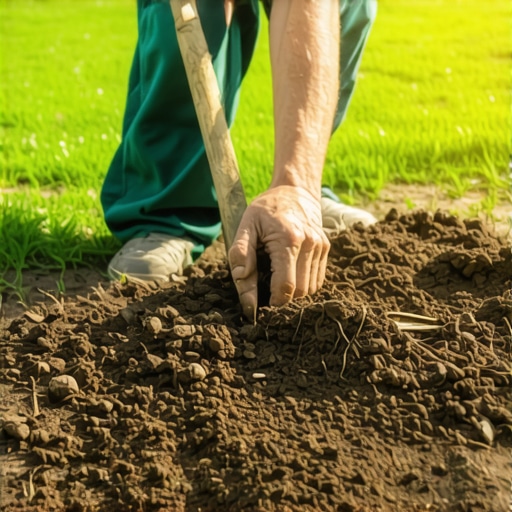
The Anatomy of a Failed Lawn: Why Your Sod Lifts Like a Rug
If you can grab a handful of your 2026 turf and lift it off the ground without effort, you are witnessing a catastrophic failure of root-to-soil contact. This happens when air pockets, soil compaction, or hydrophobicity prevent the roots from penetrating the native earth, leaving the grass to starve in its own thatch layer. It is a death sentence for your investment.
I always drill into my new crew members: if you don’t fix the soil grading first, every plant you put in the ground is just expensive compost. Last season, I watched a ‘mow-and-blow’ crew slap 4,000 square feet of high-end Tall Fescue directly onto sun-baked Georgia clay that hadn’t been tilled or amended. They didn’t even use a roller. Three weeks later, the homeowner called me because their lawn was ‘sliding.’ I walked out there, stuck my hand under a seam, and pulled up a four-foot section like I was peeling a scab. The roots were brown, stunted, and circling within the sod’s own peat base because the clay underneath was basically concrete. That is $6,000 of material headed straight for the landfill because someone was too lazy to run a Harley rake.
“Successful turfgrass establishment is contingent upon the elimination of air pockets at the soil-root interface and the maintenance of adequate moisture in the upper 2 inches of the soil profile.” – Turfgrass Agronomy Manual, Section 4.2
The Physics of Root-to-Soil Contact
To understand why sod peels, you have to understand the microscopic reality of a root hair. Roots move toward moisture and nutrients via capillary action. If there is a gap—even a 1/8th inch gap—between the sod bottom and the soil, the root hair hits an air pocket and undergoes air pruning. It dies instantly. This is why site preparation is 90% of the job. You aren’t just cleaning up a yard; you are engineering a biological transition zone.
| Feature | The Hack Method (Failure) | The Engineering Method (Success) |
|---|---|---|
| Soil Prep | Surface scratching with a rake | Tilling to 6-inch depth / Core aeration |
| Amendments | None or cheap 10-10-10 | Compost integration and pH balancing (6.5 target) |
| Compaction | Foot pressure only | 400-lb water-filled drum roller |
| Irrigation | Set-and-forget timer | Deep, infrequent saturation (1-inch weekly) |
Why is my new grass pulling up like a rug?
Your grass is pulling up because the native soil is too compacted or there is a layering transition problem. When the soil underneath is significantly denser than the soil the sod was grown in, the roots experience ‘substrate shock’ and refuse to leave the comfortable, organic-rich sod mat. This creates a shear plane where the grass simply sits on top of the ground rather than becoming part of it. You must bridge this gap with mechanical aeration or heavy tilling before the install.
The Hidden Enemy: Hydrostatic Resistance and Soil Glazing
When you use a bobcat to grade a yard, the weight of the machine often ‘glazes’ the clay. This creates a smooth, impenetrable surface. If you lay sod on this, water will sit in the sod layer and never drain into the subsoil. This is how you get Pythium blight and root rot. The grass looks wet, but it is actually drowning. You must break that glaze. We use a power rake to shatter the surface tension before the first piece of turf hits the ground. Don’t skip this. It’s the difference between a lawn and a swamp.
“A retaining wall doesn’t fail because of the stone; it fails because of the water trapped behind it, and a lawn fails because of the air trapped beneath it.” – Hardscape and Landscape Engineering Axiom
How much water does new sod actually need?
While the internet tells you to water every day, turf grass actually needs deep, infrequent watering—exactly 1 inch per week—to force roots to chase the water down. However, for the first 14 days of a 2026 install, you must maintain the ‘sponge’ state. The sod should be damp but not anaerobic. If you see water pooling at the seams, back off. If the edges are curling, you’re too late. Use a tuna can to measure your irrigation output. It’s the only way to be precise.
The 2026 Sod Installation Checklist
- Utility Marking: Call 811. Do not sever a fiber optic line for the sake of a lawn.
- Soil Testing: Get a professional lab analysis. If your pH is 5.0, your sod is dead on arrival.
- Vegetation Kill-Off: Use a non-selective herbicide to kill existing Bermuda or weeds 14 days prior.
- Mechanical Raking: Break the soil surface to a depth of at least 2 inches.
- Starter Fertilizer: Use a high-phosphorus (the ‘P’ in NPK) blend to stimulate root elongation.
- Rolling: This is non-negotiable. Use a water-filled roller to press the sod into the earth.
- Seam Tucking: Tight seams prevent the edges from drying out and ‘browning off.’
The Remediation: What to do if your sod is already peeling
If you’re reading this and your yard is already a mess, you have two choices. If the grass is still green but lifting, you can attempt heavy top-dressing with a sand/compost mix. This fills the air pockets and provides a medium for the roots to grow through. If the grass is brown and the soil underneath is dry despite watering, you have a hydrophobic barrier. You need to apply a liquid wetting agent to break the water’s surface tension. Do it now. Don’t wait for the heat of July to finish the job. If these fail, tear it up. Re-grading is cheaper than a decade of dead grass.