
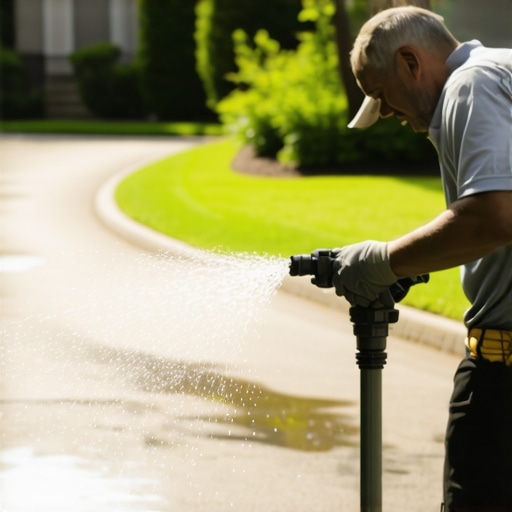
The Engineering of Precision Irrigation: Why Your Driveway Isn’t a Crop
Adjusting 2026 sprinkler heads requires a fundamental understanding of matched precipitation rates and arc adjustment. To stop watering your driveway, you must physically limit the nozzle trajectory and ensure head-to-head coverage, preventing wasteful overspray that causes pavement erosion and nutrient leaching. Most homeowners treat irrigation as a set-it-and-forget-it system. It is not. It is a hydraulic network that requires seasonal calibration to prevent structural damage to your hardscaping and biological stress to your turf.
“Irrigation efficiency is not about how much water you apply, but how much is actually absorbed by the root zone without runoff.” – Texas A&M AgriLife Extension
I always drill into my new crew members: if you don’t fix the soil grading first, every plant you put in the ground is just expensive compost. The same logic applies to irrigation. I’ve walked onto too many sites where the yard cleanup was done perfectly, but the irrigation was so poorly aimed that the brand-new sod install was bone-dry in the corners while the client’s SUV was getting an unwanted car wash every morning at 5:00 AM. This is amateur hour. If you’re watering the concrete, you’re not just wasting money; you’re actively destroying the sub-base of your driveway. Water finds its way under the slab, saturates the aggregate, and leads to cracking and heaving during the next freeze cycle. Don’t be that contractor. Don’t be that homeowner.
The Physics of the Nozzle: Radius vs. Arc
To fix the problem, you have to understand the difference between the arc and the radius. The arc is the ‘left-to-right’ sweep. The radius is the distance the water travels. If your water is hitting the driveway, your radius is too long or your arc is too wide. Most 2026 models from manufacturers like Hunter or Rain Bird use a stainless steel adjustment screw. Turning this screw clockwise breaks the stream. It reduces the distance. It increases the droplet size. This is critical. Small droplets drift in the wind. Large droplets hit the target. If you see mist, your PSI is too high. You need a pressure-regulated head (PRS). Look for the 30 PSI or 45 PSI stamp on the cap. Anything higher and you’re just creating a localized weather pattern that ends up on your neighbor’s roof.
How do I stop my sprinkler from hitting the pavement?
To stop sprinkler overspray, you must first identify the fixed left edge of the rotor and then adjust the right-side arc using a manufacturer-specific key or flathead screwdriver. Reducing the nozzle throw via the radius reduction screw ensures water remains on the turfgrass and doesn’t saturate impermeable surfaces. It is a mechanical limit. It requires manual testing. You must physically stand there and watch the cycle. There are no shortcuts here.
| Nozzle Type | Efficiency Rating | Best Use Case | Adjustment Difficulty |
|---|---|---|---|
| Fixed Spray | Low | Small, 8-15ft areas | High (Requires nozzle swap) |
| Rotary Nozzle | High | Large lawns, slopes | Low (Tool-free options) |
| Impact Head | Medium | Industrial/Large Acreage | Medium (Mechanical pins) |
The Root Zone Reality: Why Uniformity Matters
When you water the driveway, you’re creating a ‘dry shadow’ in your lawn. This is where most sod installs fail. The grass adjacent to the concrete needs more water because the concrete acts as a heat sink. It cooks the roots. If your sprinkler is overshooting that edge, the grass right next to the driveway dies first. It turns brown. It goes dormant. Then the weeds move in. Crabgrass loves hot, dry edges. You are literally farming weeds by not adjusting your heads. You need head-to-head coverage. This means the water from one head should reach the base of the next head. It sounds like overkill. It isn’t. It’s the only way to achieve 100% distribution uniformity (DU). Low DU leads to ‘leopard spotting’ in the lawn. It makes your landscaping look cheap.
“A retaining wall doesn’t fail because of the stone; it fails because of the water trapped behind it.” – Hardscape Engineering Axiom
Irrigation Audit Checklist
- Check for ‘misting’ which indicates excessive line pressure.
- Clear grass growth away from the head to prevent spray deflection.
- Align the fixed left edge with the edge of the hardscape.
- Adjust the radius screw to stop the stream 2 inches before the pavement.
- Inspect for leaking seals (the ‘donut’ of water around the head).
- Confirm the head is level. Tilted heads create dry spots.
How much water does new sod actually need?
Newly installed sod requires deep, infrequent watering after the first 14 days to encourage root penetration into the soil profile. While the initial establishment phase requires constant moisture, you must transition to a schedule that provides 1 inch of water per week, measured via a catch-can test, to prevent root rot and fungal pathogens. Don’t drown it. Force the roots to work for it. If you keep the top half-inch saturated, the roots stay lazy. They stay on the surface. Then July hits, the temperature spikes to 95 degrees, and your lawn turns into straw because it has no deep root structure. Precision adjustment of your 2026 heads ensures that this 1 inch of water goes into the dirt, not into the gutter.
The Damage of Overspray: Chemical and Structural
Let’s talk about the chemistry of your driveway. Most municipal water is treated with chlorine and minerals. When this water evaporates on your concrete, it leaves behind deposits. Over years, this causes scaling. If you’re using fertilizers—which you should be—the overspray carries nitrogen and phosphorus onto the driveway. The next rain washes those chemicals directly into the storm drain. That’s how you get algae blooms in local ponds. It’s a waste of chemicals and a violation of most local environmental codes. Adjusting your heads is a matter of professional ethics. It’s about stewardship of the land. If you’re a professional landscaper and you leave a job with heads spraying the driveway, you’re a hack. Period.
The Restoration: Post-Adjustment Yard Cleanup
Once you’ve dialed in the heads, the job isn’t done. You need to fix the damage caused by the previous neglect. This involves core aeration to break up the surface tension of the dry spots and potentially top-dressing with organic compost to kickstart the microbiology. Landscaping is a system. The irrigation is the lifeblood, but the soil is the engine. If the engine is seized, the water doesn’t matter. Clean up the edges. Trim the encroaching stolons of the grass back from the heads. Ensure the height of the head is still correct. Over time, heads sink. Soil builds up. If your head is buried, it doesn’t matter how you adjust the screw; the water is just bubbling up and creating a swamp. Dig it up. Put it on a swing pipe. Get it level. Do the work correctly.