
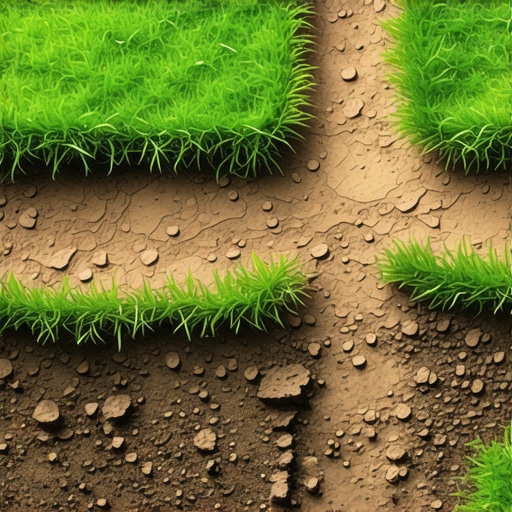
The Anatomy of a Failed Sod Installation
If you can grab a handful of your grass and lift it off the dirt like a cheap rug, your lawn is already dead. It just hasn’t turned brown yet. When new sod fails to knit with the native soil, you aren’t looking at a ‘bad batch’ of grass; you are looking at a fundamental failure of horticultural engineering. I recently got called out to a property in the suburbs where a homeowner had spent $14,000 on a high-end fescue install. Within three weeks, the entire backyard was sliding down a five-degree slope. The previous contractor had literally laid the sod over compacted, anaerobic clay without a single pass of a core aerator or a grain of soil amendment. It was a $14,000 biology experiment gone wrong. The grass roots had nowhere to go, so they simply stayed in the two-inch layer of peat they were grown in until the rot set in. Don’t let this happen to your yard.
Why Your New Sod Fails to Root
A failed sod installation occurs when the primary root system cannot penetrate the interface between the sod farm soil and your native yard soil due to compaction, air pockets, or chemical barriers. This creates a detached layer where moisture remains trapped in the thatch, leading to fungal pathogens like Rhizoctonia solani rather than deep root sequestration.
“Effective root establishment in turfgrass requires an uncompacted soil profile with a bulk density of less than 1.4 grams per cubic centimeter for silt loams to allow for oxygen exchange and water infiltration.” – Agronomy Extension Standards
The Biological Mechanics of Root Attachment
Roots do not simply ‘grow down’ because they want to. They follow a gradient of moisture and oxygen. If your native soil is a brick of hard-packed clay with a PSI of over 300, the tender rhizomes of new sod will hit that barrier and turn sideways. This is called root girdling. Instead of a vertical anchor, you get a horizontal mat. This mat acts as a sponge, holding water at the surface until the high-summer heat literally cooks the roots in a stagnant soup of lukewarm water. You must break the surface tension of the earth. I tell my crew every day: if you aren’t sweating during the yard cleanup and grading phase, you’re doing it wrong. The soil should be friable to a depth of at least 4 inches before a single piece of grass touches it.
The Role of Hydrostatic Pressure and Irrigation
Many homeowners believe they need to flood their new lawn daily. This is a mistake that causes ‘lazy roots.’ If the surface is always wet, the grass has no evolutionary reason to send roots deep into the soil. You want to transition from frequent, light misting to deep, infrequent watering cycles within the first 21 days. This forces the plant to chase the receding water table downward. When you over-water, you displace the oxygen in the soil pores. Without oxygen, the roots cannot respire, and they will slough off. It will rot. Don’t skip the drainage check. If water pools under the sod, the hydrostatic pressure will actually lift the grass off the ground, creating those ‘bubbles’ or peeling sections.
Hard Data: Soil Preparation vs. Success Rate
| Action Item | The Hack Method | The Master Professional Method | Impact on Rooting |
|---|---|---|---|
| Soil Prep | Rake the surface only | Rototill to 6 inches + Compost | +400% Root Depth |
| Compaction | Heavy roller on dry clay | Core aeration + Gypsum | Prevents ‘Carpet Peeling’ |
| NPK Ratio | Generic 10-10-10 | Soil-test specific Phosphorus-heavy | Accelerates lateral growth |
| Irrigation | 30 mins every afternoon | 3 cycles of 10 mins (Morning/Noon/3PM) | Maintains turgor pressure |
The Importance of Yard Cleanup and Debris Removal
You cannot lay sod over old grass, wood chips, or construction debris. During the yard cleanup, every piece of organic matter that isn’t soil must be removed. Why? Because as that buried organic matter decomposes, it consumes nitrogen and produces heat. This nitrogen robbery starves the new sod just when it needs it most. Furthermore, large pockets of buried debris create air gaps. A root hitting an air gap stops growing instantly. This is why professional landscaping involves a meticulous ‘screening’ of the topsoil. We are building a foundation, not just covering up a mess.
“A retaining wall doesn’t fail because of the stone; it fails because of the water trapped behind it, and a lawn doesn’t fail because of the grass; it fails because of the soil interface below it.” – ICPI Hardscape & Grading Axiom
How much modified gravel or soil amendment do I need?
For a standard 1,000 square foot sod install, you should be looking at roughly 3 to 4 cubic yards of high-quality organic compost blended into the top 4 inches of soil. This isn’t a suggestion; it is a requirement for heavy clay or sandy soils. If you are dealing with grading issues, you may also need a 21A modified stone base for any adjacent hardscapes to ensure irrigation runoff doesn’t wash out your new lawn’s foundation. Proper drainage is the silent partner of every successful green space.
How long does it take for sod to root?
Under ideal conditions, you should see white ‘feeder roots’ within 7 to 14 days. By day 21, you should not be able to lift the sod without significant resistance. If it is still peeling up after three weeks, your soil is too compacted or you have an ‘interface’ problem where the soil types are too different to bond. At this point, you must intervene with a liquid aerator or a specialized wetting agent to break the surface tension. Don’t wait for it to turn brown. Action now saves the investment.
The Master Landscaper’s Final Checklist
- Test the soil pH; target 6.0 to 7.0 for most turf varieties.
- Remove all stones larger than a golf ball and all buried organic debris.
- Grade the soil away from the house at a 2% minimum slope.
- Roll the soil lightly before laying sod to identify soft spots, then scarify the top 1/2 inch.
- Lay sod in a staggered brick pattern to prevent long seams that channel water.
- Water immediately—within 30 minutes of the first piece hitting the ground.
Landscaping is a game of inches and chemistry. If you treat your lawn like a carpet, it will behave like one—sliding, peeling, and eventually ending up in the landfill. Treat it like a living, breathing biological system, and it will anchor itself to the earth for a generation. Pay for the prep, or pay for the replacement. The choice is yours.